
In his poem titled To its People, it Mourns Reason and Resolve, Lebanese poet Khalil Gibran writes about the beauty of Egypt, saying: “In the garden are signs, and the Nile holds its own splendour, while the face of morning smiles, fragrant and radiant. Across the green fields – their brightest adornment – are stars of ripe cotton, blooming like constellations. Yet the most splendid of all within it are the palm trees, adorned like necklaces of rubies, their beauty the thread that strings them together.”
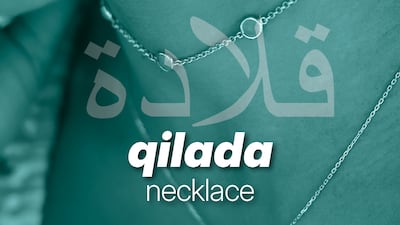
Gibran describes the beauty of the palm trees, and the date fruits on them, as if they were wearing necklaces. Our Arabic word of the week is qilada, which translates to a necklace or pendant – and sometimes a bracelet – but its meaning stretches far beyond jewellery.
Derived from the root qaf, lam, dal, meaning “to hang” or “to encircle”, the word regularly appears in classical Arabic poetry and scripture. The qilada was not merely an adornment, it often carried a spiritual or social significance. In pre-Islamic times, a qilada might be placed around the neck of a camel to mark it as sacred during pilgrimage. Among people, it could symbolise loyalty, kinship or love – a gesture that bound the giver and the receiver in a shared sense of belonging.
Across the Arab world, qiladat – the plural form – have been crafted in countless forms and materials. Gold and silver signified wealth and permanence, while shells and beads spoke to coastal and nomadic traditions, often believed to offer protection or fertility. In Yemen, Oman and the Levant, ornate qiladat have long formed part of a woman’s dowry, passed down through generations as family heirlooms. Each piece, heavy with craftsmanship and memory, tells a story of place and identity.
Over time, the word qilada took on new meanings beyond ornamentation. In modern Arabic, qallada means to bestow or to decorate, as in the phrase “qalladah wisaman”, which means “he awarded him a medal”. The gesture of placing something around the neck, whether a jewel or a ribbon, remains a sign of honour and recognition. It reflects an enduring cultural idea: that what is worn close to the heart carries meaning beyond appearance.
In some Gulf countries, the word for qilada is e’eqd, which can be found in the Mohammed Abdu song Ahla min al e’eqd labasah. In it, Abdu sings: “Sweeter than the necklace is the one who wears it – the necklace itself is proud upon her neck. A diamond wearing a diamond, it is not the jewel that beautifies her, but she who beautifies it.”