


It’s always challenging to summarise the events of one year at a glance – especially 2024. As we head towards a new year, the world was marked by many significant events in the past 12 months.
Aside from the US presidential election, there were plenty of other groundbreaking results around the world, including new leadership in Mexico and the UK. Political upheavals were experienced in Haiti, Ecuador and most recently Syria, completely changing the social and political landscape of the country.
Conflicts have also continued as the Russia-Ukraine war entered its third year, while the Israel-Gaza war has spread to other areas of the region with many notable figures still calling for a ceasefire.
There have also been many positive global changes. The world united in watching the Paris 2024 Olympics, one million doses of life-saving vaccines were administered to children in Africa, and many environmental wins, including emissions reduction and conservation efforts and initiatives were also successful with some species back from the brink of extinction.
At the core of all these substantial and sometimes polarising changes is this week’s Arabic Word of the Week, which is also our word of the year.
Khayal, which translates to imagination, is a concept that enables envisioning a better future and often serves as the only tool available for planning a more functional and peaceful world.
While khayal is a noun that translates to the word imagination, it also conjures other meanings and ideas linked with the concept of imagining. Khayal is derived from the verb khal or khala, made up of the three Arabic letters – kha, alif and lam. Khal refers to the action of assuming, believing or imagining an idea or a reality that is in fact untrue.
-
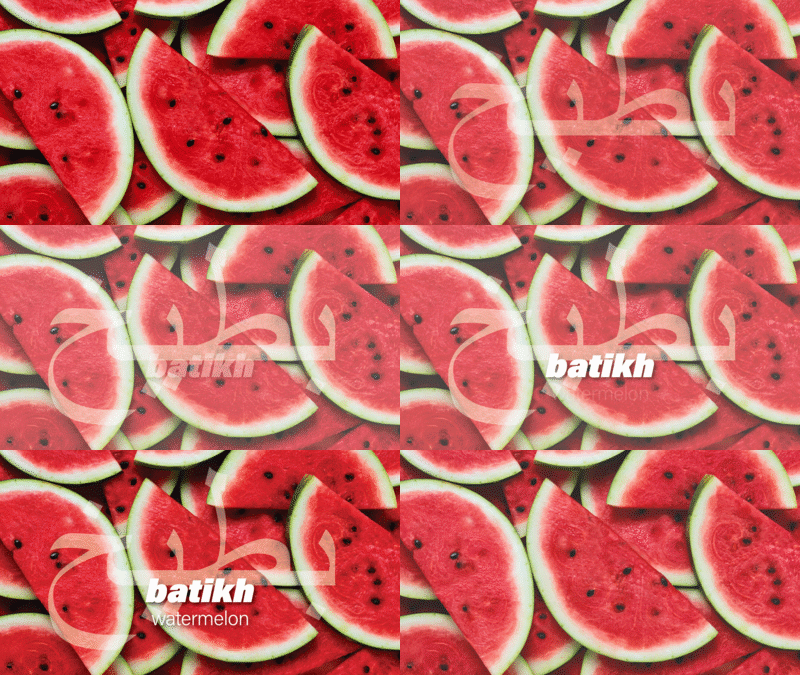
The Arabic word for watermelon, batikh, has become a symbol of Palestine. All photos: The National -

The Arabic word for union, etihad, is intrinsically connected to the UAE -

The Arabic for water, ma'a, is a universal symbol for rebirth -

The Arabic for echo, sada, is a literary device in poetry -

Aasal, the Arabic word for honey can also be used in a complimentary manner -

Jisim, the Arabic word for body extends across chemistry, medicine and aphorisms -

Jawab, the Arabic for answer resonates with knowledge -

Fikir is the Arabic word for think or to think -
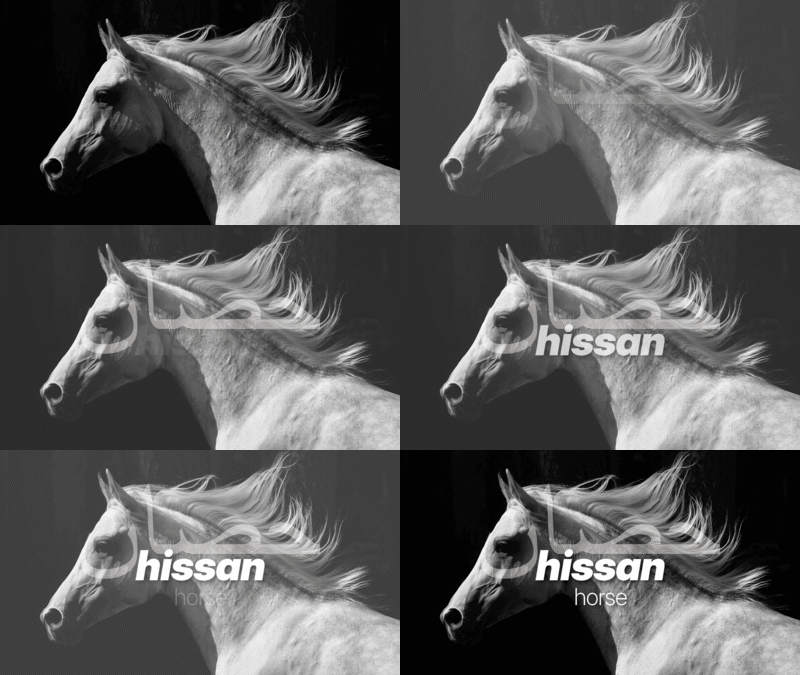
The Arabic word for hissan or horse can have more than one origin -

The Arabic word shaghaf or passion refers to intense love -
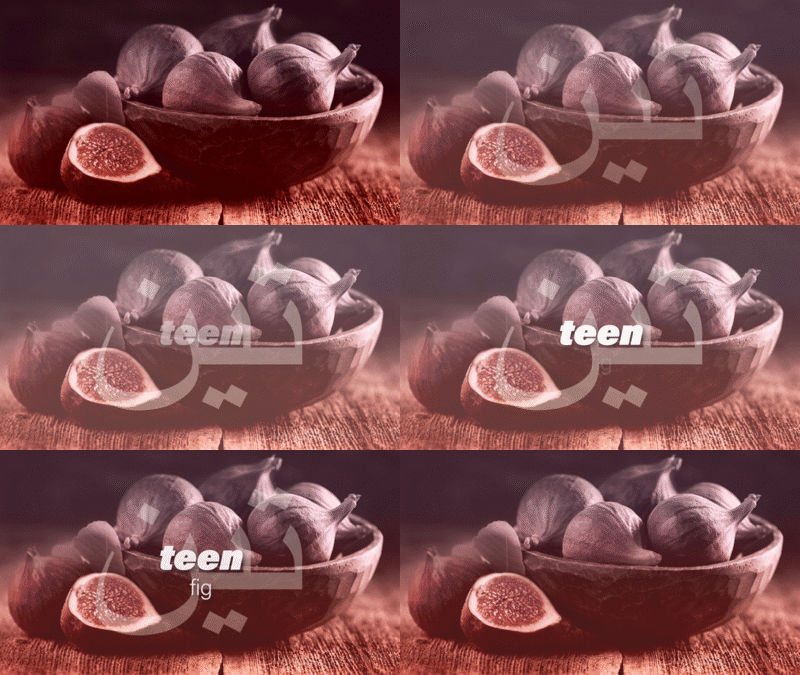
The Arabic word teen or onion doesn't have a clear Arabic source -

The Arabic word saraha means honesty -
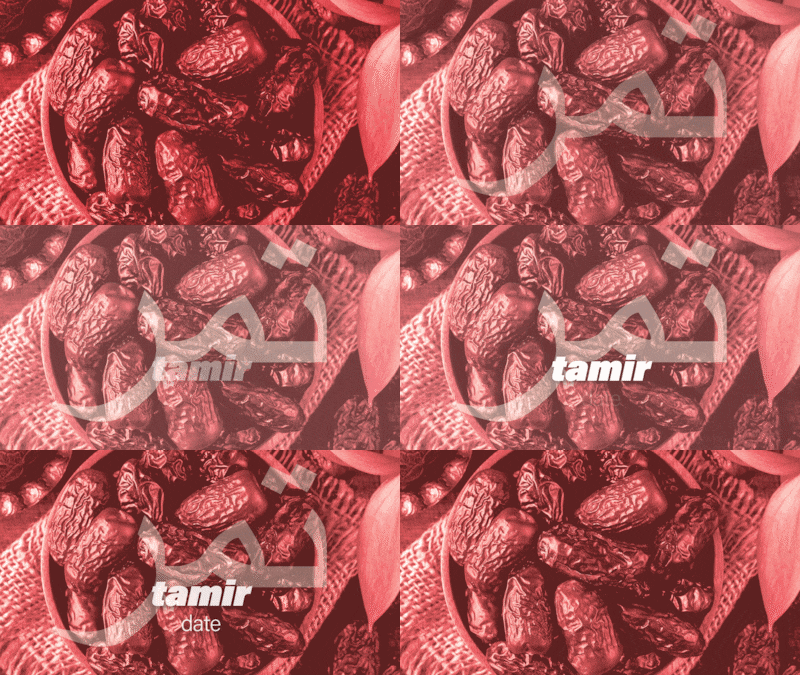
Tamir, the Arabic word for date is a fruit that has over 400 variations -

The Arabic word for tongue, lisan, is connected to the idea of truth -

The Arabic word for olive, zaytoon, is also the word for olive tree -

The Arabic word for sign, alama, has several meanings


For example, if there's thunder and lightning, a person will assume it will rain even though it might not. Someone might see a scarecrow in a field and believe that the prop is a real person. In both cases, a belief and an assumption were unintentionally made based on perceived realities. Within this meaning, concepts such as thought, ideation, meditation and reflection are also inferred.
Khal can also reference a mole on someone’s face. While this doesn’t naturally link to the other meaning of khal, it does influence one of the meanings behind khayal.
Officially khayal – whose plural form is either akhyala or kheelan – means imagination or to create and believe a misrepresentation of reality purposely or by accident. This can include acts of assumption or delusion and can occur while sleeping or when awake, when a person is either daydreaming or seeing something that isn’t as it seems.
From this, we get one of the most common meanings of khayal – the ability to act and form new ideas or images not currently present in a person’s immediate reality. This can also include picturing things that don’t exist in reality.
This then lends to another meaning for khayal – fiction. When used in certain contexts, it can refer to fictional stories and narratives, linking khayal to the rich and long tradition of literature and storytelling in the region.
The third most common definition of khayal is shadow. This is a more literal meaning and can refer to a shadow or reflection of something cast by an object. In fact, khayal can also sometimes refer to the overall appearance of a person – not their essence or the details of their features, but the image of someone from a glance.
Also, one’s reflection can be referred to as khayal since a reflection in a mirror is considered an unreal version of someone.
These facets of definitions for khayal, while not linguistically proven, probably stem from the meaning of the root word khal when referencing a mole on the face, which can appear like a shadow.
Other interesting words share the root word. There is khail, which means a trait of arrogance and vanity, and also khaile, which means horses, and khayaal, which references the person who takes care of horses.
Overall, khayal encompasses many concepts – both abstract and concrete. In essence, it is the unique ability that people have to use their minds to imagine what they can't see and haven’t experienced or that doesn’t exist.
It is the basis of many great works of the human mind, from novels, architecture and art, as well as our ability to empathise and imagine a better world for ourselves.

