


Ishtar, also known as Inanna, was the ancient Mesopotamian goddess of love, war, and fertility.
While she is connected to many stories and mythologies across Akkadian and Assyrians cultures, it’s in Babylonian mythology that Ishtar took the form of the divine fig tree, Xikum, to represent the notion of the primal mother who sits at the central place of Earth.
This week’s Arabic word of the week "teen", which means fig, has therefore had a revered place in the culture of the region.
The word 'teen' refers to the edible fruit of the Ficus carica tree, which is mostly native to the Mediterranean region and has been cultivated since ancient times. The earliest fossils of teen being cultivated and preserved by humans date back to around 9400BC to 9200BC and were found in the early Neolithic village of Gilgal I in the Jordan Valley. This precedes the domestication of wheat and barley and could be the first known instance of agriculture.
The word "teen" is believed to have come from Aramaic, as there is no linguistic indication or link to the word in Arabic. The word also doesn’t fit the typical Proto-Semitic root structure within the Arabic language.
-
The Arabic word for watermelon, batikh, has become a symbol of Palestine. All photos: The National -

The Arabic word for union, etihad, is intrinsically connected to the UAE -

The Arabic for water, ma'a, is a universal symbol for rebirth -

The Arabic for echo, sada, is a literary device in poetry -

Aasal, the Arabic word for honey can also be used in a complimentary manner -

Jisim, the Arabic word for body extends across chemistry, medicine and aphorisms -

Jawab, the Arabic for answer resonates with knowledge -

Fikir is the Arabic word for think or to think -

The Arabic word for hissan or horse can have more than one origin -

The Arabic word shaghaf or passion refers to intense love -
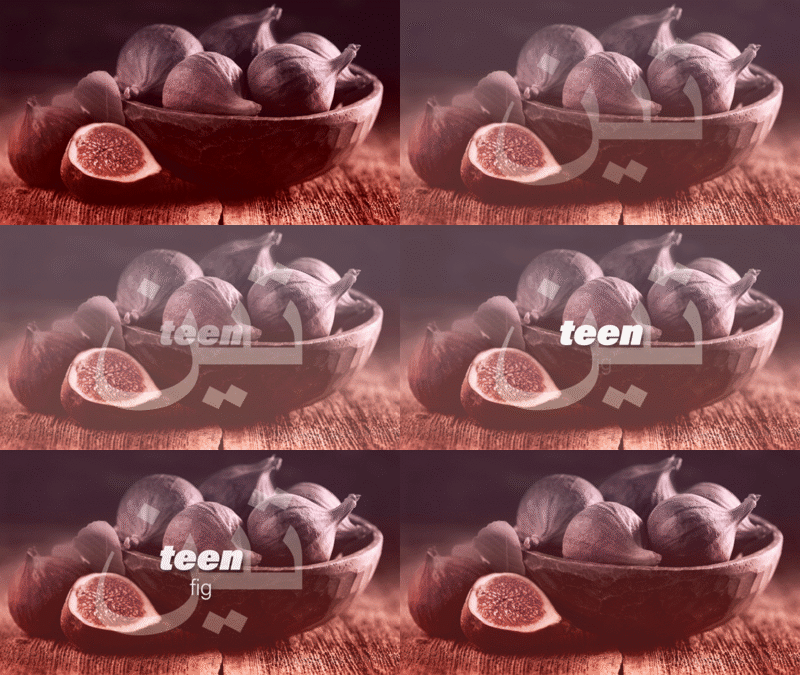
The Arabic word teen or onion doesn't have a clear Arabic source -

The Arabic word saraha means honesty -
Tamir, the Arabic word for date is a fruit that has over 400 variations -

The Arabic word for tongue, lisan, is connected to the idea of truth -
The Arabic word for olive, zaytoon, is also the word for olive tree -

The Arabic word for sign, alama, has several meanings


Technically, in classical Arabic, the word "teena" is used to reference the fig fruit while "teen" is used for the fig tree. However, across colloquial Arabic dialects, "teen" is used to reference both the tree and the fruit. Tayan is the specific name used for the man who sells "teen" fruit in markets.
There are a number of variations of the "teen" fruit. The most well known are caprifigs, Smyrna figs, San Pedro figs and common figs. "Teen" comes in a number of colours, from shades of green to brown and purple. Regardless of their variety or colour, "teen" develop a hollow, fleshy structure internally lined with numerous edible seeds.
"Teen" also refers to a different type of fig, teen shawky, which loosely translates to fig with thorns. The English technical name for this is Opuntia ficus-indica or the cactus fig, the prickly pear or the Indian fig opuntia. It’s an oval-shaped berry with a thick, spiny rind and is known for its fresh taste when ripe. In the Middle East, it’s most abundant in Saudi Arabia.
Aside from being eaten as fresh fruit, "teen" are used in various Arabic cuisines.
Dried figs, which are known as quttain, are often used in recipes for fig-filled cookies or meat stews. "Teen" is also used to make jams. The sap of the tree is used to tenderise meat and is also used for ricotta-like cheese called krish which incorporates fresh sheep's milk. Malabi is a milk pudding that also uses dried "teen" with condensed the milk.
"Teen" also has strong religious significance in the region and is sometimes known as the heavenly fruit for its mention in the Quran.
The 95th chapter in the Quran is called Surat Al Teen, which begins with a series of significant oaths which include the fig and the olive in representing the lands where many prophets were sent. This has often been interpreted to emphasise the importance and sacredness of the fig fruit. "Teen" is one of only five fruits mentioned in the Quran, along with zaytoon (olives), enab (grapes), rouman (pomegranates) and tamir (dates).
Lebanese songstress Fairouz’s song, Waraq Al Teen which translates to The Leaves the Fig Tree, written by the Rahbani brothers, uses "teen" as a powerful metaphor.
“Let the leaves of the fig tree disburse and scatter, to run away with the sun, and turn as red as tender love,” goes one of the lyrics to the song, which weaves in the leaf of the fruit tree as a device to connect to the feelings of loss the narrator experiences after her lover has abandoned her.

