

As Barbie continues to take over the world as one of the biggest earning movies of the year, top activists are also joining the pink-infused phenomenon.
On Sunday, Nobel laureate Malala Yousafzai posted a photo of herself and husband Asser Malik taken at a screening of the movie.
Posing inside a life-size Barbie doll box, she cheekily captioned the photo “This Barbie has a Nobel Prize. He’s just Ken” – a reference to the “This Barbie …” meme that's taken over social media.
Yousafzai, 26, added: “We loved the movie, it was so funny and thoughtful. I hope this caption doesn’t hurt all the Kens as much as the movie Ken.”
While UAE fans will have to wait until August 31 to see Barbie, the Greta Gerwig-directed film has already grossed more than $775 million at the global box office. It's also earned the highest-grossing opening weekend for a film directed by a woman.
The film stars Margot Robbie in the titular role and Ryan Gosling as Ken, and follows them as they set off on an adventure into the real world.
Climate activist Greta Thunberg, who joined demonstrators in London to protest against the planned development of the Rosebank oil and gas field, also used an audio clip from the film.
In the audio, Robbie's Barbie asks her fellow Barbies the existential question: “Do you guys ever think about dying?”.
Thunberg's video features the words: “Do you guys ever think about the climate crisis?” along with the names of British Prime Minister Rishi Sunak, UK Energy Secretary Grant Shapps and energy company Equinor.
Demonstrators want the British government to abolish development of the Rosebank site, believed to be the UK’s largest undeveloped oil and gasfield.
Journalist Christiane Amanpour, known for her war reporting in the 1990s, also posted a photo of herself at a screening with the caption: “This Barbie is a war correspondent.”
First launched in 1959, Barbie is still the most popular doll on the market. Last year alone, Barbie dolls generated $1.49 billion in sales, according to data company Statista.
Barbies have also celebrated inspirational role models over the years.
A doll modelled on American fencer Ibtihaj Muhammad – the first hijabi Barbie – was launched in 2018 as part of the Barbie Shero line honouring women who break boundaries. Muhammad was the first American to compete at the Olympics while wearing a hijab, and won a bronze medal in fencing at the 2016 games in Rio de Janeiro.

In 2019, in honour of Barbie's 60th anniversary and International Women’s Day, Mattel announced 20 new figures based on the likeness of prominent women, including activist and supermodel Adwoa Aboah; conservationist and daughter of the late “crocodile hunter” Steve Irwin, Bindi Irwin; actress, model and activist Yara Shahidi; tennis star Naomi Osaka; and film director Ava DuVernay.
British coronavirus vaccine developer Sarah Gilbert was honoured with a Barbie in 2021, while British primatologist Jane Goodall had a doll made in her likeness last year.
“I wanted a doll to be me even before this idea came up. I've seen little girls playing with Barbie dolls and certainly at the beginning, they were all very girlie-girlie, and I thought little girls need some choice,” Goodall said.
More recently in March, British scientist Maggie Aderin-Pocock, who's been praised for her contributions in making space and science accessible to girls, was also honoured with a doll.
-

Los Angeles: Margot Robbie kicked off the global press tour by recreating 2015’s Pink & Fabulous Barbie in a Valentino mini dress. Getty; Mattel -

Beverly Hills: Robbie co-ordinated with her convertible in a pink Bottega Veneta outfit and custom-pink Manolo Blahnik Jada heels. Photo: Warner Bros -

Seoul: Sparkling Barbie from 1964 was the inspiration for Robbie’s pink Moschino matching set. Getty; Mattel -

Seoul: For the premiere in South Korea, the actress wore two outfits inspired by 1985's Day to Night Barbie, including a pink Versace skirt suit for the day look. AFP; Mattel -

Seoul: The night version of the look was also Versace, a tulle skirt and sparkling beaded bodice. AFP; Mattel -
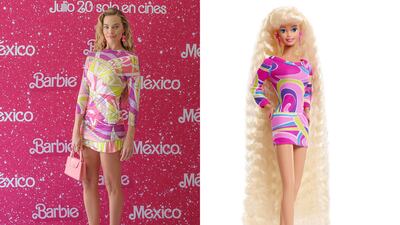
Mexico City: Robbie drew inspiration from 1992's Totally Hair Barbie, wearing a custom multicoloured dress by Pucci, with Chanel jewellery and a pink Chanel bag. AFP; Mattel -
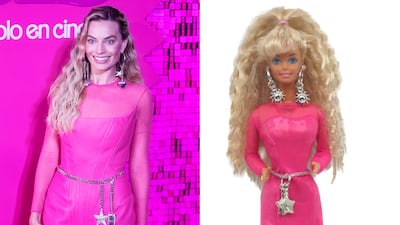
Mexico City: Robbie wore a neon pink leather Balmain mini dress, adding a star-shaped belt and earrings to channel 1992's Earring Magic Barbie. EPA; Mattel -
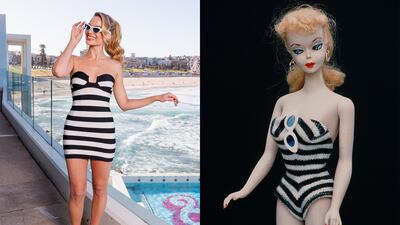
Sydney: The actress paid homage to Barbie’s 1959 black-and-white swimming costume in a striped Herve Leger bandage dress. Photo: Warner Bros; Getty -
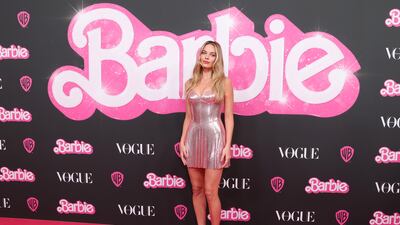
Sydney: For a Barbie party, the actress wore a blush pink chainmail Versace mini dress. WireImage -
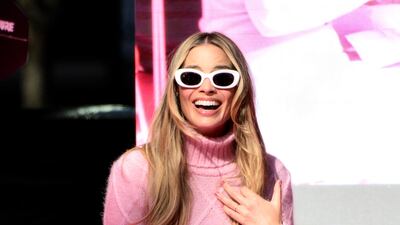
Sydney: Robbie in vintage Versace from the Italian fashion house's autumn/winter 1994 collection for a Barbie celebration party. Getty Images -
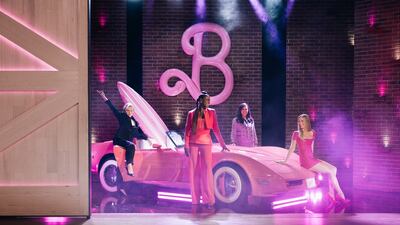
Los Angeles: The star wore a hot-pink mini dress by Valentino on The Kelly Clarkson Show. Getty Images -
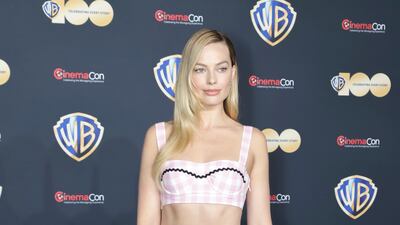
Las Vegas: To promote the film at CinemaCon, the actress wore a two-piece pink-and-white chequered look by Prada, adding bright pink Christian Louboutin heels. WireImage -

London: For the UK premiere, Robbie channelled Enchanted Evening Barbie from 1960 in a custom Vivienne Westwood gown. Photo: Getty Images / Mattel -
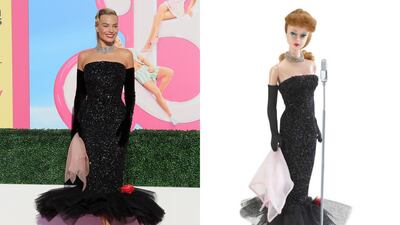
Los Angeles: The actress wore Schiaparelli couture in homage to the 1960's Solo in the Spotlight Barbie. Photo: EPA / Mattel



