


Focus next week turns to Jeddah for Saudi Arabia's first Islamic Arts Biennale.
Curated by Omniya Abdel, Saad Alrashid, Julian Raby and Sumayya Vally, the event begins on Monday at one of the Hajj terminals at Jeddah's airport built to welcome pilgrims en route to Makkah and Madinah.
Never used, the Western Hajj Terminal is now serving this purpose in a more abstract sense: as a gateway for visitors to art and culture from the Islamic tradition, conceived by contemporary artists. Here are 10 to look out for.
Rund Alarabi
An artist who splits their time between Khartoum and Frankfurt, Rund Alarabi’s work plays with archives and personal memories. Ideas of migration and diasporas are in focus, but so too are the relations between people and space: how one occupies, or claims a space around oneself, and perhaps also how this space can turn around and claim you. Alarabi often works in collage or video, bringing out her layered understanding of history and experienced reality.
Nasser Alsalem

An architect, calligrapher and artist, Nasser Alsalem’s piecescarefully and thoughtfully parse ideas around language and philosophy, and then translate them into the visible world: from how fairytales and traditional stories express ideas of time, to the use of repetition in performances of devotion.
He is particularly interested in how these philosophical questions can be tackled through calligraphic works; produced in a range of styles, including three-dimensional abstracted sculptures, neon lights and drawn compositions.
Farah Behbehani
Whether working with textiles or embroidered calligraphy that only appears under black light, the Kuwaiti artist Farah Behbehani investigates the symbolism and practices of various forms of spirituality.
While her installations evoke the sense of illumination associated with enlightenment, her careful, hand-crafted repetition of poems and verses draws on forms of symbolism and numerology from Islam, grounding her evocative imagination. Behbehani will have a show at Athr Gallery during the biennial.

Bricklab
Bricklab is riding high at the moment. Straight from finishing Hayy Cinema — Saudi Arabia's first art house cinema, built in their home town — the architectural firm is also finishing up a research and exhibition project around Saudi modernism, contributing as an art practice to different biennials, and working on major sites in Riyadh.
The two brothers who founded the firm, Abdulrahman and Turki Gazzaz, take this multidisciplinary approach to each project, looking at how historical, cultural and theoretical trends and ideas inform the built environment.
Civil Architecture
This Bahrain architecture practice, founded by Hamed Bukhamseen and Ali Karimi, takes the building of the Middle East as its subject.
The firm's research into Arab states’ modern and contemporary architecture, politics and economics reveals that much of the Middle East has emerged from the 20th century ill-equipped to function in a warming, changing environment and explores what might be done to propose a new model for the future.
Their buildings have also garnered numerous awards and landed on various shortlists since the duo began working together in 2018.
Alia Farid

The Kuwait-Puerto Rican artist Alia Farid has become a well-known fixture on the international circuit of late, with works in the 2022 Whitney Biennial in New York, a solo show at the non-profit gallery Chisenhale in London and a presentation at the 2019 Sharjah Biennial, where she filmed new year’s celebrations on an island in the Arabian Gulf.
Her work explores different geographies and how people’s lives respond to their local environments and histories. It is particularly attuned to cultural intersections, or where different traditions and pastimes overlap, often because of migration.
An ongoing project maps the emergence of the Arab and South Asian migration in Latin America and the Caribbean, inspired by her own personal history.
Basmah Felemban

Basmah Felemban is from the young Jeddah generation who emerged in the 2010s, just as Saudi Arabia's cultural reforms were beginning to be rolled out.
Her work retains the cross-over, independent spirit of that era: operating equally in the realms of art and graphic design — which she taught herself — Felemban has pursued a number of different interests, among them symbolism, numerology and Islamic astrology.
Her studio space has also hosted other artists and held exhibitions for travelling curators and visitors, in modes of natural collaboration.
Huda Lutfi

Born in 1948, the Egyptian artist Huda Lutfi explores craft, pop culture, politics, history and spirituality — the gamut of life. Her paintings often incorporate famous faces from pop culture, slogans or national symbols, juxtaposing these with a sense of fragility and constraint.
The Cairo artist earned a PhD in Islamic culture and history at McGill University in Canada — an influence noticeable in her use of geometric patterns and frequent references to Islamic motifs. Lutfi also explores the craft element of constructing these works, recently making a series she called Healing Devices (2020) whose construction was itself posited as a form of personal, and perhaps national, healing.
Ahmed Mater
The father of Saudi Arabia's contemporary art scene, Ahmed Mater has long pondered on the relationship between religion and modern life, whether in his acclaimed series imagining the Kaaba as a magnet to which metal shavings are attracted to, or in his photo series and book chronicling the expansion of Makkah.
Mater also often celebrates the craftsmanship and beauty of traditional Islamic arts, such as its geometric patternings or carved woodwork and, one suspects, the lack of a named artist beyond many of these works. An artist who tends towards collective authorship and thinking, Mater's projects are also often partially platforms for others.
Shahpour Pouyan

Iranian-born artist Shahpour Pouyan’s work addresses what it means to live in a diaspora, also exploring the interests of media and the art world in identifying where artists and cultural workers are from.
In one work, My Place is the Placeless, he took a DNA test and discovered his genetic make up spanned 33 different countries. He then made 33 different ceramic objects referencing cultural traditions from those countries, and installed these on a vitrine-like structure, evoking a museum display.
Other works create small-scale ceramic versions of traditional buildings and forms of architecture, suggesting miniature cities in absentia: placeholders for places lost, whether to migration or to time.
Wael Shawky

Egyptian artist Wael Shawky, one of the most significant Arab artists of his generation, is a storyteller. Narratives, compelling anecdotes and past injustices haunt his practice, which reveals them to the world in compelling, various ways. For example, a marionette performance and video that animates the history of the Crusades; collaborations with child actors; a heavy metal concert in a remote Egyptian village.
Shawky begins from the small detail and expands his enquiry outwards, taking in geopolitical and historical currents such as economic development, religious intolerance and economic strife.
Dima Srouji

The Palestinian architect investigates and untangles claims and rights, exploring what land belongs to whom, who owns the objects in the land and restitution. Dima Srouji also takes care to unravel the stories that are told by heritage objects, giving these silenced stories a new voice in her works — particularly those from Palestine.
Forms of craft are also highly important, as each object tells a story of a different cultural tradition, set of skills and history. Srouji, who runs the MA City Design studio at the Royal College of Art in London, works with text, archives, maps, films and glass-blowing to create multifaceted understandings of heritage and public space, weaving together artistic, architectural, archaeological and emotional terms.
Ayman Zedani

Great subjects find their authors — and the Saudi artist Ayman Zedani is a master of sourcing extraordinary material from the natural world, from parasitic desert plants to a dwindling population of Arabian Sea humpback whales.
Nominally his territory is that of the anthropocene — a not-so-short short-hand term for the idea of the era in which man began destroying the planet — and the future of the Gulf. However, the stories elaborated in his layered installations are also about co-dependency: tenuous, unexpected moments that show chains of interconnection, where a change to one element affects them all.
Scroll through images of 10 contemporary Arab artists you should know below
-
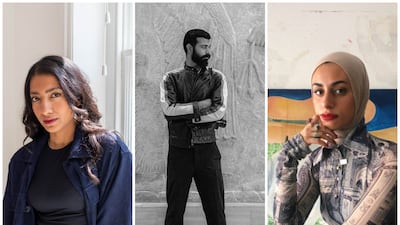
From left, Maitha Abdalla, Amir Hazim and Alymamah Rashed are among 10 Arab artists who are helping to diversify the creative landscape. Photo: Tabari Artspace / Instagram / @amirhazimx / Hunna Art -
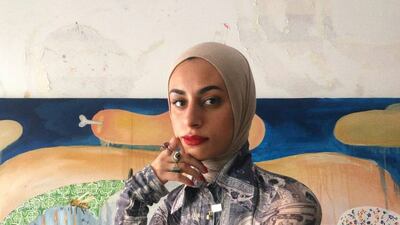
Kuwaiti artist Alyamamah Rashed. Photo: Hunna Art -
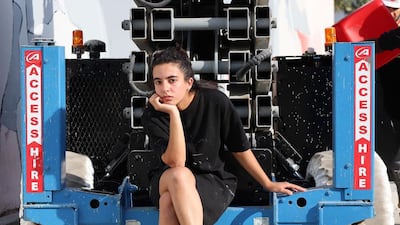
Iraqi visual artist and muralist Miramar Muhd. Photo: Instagram / @miramar.muhd -
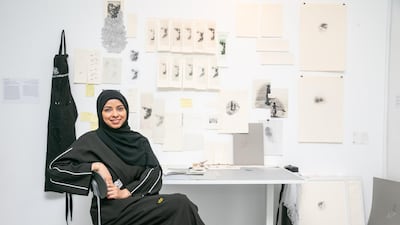
Emirati artist Salama Nasib in her studio. Photo: Tashkeel -
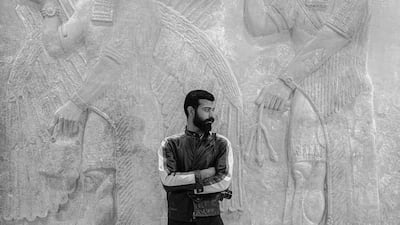
Iraqi artist Amir Hazim. Photo: Instagram / @amirhazimx -
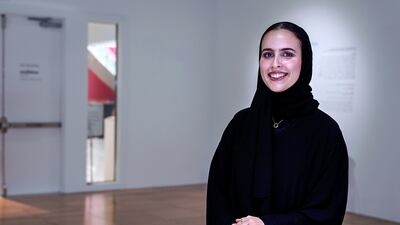
Emirati artist Sarah Al Mehairi. Victor Besa / The National -
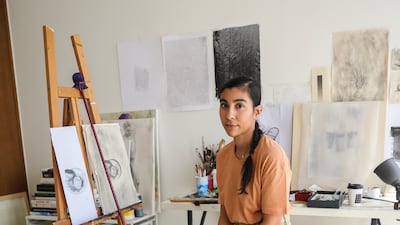
Syrian artist Sawsan Al Bahar. Photo: Firetti Contemporary -
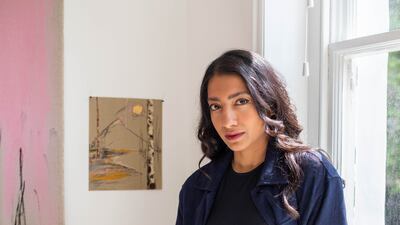
Emirati artist Maitha Abdalla. Photo: Tabari Artspace -
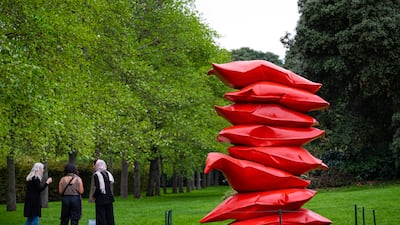
Emirati artist Shaikha Al Mazrou's Red Stack, as part of Frieze Sculpture in Regent's Park, London. Photo: Lawrie Shabibi -
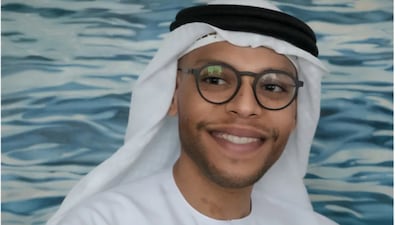
Emirati artist Hashel Al Lamki. Photo: Tabari Artspace -
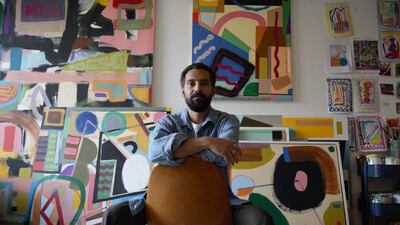
Saudi artist Nasser Almulhim. Photo: Tabari Artspace



