

Leonardo da Vinci’s Saint John the Baptist has settled into its temporary new home at Louvre Abu Dhabi, where the masterpiece by the Tuscan renaissance painter will be on display for the next two years.
The painting, on loan from Paris' Musee de Louvre, was removed from the prestigious French institution last month. After taking meticulous measurements to ensure its level presentation, workers hung Saint John the Baptist at Louvre Abu Dhabi on Monday. The artwork is being displayed in Gallery 7 of the museum, First Globalisation, and is dedicated to the unprecedented cultural exchange that swept the globe between the 1500s and 1700s.
Displayed among other works from the era that have been sourced from around the world, the painting is a fitting addition to Louvre Abu Dhabi’s ‘universal museum’ model and its director, Manuel Rabate, says it is a “vibrant manifestation” of the relationship between the two Louvres.
“The painting is one of the crown jewels of the Louvre in Paris,” he tells The National. “And it’s now in Abu Dhabi. Da Vinci is a universal genius, a polymath and an icon of artistry. He was open to the world and interacting with it, and this is what’s happening in Saadiyat right now. Louvre Abu Dhabi, Zayed National Museum, Guggenheim Abu Dhabi, the Abrahamic House and the Natural History Museum, all of this shows a curiosity and openness to the world, but also to do it with intelligence and beauty.”

Thought to have been painted between 1513 and 1516, Saint John the Baptist is perhaps the best representation of Leonardo's chiaroscuro technique — a method of treating light and shadow — as well as a spectacular example of sfumato, a canonical mode of painting during the Renaissance, featuring a softened transition of colours. The painting was among those that Leonardo continuously worked on until his death in France in 1519.
Vincent Delieuvin, curator of Italian paintings of the 16th century at Musee du Louvre, says the work is the zenith of Leonardo's experimentations.
“He lived quite long for his time,” he tells The National. “He was 67 when he died. He only painted a few paintings but wanted them to be perfect. During his career, he developed an experimental technique called sfumato to make a perfect transition between light and shadow. It gives a kind of vibration to the painting.

"He improved his technique with his last three paintings, which include the Mona Lisa and Saint John the Baptist, the most complex and sophisticated. They show Leonardo at his highest level.”
The chiaroscuro also helps to give an unparalleled depiction of the biblical subject, and with its play on light and shadow, is ideal in rendering on canvas the “messenger of light and hope”, Souraya Noujaim, director of scientific, curatorial and collections management at Louvre Abu Dhabi, tells The National.

“You see this figure, and you see this twist of his body, and he is speaking to you as an individual,” she says. “It’s important to our narrative. It has a history of movement, not only with Leonardo da Vinci, and that also makes it meaningful. Seeing it here in Abu Dhabi as a symbol of those exchanges is a gift for us and the audience.”
The painting has arrived at Louvre Abu Dhabi in midst of its fifth anniversary celebrations. Whereas another Leonardo work, Portrait of an Unknown Woman, also known as La Belle Ferronniere, was loaned by the Louvre to its Abu Dhabi sibling to celebrate its opening in 2017, Saint John the Baptist marks a new chapter in the museum’s mission, says Mohamed Khalifa Al Mubarak, Chairman of the Department of Culture and Tourism — Abu Dhabi.

“The arrival of the globally revered masterpiece, Saint John the Baptist, as Louvre Abu Dhabi celebrates its five-year anniversary, is symbolic of our enduring collaboration with our partners in France and reinforces Abu Dhabi’s position as a global cultural centre,” he says.
“In one month alone, we will have featured a powerhouse of cultural events in the emirate, including the Culture Summit Abu Dhabi, Abu Dhabi Art and, of course, this important milestone celebration for Louvre Abu Dhabi.
"Over the past five years, Louvre Abu Dhabi has evolved into a flagship museum in the Arab world and now, visitors, both from home and overseas, have yet another reason to visit the museum and engage with a magnificent artwork that captures an extraordinary moment in history.”
Rabate echoes the sentiment, saying: “We opened and welcomed more than three million visitors in the past five years. This, including the years of travel restrictions due to the Covid-19 pandemic. We put the first universal museum in the Arab world. It’s a model that is truly rooted in its territory, in Abu Dhabi, in the UAE and the Arab world.
"You see that in the way the seven emirates are represented, in the loans from Saudi Arabia and from Oman. There will be new loans and programming that will keep telling this universal story.
"We will continue enhancing the innovative visitor experience, and to be an educational hub. We helped in the creation of a new generation of museum specialists here. That’s very important and will be developed again and again for the future.”
Scroll through images of Louvre Abu Dhabi's Impressionism exhibition below
-
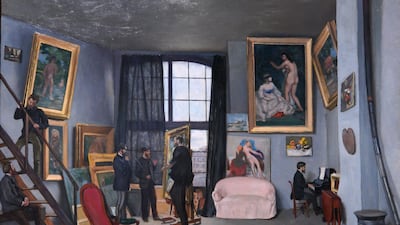
'Bazille Studio' (1870), oil on canvas by Frederic Bazille and Edouard Manet. Victor Besa / The National -
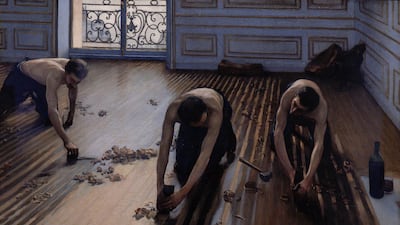
'Floor Scrapers' (1875), oil on canvas by Gustave Caillebotte. Victor Besa / The National -
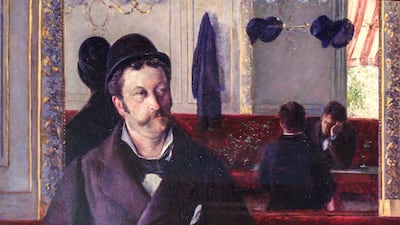
'In the Cafe' (1880), oil on canvas by Gustave Caillebotte. Victor Besa / The National -
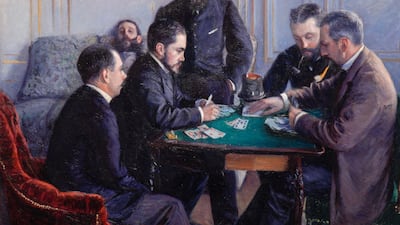
'The Bezique Game' (1880), oil on canvas by Gustave Caillebotte. Victor Besa / The National -
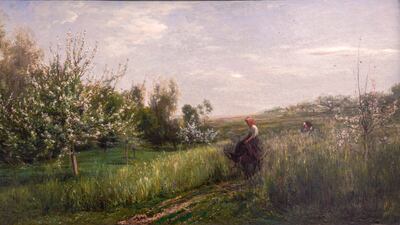
'Spring' (1857), oil on canvas by Charles-Francois Daubigny. Victor Besa / The National -
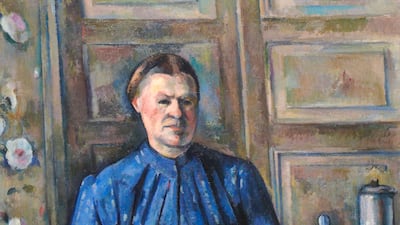
'Woman with a Coffee Pot' (1890-95), oil on canvas by Paul Cezanne. Victor Besa / The National -
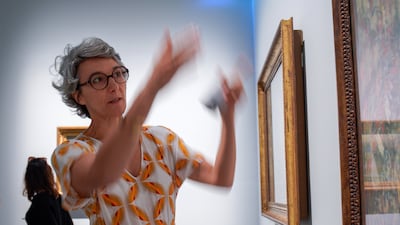
Sylvie Patry, chief curator and deputy director for Collections and Curatorial Affairs at Musée d’Orsay. Victor Besa / The National -
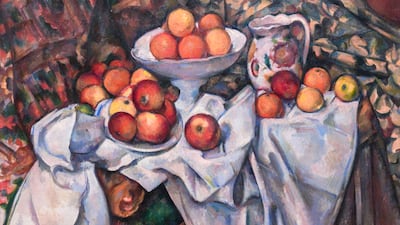
'Apples and Oranges' (1839), oil on canvas by Paul Cezanne. Victor Besa / The National -
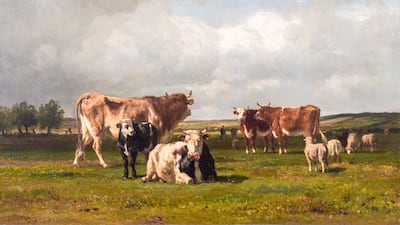
'The Pastures under a Cloudy Sky' (1856-60), oil on canvas by Constant Troyon. Victor Besa / The National -
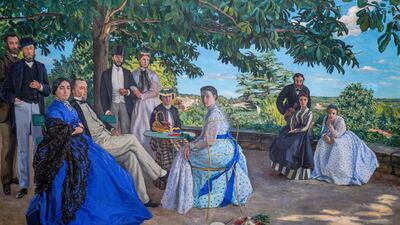
'Family Reunion' (1867-1841), oil on canvas by Frederic Bazille. Victor Besa / The National -
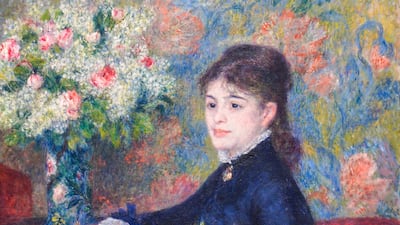
'The Cup of Chocolate' (1877-78), oil on canvas by Pierre-Auguste Renoir. Victor Besa / The National -
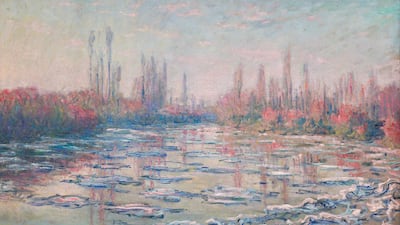
'The Ice Floes' (1880), oil on canvas by Claude Monet. Victor Besa / The National -
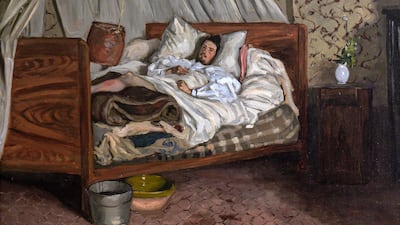
'The Improvised Field Hospital' (1865), oil on canvas by Frederic Bazille. Victor Besa / The National -
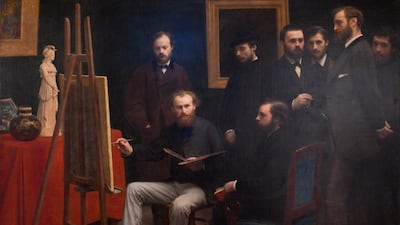
'A Studio at Les Batignolles' (1870), oil on canvas by Henri Fantin-Latour. Victor Besa / The National -
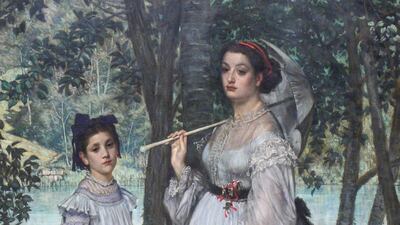
'The Two Sisters' (1863), oil on canvas by James Tissot. Victor Besa / The National -
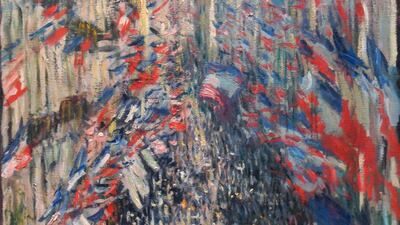
'Rue Montorgueil, Paris' (1878), oil on canvas by Claude Monet. Victor Besa / The National -
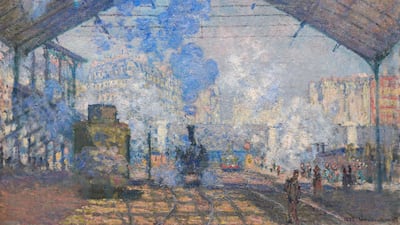
'Saint-Lazare Railway Station' (1877), oil on canvas by Claude Monet. Victor Besa / The National -
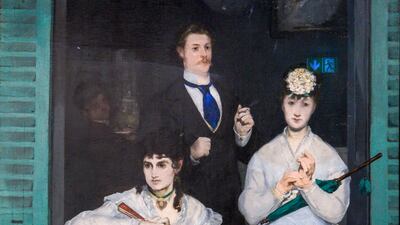
'The Balcony' (1868-69), oil on canvas by Edouard Manet. Victor Besa / The National -
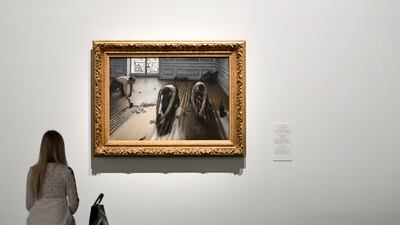
'Floor Scrapers' by Gustave Cailebotte, oil on canvas. Khushnum Bhandari / The National -
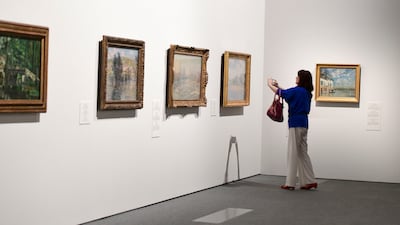
The exhibition is running until February. Khushnum Bhandari / The National -
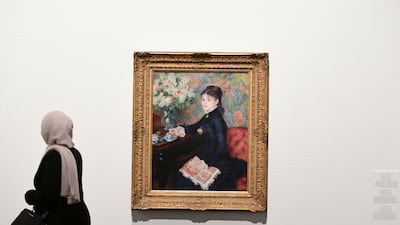
It highlights how the French artists, known as 'the impressionists', were rebels of their time. Khushnum Bhandari / The National -
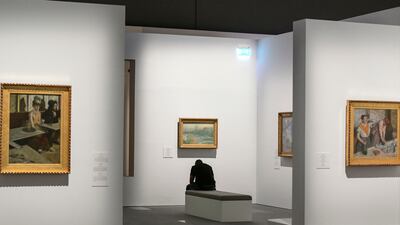
Their vibrant brushstrokes and outdoor landscapes broke conventional art rules in the 19th century. Khushnum Bhandari / The National -
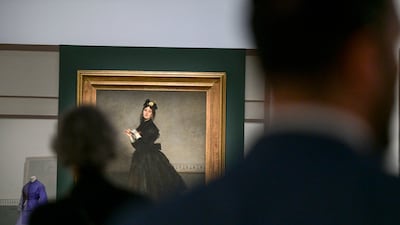
'The Lady with the Glove' by Carlos-Duran. Khushnum Bhandari / The National



