



The short play Saber Came to Tea explores powerful themes.
It will be performed at the Edinburgh Festival Fringe this weekend. The collaborative production featuring original music and multimedia elements, is based on true events about a young Yemeni couple defying traditions and risking their lives to be together.
Yemeni artists-in-exile Shatha Altowai and her husband, composer Saber Bamatraf, used their experience to create the narrative with writer and director Robert Rae.
Saber Came to Tea is part of five other theatre pieces from Community Interest Company ART27’s First Hand series.
Rae is co-director of ART27 and also co-wrote Saber Came to Tea.
“Saber and Shatha arrived in Scotland via the University of Edinburgh artists in exile scheme,” Rae tells The National. “When we met, it struck me that here’s a real opportunity in terms of the context of what ART27 does.”
Altowai and Bamatraf relocated to Edinburgh after the escalation of the civil war in Yemen made it dangerous for them as artists. The couple had earlier released a short documentary, Voice of the Rainbow, which explored and questioned many conventions of Yemeni society, which restricted the freedoms of artists and women.
After facing harassments and threats they emigrated to Edinburgh in November 2020 with the support of the Artist Protection Fund.

Saber Came to Tea was an idea Altowai and Bamatraf had while still in Yemen.
“These kinds of stories are based on issues in a family are a bit sensitive,” Altowai says. “We wanted to do it but we didn’t know how until we came to Scotland and met Robert who encouraged us to just get it done.”
Consisting of seven cast members including two musicians, Saber Came to Tea is the story of a groom who leaves the city to visit his new wife’s family in their village. Once there, he’s surprised at the modest and conservative life her family lead.
“This is basically a true story,” Bamatraf says.
“When the civil war erupted in Yemen two months into our marriage we had to be separated. Women went to the villages for safety and men stayed in the capital. After six months, we decided we’d get together in the capital and start our art initiatives but then our house was destroyed by an air strike. These kinds of stories and conversations are covered in the play.”
Through a little magic and drama, the audience is immersed in the story of the wife Aflan, played by Altowai, who stands in defiance against the constraining social norms of her family.
Altowai explains how surreal and difficult it was to play a version of herself based on actual events that defined her.
“It’s interesting to be myself in Scotland but feeling that I’m still in Yemen,” she says. “I miss my family and my country and that’s why I changed the name of my character. I couldn’t do it with my name, it evoked too many emotions.”
The drama is performed in Arabic with English subtitles appearing on screens on each side of the stage. The screens also provide stunning visuals of the Yemeni landscape.
“Like many people, my head has been filled with images of the destruction in Yemen,” says Rae. “But suddenly we are looking at very beautiful images and you recognise what a stunning place it is.
"Also Saber’s music is incredibly accessible. For example, the piece Arabia is a beautiful.”
Bamatraf performs four pieces of originally music in the play, most of them composed in Yemen.
"Arabia explores and expresses my feelings of living in the complexities of our city during the war and the everything that’s been happening in Arabia. The piece is more of interpretations and expressions form my inner self," he says.
“I hope that the audience, gets to see our position when we were in Yemen. We were living in very hard conditions. Bombardments from the sky, dealing with these social norms specially constraining women’s freedoms, a lot of issues against artists and all of these issues we see in the news.
"But within that we can see positivity and resilience and that is what I want people to see is also happening in Yemen.”
Scroll through the gallery for more pictures from Edinburgh Festival Fringe
-

A street entertainer performs on Edinburgh's Royal Mile during the city's Festival Fringe. Getty Images -

Thousands of performers from across the world are in the Scottish Capital for the world's biggest arts festival, Edinburgh Festival Fringe, which is hosting more than 3,000 shows from 58 countries. Getty Images -
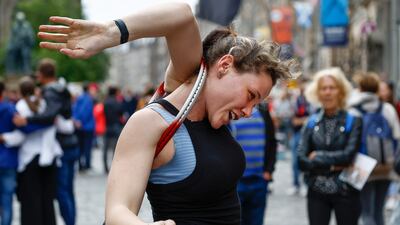
Celebrating its 75th Anniversary, this year Edinburgh Fringe runs from August 5 to 29. Getty Images -
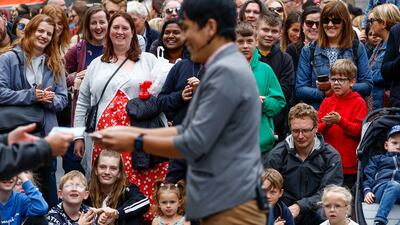
Every year, artists descend upon Edinburgh from across the world for Fringe. Getty Images -
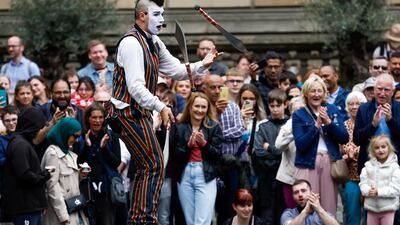
Throughout Fringe, Edinburgh's Royal Mile hosts a varied array of artists and entertainers, ranging from opera singers to circus performers. Getty Images -
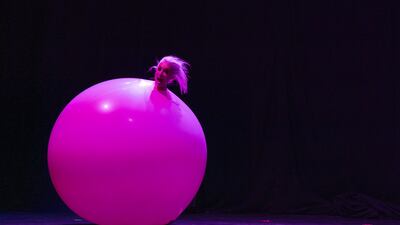
Cabaret artist from La Clique on stage during the launch of Underbelly at the Edinburgh Festival Fringe. PA -

Artists from Circus Abyssinia perform in the McEwan Hall in Edinburgh, Scotland. Getty Images -

Performers from the show Dragons and Mythical Beasts. PA -
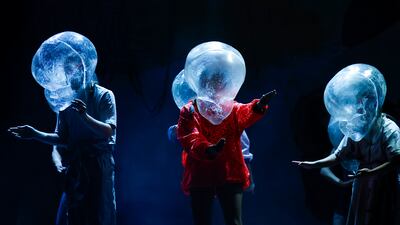
Artists from Circus Abyssinia perform in the McEwan Hall at the launch of the Underbelly at the Edinburgh Festival Fringe in Edinburgh, Scotland. Getty Images -
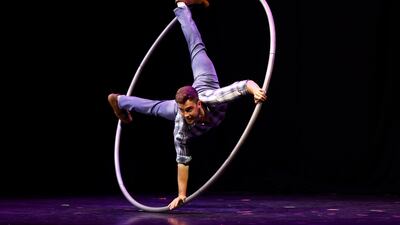
Performance artist Charlie Wheeler from La Clique. Getty Images -
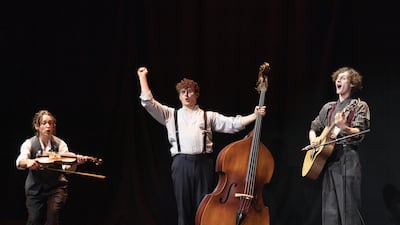
Musicians from Caligari also perform. PA -
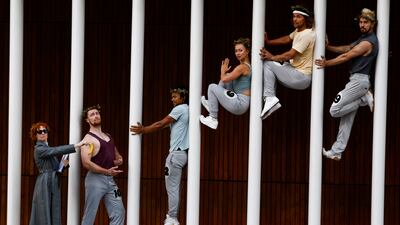
Artists from Barely Methodical Troupe brought their show Kin to the Assembly Rooms. Getty Images -

Dancers from the Ukrainian ballet company Freedom Ballet during a rehearsal. PA



