• Arabic calligraphy is the latest addition from the UAE, among other countries, to Unesco's intangible cultural heritage lists. AFP
    Arabic calligraphy is the latest addition from the UAE, among other countries, to Unesco's intangible cultural heritage lists. AFP
  • Falconry has been practised in the Arab region for 4,000 years, mainly by desert-dwelling Bedouins as an important form of hunting and fishing in a land with scarce natural resources. Pawan Singh / The National
    Falconry has been practised in the Arab region for 4,000 years, mainly by desert-dwelling Bedouins as an important form of hunting and fishing in a land with scarce natural resources. Pawan Singh / The National
  • Learn more about al aflaj system in Al Ain in 'Emirates from Above', a National Geographic film. The traditional irrigation network system in the UAE has been added to Unesco's list.
    Learn more about al aflaj system in Al Ain in 'Emirates from Above', a National Geographic film. The traditional irrigation network system in the UAE has been added to Unesco's list.
  • Camel racing, an age-old tradition in the region, is still as popular today. EPA
    Camel racing, an age-old tradition in the region, is still as popular today. EPA
  • Date palms have been used for centuries for myriad purposes around the Gulf, including the UAE. It was added by Unesco in 2019. Antonie Robertson / The National
    Date palms have been used for centuries for myriad purposes around the Gulf, including the UAE. It was added by Unesco in 2019. Antonie Robertson / The National
  • Al azi poetry has been offered protected status by Unesco to develop a clear national identity in the UAE.
    Al azi poetry has been offered protected status by Unesco to develop a clear national identity in the UAE.
  • Al rafza is a traditional art form performed by men during special occasions, from weddings to national festivals. Reem Mohammed / The National
    Al rafza is a traditional art form performed by men during special occasions, from weddings to national festivals. Reem Mohammed / The National
  • The serving of Arabian coffee is a vital part of hospitality in the region and 'considered a ceremonial act of generosity', says the Unesco inscription. Khushnum Bhandari / The National
    The serving of Arabian coffee is a vital part of hospitality in the region and 'considered a ceremonial act of generosity', says the Unesco inscription. Khushnum Bhandari / The National
  • The majlis, a cultural and social space prevalent throughout the region, was added in 2015 on behalf of the UAE, Saudi Arabia, Oman and Qatar. Jaime Puebla / The National
    The majlis, a cultural and social space prevalent throughout the region, was added in 2015 on behalf of the UAE, Saudi Arabia, Oman and Qatar. Jaime Puebla / The National
  • Al ayyala is a cultural performance practised in north-western Oman and throughout the UAE. It was added in 2014.
    Al ayyala is a cultural performance practised in north-western Oman and throughout the UAE. It was added in 2014.
  • Al taghrooda, traditional Bedouin chanted poetry, was added in 2012. Mona Al Marzooqi / The National
    Al taghrooda, traditional Bedouin chanted poetry, was added in 2012. Mona Al Marzooqi / The National
  • Sadu, a traditional weaving technique, is on the list twice, once for the UAE and once for Saudi Arabia and Kuwait. It was added for the UAE in 2011. Reem Mohammed / The National
    Sadu, a traditional weaving technique, is on the list twice, once for the UAE and once for Saudi Arabia and Kuwait. It was added for the UAE in 2011. Reem Mohammed / The National

From falconry to sadu, the UAE has 12 traditions on Unesco's intangible heritage lists


Katy Gillett
  • English
  • Arabic

On World Heritage Day, we explore the UAE’s ‘intangible heritage’, the customs, traditions and practices that are invaluable to the planet

Most people are aware of the world’s Unesco World Heritage Sites, and will often add them to travel itineraries when visiting a new city or country.

But what about the intangible heritage? The non-physical traditions, folklore and practices that you can’t necessarily put on the bucket list, but simply admire from afar or on an intellectual level.

In 2008, Unesco created its Lists of Intangible Cultural Heritage, after the 2003 Convention for the Safeguarding of the Intangible Cultural Heritage took effect.

It aims to better protect these traditions and raise awareness of them, acting as a repository of cultural diversity and creative expression.

Its importance "is not the cultural manifestation itself but rather the wealth of knowledge and skills that is transmitted through it from one generation to the next", it says on Unesco's site.

Here we explore the UAE’s 12 entries on Unesco's lists, which sit alongside dozens more from the Gulf and wider Mena region.

Arabic calligraphy

Arabic calligraphy was added to the List of Intangible Cultural Heritage in December 2021. AFP

In December, Unesco added Arabic calligraphy to its Intangible Cultural Heritage List.

Sixteen countries, led by Saudi Arabia and including the UAE, presented the nomination to the UN Educational, Scientific and Cultural Organisation.

"Arabic calligraphy is the artistic practice of handwriting Arabic script in a fluid manner to convey harmony, grace and beauty," Unesco said on its website.

"The fluidity of Arabic script offers infinite possibilities, even within a single word, as letters can be stretched and transformed in numerous ways to create different motifs."

Falconry

Falconer Alia Obaid, 8, from Madinat Zayed, at Al Dhafra Festival in Abu Dhabi. Falconry is an age-old tradition in the UAE and neighbouring countries. Khushnum Bhandari / The National

Falconry has been practised in the Arab region for 4,000 years, mainly by desert-dwelling Bedouins as an important form of hunting and fishing in a land with scarce natural resources.

Last year, falconry’s inclusion on Unesco’s list of Intangible Cultural Heritage of Humanity was extended to include another six countries.

The UAE led the efforts of 24 countries around the world to expand the inscription, which now includes Croatia, Ireland, Poland, the Netherlands, Slovakia and Kyrgyzstan.

"The successful fourth inscription of falconry and the growing interest among countries from all regions of the world in elaborating a multinational file reflects the importance of falconry as an integral part of our shared living heritage,” Noura Al Kaabi, the UAE Minister of Culture and Youth, said at the time.

Al aflaj

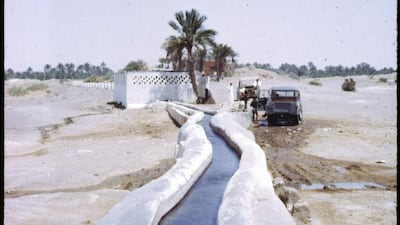
  • A aflaj in the Al Ain area taken at some point between 1962 and 1964. The aflaj is now on Unesco’s Representative List of Intangible Cultural Heritage. Courtesy David Riley
    A aflaj in the Al Ain area taken at some point between 1962 and 1964. The aflaj is now on Unesco’s Representative List of Intangible Cultural Heritage. Courtesy David Riley
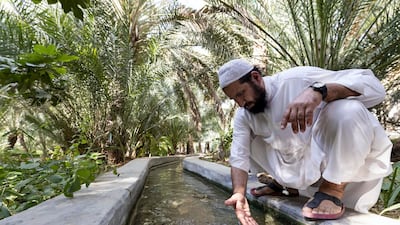
  • A farmer dips his hands into the aflaj at Al Ain Oasis. A aflaj is an ancient irrigation channel. Chris Whiteoak / The National
    A farmer dips his hands into the aflaj at Al Ain Oasis. A aflaj is an ancient irrigation channel. Chris Whiteoak / The National
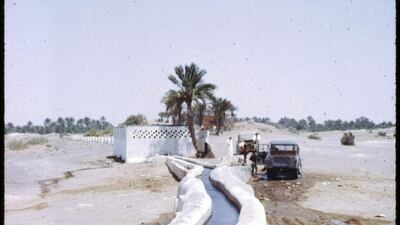
  • An aflaj in the Al Ain area taken at some point between 1962 and 1964. The development of the falaj system allowed settlements to expand. Courtesy David Riley
    An aflaj in the Al Ain area taken at some point between 1962 and 1964. The development of the falaj system allowed settlements to expand. Courtesy David Riley
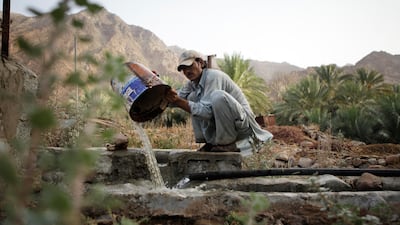
  • A worker pours water into an aflaj in the town of Nahwa. Galen Clarke / The National
    A worker pours water into an aflaj in the town of Nahwa. Galen Clarke / The National
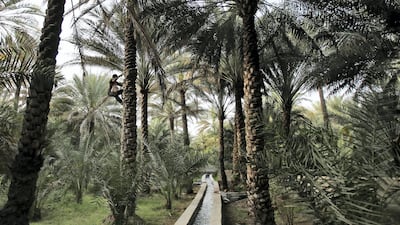
  • Shahid Iqbal, a date farm worker from Pakistan, climbs up a palm tree over a fresh water canal based on the aflaj at the Al Qattara Oasis in Al Ain. Kamran Jebreili / AP Photo
    Shahid Iqbal, a date farm worker from Pakistan, climbs up a palm tree over a fresh water canal based on the aflaj at the Al Qattara Oasis in Al Ain. Kamran Jebreili / AP Photo

Al aflaj, the traditional irrigation network system in the UAE, is on the representative list as of 2020, as are its oral traditions, knowledge and skills of construction, and maintenance and equitable water distribution.

The aflaj is a "source of pride for the associated communities", Unesco recognised, as its knowledge has been passed down over 3,000 years.

"Throughout the centuries, al aflaj have served to provide drinkable water for humans and animals, and to irrigate farms in an arid environment, demonstrating the community’s creativity in the face of water scarcity and the desert environment," Unesco says.

Camel racing

  • Katie Higgins is part of the first all-female camel racing team in the UAE. Chris Whiteoak / The National
    Katie Higgins is part of the first all-female camel racing team in the UAE. Chris Whiteoak / The National
  • Ms Higgins (second from left) and Linda Krockenberger (third from left) at the Arabian Desert Camel Riding Centre in Dubai. Chris Whiteoak / The National
    Ms Higgins (second from left) and Linda Krockenberger (third from left) at the Arabian Desert Camel Riding Centre in Dubai. Chris Whiteoak / The National
  • Ms Higgins competed in the first Female Camel Racing Series C1 Championship at Al Marmoom Camel Racing Track in October. Chris Whiteoak / The National
    Ms Higgins competed in the first Female Camel Racing Series C1 Championship at Al Marmoom Camel Racing Track in October. Chris Whiteoak / The National
  • The Irish art teacher says she used to be petrified of camels. Chris Whiteoak / The National
    The Irish art teacher says she used to be petrified of camels. Chris Whiteoak / The National
  • Ms Higgins says each camel has its own personality. Chris Whiteoak / The National
    Ms Higgins says each camel has its own personality. Chris Whiteoak / The National
  • Ms Higgins and Ms Krockenberger set up the UAE’s first camel racing team, made up solely of women, after a chance meeting on social media. Chris Whiteoak / The National
    Ms Higgins and Ms Krockenberger set up the UAE’s first camel racing team, made up solely of women, after a chance meeting on social media. Chris Whiteoak / The National
  • Ms Higgins and Ms Krockenberger with one of the racing camels. Chris Whiteoak / The National
    Ms Higgins and Ms Krockenberger with one of the racing camels. Chris Whiteoak / The National
  • While some of the team had horse riding experience, most are completely new to the sport. Chris Whiteoak / The National
    While some of the team had horse riding experience, most are completely new to the sport. Chris Whiteoak / The National
  • The team trains in the mornings and evenings and covers between eight and 12 kilometres in each session. Chris Whiteoak / The National
    The team trains in the mornings and evenings and covers between eight and 12 kilometres in each session. Chris Whiteoak / The National
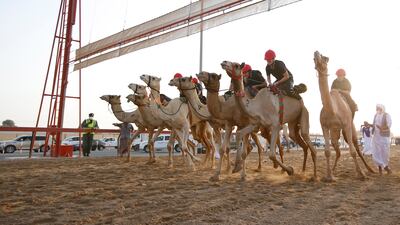
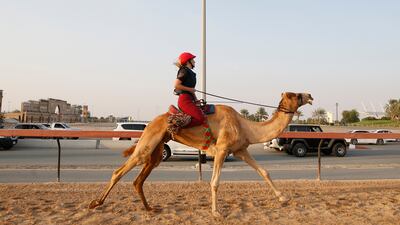
  • Female participants compete during the first Female Camel Racing Series C1 Championship at Al Marmoom Camel Racing Track in Dubai. EPA
    Female participants compete during the first Female Camel Racing Series C1 Championship at Al Marmoom Camel Racing Track in Dubai. EPA
  • Eight female participants took part in the race. EPA
    Eight female participants took part in the race. EPA
  • The all-female camel racing team. EPA
    The all-female camel racing team. EPA
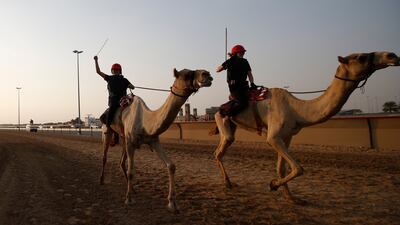
  • Travelling at speeds of up to 45kmph, riders hold on to a small handle for support and use a stick to help direct the camel. EPA
    Travelling at speeds of up to 45kmph, riders hold on to a small handle for support and use a stick to help direct the camel. EPA

Camel racing was recognised for the UAE and Oman in 2020 on the Representative List of the Intangible Cultural Heritage of Humanity.

The sport remains popular today but has been around for centuries. Scholars believe it dates as far back as the 7th century.

"Camel racing is a fundamental part of their nomadic lifestyle and a source of inspiration in poetry and singing," Unesco says on its website.

"Its importance and continuity in Bedouin society is connected to the prominent role camels play in the desert environment."

Date palm

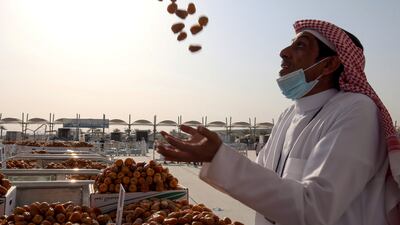
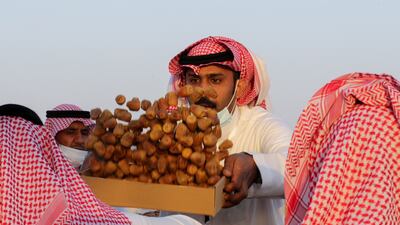
  • A Saudi farmer displays his dates during the Unaizah Season for Dates at Unaizah city in Al Qassim, Saudi Arabia.
    A Saudi farmer displays his dates during the Unaizah Season for Dates at Unaizah city in Al Qassim, Saudi Arabia.
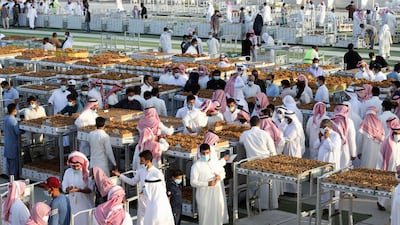
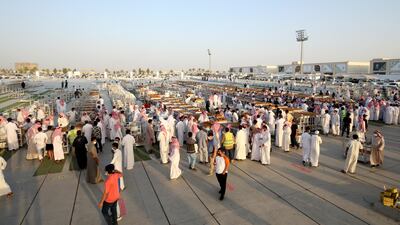
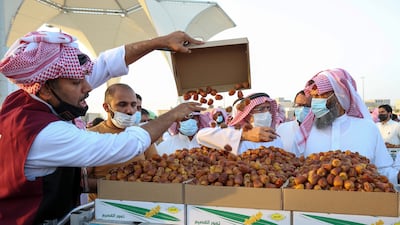
  • Traders flock to buy dates from a market in Unaizah, Saudi Arabia.
    Traders flock to buy dates from a market in Unaizah, Saudi Arabia.
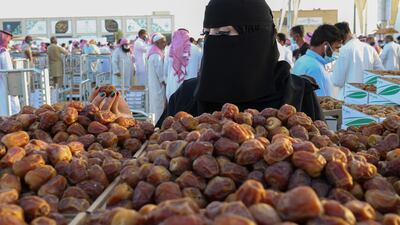
  • A Saudi woman peruses the vast selection of dates on display in Unaizah, Saudi Arabia, during the Unaizah Season for Dates.
    A Saudi woman peruses the vast selection of dates on display in Unaizah, Saudi Arabia, during the Unaizah Season for Dates.
  • Traders flock to buy dates from Saudi farmers during the Unaizah Season for Dates in Saudi Arabia.
    Traders flock to buy dates from Saudi farmers during the Unaizah Season for Dates in Saudi Arabia.
  • A Saudi farmer displays dates to customers.
    A Saudi farmer displays dates to customers.
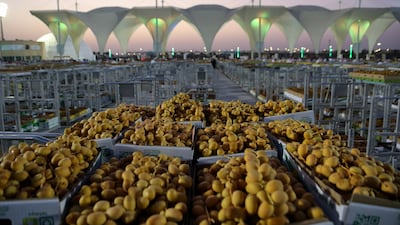
  • Thousands of dates have been picked, ready for customers to enjoy.
    Thousands of dates have been picked, ready for customers to enjoy.
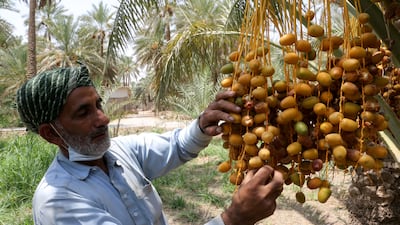
  • A worker collects dates from a palm tree in Saudi Arabia's Al Qassim province.
    A worker collects dates from a palm tree in Saudi Arabia's Al Qassim province.
  • Fresh dates can be found for sale every day during the Unaizah Season for Dates, in Unaizah, Saudi Arabia.
    Fresh dates can be found for sale every day during the Unaizah Season for Dates, in Unaizah, Saudi Arabia.

Fourteen countries, including the UAE, nominated the date palm for inscription and were successful in 2019.

"The date palm has been connected to the regional population of the submitting states for centuries, serving both as the source of numerous associated crafts, professions and social and cultural traditions, customs and practices, and as a key form of nutrition," Unesco says.

It recognised the crucial role the evergreen plant has played in strengthening the people and land in the Arab region, helping to face challenges brought about by the desert environment.

"The cultural relevance and proliferation of the element over the centuries prove how committed the local communities are to sustaining it."

Al azi

A group perform al azi during the official ceremony celebrating the UAE 50th National Day at Expo 2020 Dubai. AP

Al azi is a traditional poetry recital performed by a group of people without rhythmical or musical instruments and it was inscribed on to the list in 2017 of cultural heritage in need of urgent protection.

While al azi was performed frequently among communities until the mid 1900s, performances began to decrease gradually over the years, as citizens moved from rural to urban areas and sought employment in sectors not associated with culture and arts.

"The number of poets has decreased greatly over the past 20 years," says Unesco. "Despite these challenges, al azi has withstood extinction thanks to the efforts of a number of creative people and traditional art troupes."

Al razfa

Al razfa performance as part of the celebrations of UAE's 44th National Day in 2015 at Heritage Village. Reem Mohammed / The National

After a submission again from Oman and the UAE, Al Razfa was added to the Representative List of the Intangible Cultural Heritage of Humanity in 2015.

It is a traditional artform performed by men during special occasions, from weddings to national festivals. Performers form two lines facing each other, as dancers fill the space between.

A main singer leads, while the two rows create a dual chorus and sing chants, such as verses of nabati poetry, accompanied by drums and other instruments. Dancers move to the music while holding swords and wooden replica rifles.

"Practitioners have adapted musical instruments and composed melodies to interest younger audiences while maintaining the older expressions and oral traditions of the art," says Unesco.

Arabian coffee

There are various rituals involved when serving Arabian coffee. EPA

The UAE, Saudi Arabia, Oman and Qatar led the nomination for Arabian coffee, which was added to the representative list in 2015.

The serving of Arabian coffee is a vital part of hospitality in the region and "considered a ceremonial act of generosity", says the Unesco inscription.

There are various traditional rituals associated with making and serving it. For example, it is prepared in front of guests and the most important or oldest drinker will be served first.

A quarter of the small cup will be filled, but then refilled when they ask for more. It is customary for guests to drink at least one, but not more than three.

"Arabic coffee is made and enjoyed by men and women from all segments of society, particularly in the home.

"The sheikhs and heads of tribes who serve Arabic coffee in their meeting spaces, elderly Bedouin men and women and owners of coffee trading shops are considered the main bearers.

"Knowledge and traditions are passed on within the family through observation and practice."

Majlis

Arabian coffee is often served in the majlis. Chris Whiteoak / The National

The majlis, a cultural and social space prevalent throughout the region, was also added in 2015 on behalf, again, of the UAE, Saudi Arabia, Oman and Qatar.

It is a sitting area, usually filled with floor cushions in a vast space, where members of the community gather to talk about news, issues and to generally socialise.

"The majlis is where the community gathers to resolve problems, pay condolences and hold wedding receptions," the Unesco description says.

It's here that knowledge is passed on through generations.

"As majlis spaces are open to all age groups, knowledge is mostly transmitted informally as children accompany community members on their visits," Unesco says.

"Through observing elders in the majlis, young people learn the manners and ethics of their community, dialogue and listening skills, and respect for the opinion of others."

Al ayyala

Young Emirati girls often wave their hair during al ayyala traditional dances, keeping time with a steady drum rhythm. Photographed at the Qasr Al Hosn festival. Khushnum Bhandari / The National

Al ayyala, a cultural performance practised in north-western Oman and throughout the UAE, was added in 2014.

It involves chanting poetry, percussion and dance, and a simulated battle scene.

Two rows of 20 men face each other, carrying bamboo sticks, and they move their heads and props to the rhythm, while other performers move around holding other weapons.

It usually takes place at weddings and special occasions.

"Performers come from diverse backgrounds and age groups. The lead performer is usually an inherited role and is responsible for training others performers.

"Al ayyala is inclusive of all ages, genders and social classes."

Al taghrooda

A man performs al taghrooda at the Qasr Al Hosn Festival in Abu Dhabi. Delores Johnson / The National

This was another joint effort between the UAE and Oman, and al taghrooda, traditional Bedouin chanted poetry, was added in 2012.

This poetry is composed and recited by men travelling on camels through the deserts.

"Bedouins believe that chanting entertains the riders and stimulates animals to walk in time," Unesco says.

They are short poems, about seven lines or less, and the lead singer will chant the first verse while a second group responds. They can also be chanted around campfires and at special occasions, and often camel races.

"The most important aspect is the social bonding during the oral exchange of verses," says Unesco.

"Themes include sending messages to loved ones, relatives, friends or tribal chiefs. It is also a medium for the poet to pass comment on social issues."

Al sadu

Nadia Al Shamsi, 60, weaves sadu, a form of embroidery in geometrical shapes using handwoven wool that is traditionally used to make Bedouin tents, carpets, pillows and cushions, at the Women's Handicraft Centre in Abu Dhabi. Khushnum Bhandari / The National

Sadu, a traditional weaving technique, is on the list twice, one for the UAE and another for Saudi Arabia and Kuwait.

It marks the UAE's first appearance on the list, as it was added in 2011.

It is a traditional art form practised by Bedouin women in rural communities, creating soft furnishings and decorative accessories and using wool from sheep, camels and goats.

The traditional colours are black, white, brown, beige and red, with distinctive patterns appearing throughout the designs, including bands and geometric markings.

"Weavers often gather in small groups to spin and weave, exchanging family news and occasionally chanting and reciting poetry," Unesco says.

"Such gatherings are the traditional means of transmission: girls learn by watching and are gradually given tasks to do, such as sorting the wool, before learning the more intricate skills involved."

The practice has declined over the years, but is still prevalent among older women.

The Kites

Romain Gary

Penguin Modern Classics

Company%20profile
%3Cp%3E%3Cstrong%3EName%3A%3C%2Fstrong%3E%20JustClean%3Cbr%3E%3Cbr%3E%3Cstrong%3EBased%3A%20%3C%2Fstrong%3EDubai%20with%20offices%20in%20other%20GCC%20countries%3Cbr%3E%3Cbr%3E%3Cstrong%3ELaunch%20year%3A%3C%2Fstrong%3E%202016%3Cbr%3E%3Cbr%3E%3Cstrong%3ENumber%20of%20employees%3A%3C%2Fstrong%3E%20160%2B%20with%2021%20nationalities%20in%20eight%20cities%3Cbr%3E%3Cstrong%3E%3Cbr%3ESector%3A%3C%2Fstrong%3E%20online%20laundry%20and%20cleaning%20services%3Cbr%3E%3Cbr%3E%3Cstrong%3EFunding%3A%20%3C%2Fstrong%3E%2430m%20from%20Kuwait-based%20Faith%20Capital%20Holding%20and%20Gulf%20Investment%20Corporation%3C%2Fp%3E%0A
Cryopreservation: A timeline
  1. Keyhole surgery under general anaesthetic
  2. Ovarian tissue surgically removed
  3. Tissue processed in a high-tech facility
  4. Tissue re-implanted at a time of the patient’s choosing
  5. Full hormone production regained within 4-6 months
Company Profile

Name: Thndr
Started: 2019
Co-founders: Ahmad Hammouda and Seif Amr
Sector: FinTech
Headquarters: Egypt
UAE base: Hub71, Abu Dhabi
Current number of staff: More than 150
Funds raised: $22 million

Avatar: Fire and Ash

Director: James Cameron

Starring: Sam Worthington, Sigourney Weaver, Zoe Saldana

Rating: 4.5/5

WHAT IS A BLACK HOLE?

1. Black holes are objects whose gravity is so strong not even light can escape their pull

2. They can be created when massive stars collapse under their own weight

3. Large black holes can also be formed when smaller ones collide and merge

4. The biggest black holes lurk at the centre of many galaxies, including our own

5. Astronomers believe that when the universe was very young, black holes affected how galaxies formed

Emirates Cricket Board Women’s T10

ECB Hawks v ECB Falcons

Monday, April 6, 7.30pm, Sharjah Cricket Stadium

The match will be broadcast live on the My Sports Eye Facebook page


Hawks

Coach: Chaitrali Kalgutkar

Squad: Chaya Mughal (captain), Archara Supriya, Chamani Senevirathne, Chathurika Anand, Geethika Jyothis, Indhuja Nandakumar, Kashish Loungani, Khushi Sharma, Khushi Tanwar, Rinitha Rajith, Siddhi Pagarani, Siya Gokhale, Subha Srinivasan, Suraksha Kotte, Theertha Satish


Falcons

Coach: Najeeb Amar

Squad: Kavisha Kumari (captain), Almaseera Jahangir, Annika Shivpuri, Archisha Mukherjee, Judit Cleetus, Ishani Senavirathne, Lavanya Keny, Mahika Gaur, Malavika Unnithan, Rishitha Rajith, Rithika Rajith, Samaira Dharnidharka, Shashini Kaluarachchi, Udeni Kuruppuarachchi, Vaishnave Mahesh


RESULTS

6pm: Al Maktoum Challenge Round-2 – Group 1 (PA) $55,000 (Dirt) 1,900m
Winner: Rajeh, Antonio Fresu (jockey), Musabah Al Muhairi (trainer)

6.35pm: Oud Metha Stakes – Rated Conditions (TB) $60,000 (D) 1,200m
Winner: Get Back Goldie, William Buick, Doug O’Neill

7.10pm: Jumeirah Classic – Listed (TB) $150,000 (Turf) 1,600m
Winner: Sovereign Prince, James Doyle, Charlie Appleby

7.45pm: Firebreak Stakes – Group 3 (TB) $150,000 (D) 1,600m
Winner: Hypothetical, Mickael Barzalona, Salem bin Ghadayer

8.20pm: Al Maktoum Challenge Round-2 – Group 2 (TB) $350,000 (D) 1,900m
Winner: Hot Rod Charlie, William Buick, Doug O’Neill

8.55pm: Al Bastakiya Trial – Conditions (TB) $60,000 (D) 1,900m
Winner: Withering, Adrie de Vries, Fawzi Nass

9.30pm: Balanchine – Group 2 (TB) $180,000 (T) 1,800m
Winner: Creative Flair, William Buick, Charlie Appleby

Mercer, the investment consulting arm of US services company Marsh & McLennan, expects its wealth division to at least double its assets under management (AUM) in the Middle East as wealth in the region continues to grow despite economic headwinds, a company official said.

Mercer Wealth, which globally has $160 billion in AUM, plans to boost its AUM in the region to $2-$3bn in the next 2-3 years from the present $1bn, said Yasir AbuShaban, a Dubai-based principal with Mercer Wealth.

Within the next two to three years, we are looking at reaching $2 to $3 billion as a conservative estimate and we do see an opportunity to do so,” said Mr AbuShaban.

Mercer does not directly make investments, but allocates clients’ money they have discretion to, to professional asset managers. They also provide advice to clients.

“We have buying power. We can negotiate on their (client’s) behalf with asset managers to provide them lower fees than they otherwise would have to get on their own,” he added.

Mercer Wealth’s clients include sovereign wealth funds, family offices, and insurance companies among others.

From its office in Dubai, Mercer also looks after Africa, India and Turkey, where they also see opportunity for growth.

Wealth creation in Middle East and Africa (MEA) grew 8.5 per cent to $8.1 trillion last year from $7.5tn in 2015, higher than last year’s global average of 6 per cent and the second-highest growth in a region after Asia-Pacific which grew 9.9 per cent, according to consultancy Boston Consulting Group (BCG). In the region, where wealth grew just 1.9 per cent in 2015 compared with 2014, a pickup in oil prices has helped in wealth generation.

BCG is forecasting MEA wealth will rise to $12tn by 2021, growing at an annual average of 8 per cent.

Drivers of wealth generation in the region will be split evenly between new wealth creation and growth of performance of existing assets, according to BCG.

Another general trend in the region is clients’ looking for a comprehensive approach to investing, according to Mr AbuShaban.

“Institutional investors or some of the families are seeing a slowdown in the available capital they have to invest and in that sense they are looking at optimizing the way they manage their portfolios and making sure they are not investing haphazardly and different parts of their investment are working together,” said Mr AbuShaban.

Some clients also have a higher appetite for risk, given the low interest-rate environment that does not provide enough yield for some institutional investors. These clients are keen to invest in illiquid assets, such as private equity and infrastructure.

“What we have seen is a desire for higher returns in what has been a low-return environment specifically in various fixed income or bonds,” he said.

“In this environment, we have seen a de facto increase in the risk that clients are taking in things like illiquid investments, private equity investments, infrastructure and private debt, those kind of investments were higher illiquidity results in incrementally higher returns.”

The Abu Dhabi Investment Authority, one of the largest sovereign wealth funds, said in its 2016 report that has gradually increased its exposure in direct private equity and private credit transactions, mainly in Asian markets and especially in China and India. The authority’s private equity department focused on structured equities owing to “their defensive characteristics.”

Classification of skills

A worker is categorised as skilled by the MOHRE based on nine levels given in the International Standard Classification of Occupations (ISCO) issued by the International Labour Organisation. 

A skilled worker would be someone at a professional level (levels 1 – 5) which includes managers, professionals, technicians and associate professionals, clerical support workers, and service and sales workers.

The worker must also have an attested educational certificate higher than secondary or an equivalent certification, and earn a monthly salary of at least Dh4,000. 

Updated: April 18, 2022, 9:50 AM