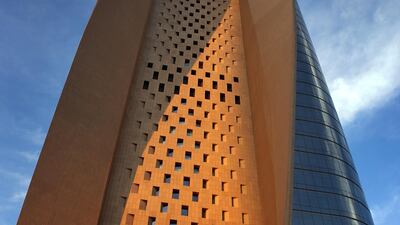
The top spire of Merdeka 118, the second-tallest building in the world, has been completed. Getty Images

Merdeka 118: world's second-tallest building rises to 678.9 metres in Malaysia


  • English
  • Arabic

The world's second-tallest skyscraper has reached its final height, only 150 metres short of the current record holder for the tallest building, Dubai's Burj Khalifa.

The pointed spire atop the Merdeka 118 in Downtown Kuala Lumpur has been completed, making it the second-tallest building in the world at 678.9 metres, and stealing the title from China's Shanghai Tower, which stands 632 metres tall. Burj Khalifa, which opened in January 2010, still towers above all at 828 metres.

Designed by Australian firm Fender Katsalidis, Merdeka 118 is scheduled to be completed in late 2022. Built on the historically significant Merdeka site, where Malaysia's independence was declared in 1957, the building’s 118 storeys will house offices and a hotel, topped by a dual-level observation deck and a restaurant, which is expected to be the highest in South-East Asia.

The building’s exterior design is modelled on triangular shapes found in traditional Malaysian arts and crafts, Fender Katsalidis says on its website, while elements of the theme are also used in the interiors.

"Seemingly cleft from solid stone, it comprises a lower lobby for hotel access at one end, and at the opposite end, an upper lobby for the offices and retail," the description reads.

At 678.9 metres, Merdeka 118 is only 150 metres shorter than the Burj Khalifa. EPA

Initially scheduled to be completed last year, the construction of Merdeka 118, which began in 2015, was delayed by more than six months in 2019 owing to the Covid-19 pandemic. The project has a budget of 5 billion Malaysian ringgits ($1.1 billion).

"We feel incredibly proud to have contributed to the creation of this building and its host of community assets which enrich one of the most culturally significant sites in Malaysia," Fender Katsalidis, co-founder Karl Fender, told architecture and design magazine Dezeen.

"This building and its surrounding precinct has added an aspirational sense of new place to the city's identity, and has at the same time enabled much-needed major improvement to the pedestrian and traffic infrastructure of the area."

The 128-storey Shanghai Tower houses the J Hotel Shanghai Tower, which opened in July and is now the world's highest hotel. While the Burj Khalifa also has the Armani Hotel Dubai, it occupies floors one to eight of the world’s tallest tower, as well as floors 38 and 39.

Scroll through the gallery below for pictures of the tallest buildings in the Middle East:

  • ALMAS TOWER, DUBAI, 360 metres: Part of Jumeirah Lakes Towers, Almas tower was briefly the tallest in Dubai when it was topped out in 2008. It is the headquarters of Dubai Multi Commodities Centre, with high security vaults and safe deposits to protect clients' assets. Gabriela Maj / Bloomberg
    ALMAS TOWER, DUBAI, 360 metres: Part of Jumeirah Lakes Towers, Almas tower was briefly the tallest in Dubai when it was topped out in 2008. It is the headquarters of Dubai Multi Commodities Centre, with high security vaults and safe deposits to protect clients' assets. Gabriela Maj / Bloomberg
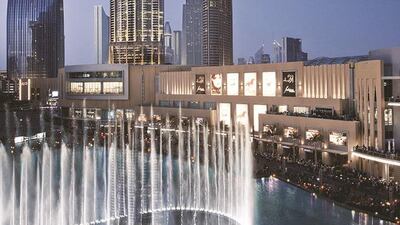
  • ADDRESS BOULEVARD, DUBAI, 370 metres: Opened in March 2017, Address Boulevard boasts sells itself as a "city lifestyle resort". Residents and guests do not need to step onto the balmy streets to access Dubai Mall, which is it connected to with an air conditioned bridge. Not to be confused with the 300 metre tall Address Downtown, which was built in a similar modernist Art Deco style and opened in 2008. Courtesy: Emaar Hospitality
    ADDRESS BOULEVARD, DUBAI, 370 metres: Opened in March 2017, Address Boulevard boasts sells itself as a "city lifestyle resort". Residents and guests do not need to step onto the balmy streets to access Dubai Mall, which is it connected to with an air conditioned bridge. Not to be confused with the 300 metre tall Address Downtown, which was built in a similar modernist Art Deco style and opened in 2008. Courtesy: Emaar Hospitality
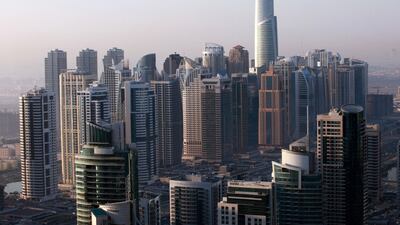
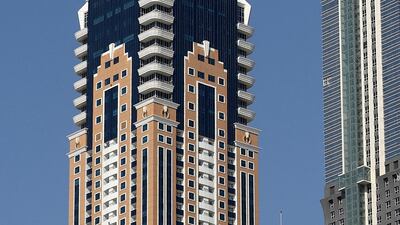
  • ELITE RESIDENCE, DUBAI, 380 metres: Opened in 2012, at an estimated cost of Dh1bn, the 91 floors have nearly 700 flats with views over Palm Jumeirah. It boasts a distinctive design and is recognisable on the marina skyline. Chris Whiteoak / The National
    ELITE RESIDENCE, DUBAI, 380 metres: Opened in 2012, at an estimated cost of Dh1bn, the 91 floors have nearly 700 flats with views over Palm Jumeirah. It boasts a distinctive design and is recognisable on the marina skyline. Chris Whiteoak / The National
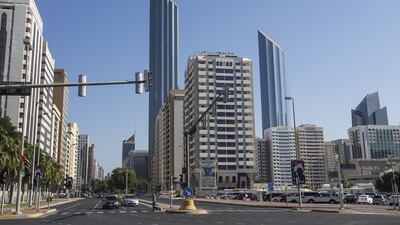
  • BURJ MOHAMMED BIN RASHID, ABU DHABI, 381 metres: Abu Dhabi makes it into the top 10, with a building named in honour of the Ruler of Dubai. Completed in 2013, the capital’s tallest building is part of the World Trade Centre which includes a mall and souq. Mona Al Marzooqi/ The National
    BURJ MOHAMMED BIN RASHID, ABU DHABI, 381 metres: Abu Dhabi makes it into the top 10, with a building named in honour of the Ruler of Dubai. Completed in 2013, the capital’s tallest building is part of the World Trade Centre which includes a mall and souq. Mona Al Marzooqi/ The National
  • 23 MARINA, DUBAI, 392 metres: Briefly the world’s tallest residential tower, 23 Marina opened in 2012. It includes 57 swimming and plunge pools, with 62 high speed lifts, including one for each of the 23 four bedroom duplexes, and boasts views over Media City's lake and amphitheatre. Chris Whiteoak / The National
    23 MARINA, DUBAI, 392 metres: Briefly the world’s tallest residential tower, 23 Marina opened in 2012. It includes 57 swimming and plunge pools, with 62 high speed lifts, including one for each of the 23 four bedroom duplexes, and boasts views over Media City's lake and amphitheatre. Chris Whiteoak / The National
  • AL HAMRA TOWER, KUWAIT CITY, 412 metres: Kuwait’s tallest building is marked by its curved sculpted concrete exterior, which is also the world’s tallest of its type. It was completed in 2011 with offices, a shopping mall and a rooftop restaurant. AFP
    AL HAMRA TOWER, KUWAIT CITY, 412 metres: Kuwait’s tallest building is marked by its curved sculpted concrete exterior, which is also the world’s tallest of its type. It was completed in 2011 with offices, a shopping mall and a rooftop restaurant. AFP
  • PRINCESS TOWER, DUBAI, 413 metres: The tallest residential building in the world until it was overtaken by 432 Park Avenue in Manhattan five years ago, Princess Tower was opened in 2012 with 763 residential units. There are 107 storeys, including six underground, with an observation deck on the 97th floor. Chris Whiteoak / The National
    PRINCESS TOWER, DUBAI, 413 metres: The tallest residential building in the world until it was overtaken by 432 Park Avenue in Manhattan five years ago, Princess Tower was opened in 2012 with 763 residential units. There are 107 storeys, including six underground, with an observation deck on the 97th floor. Chris Whiteoak / The National
  • MARINA 101, DUBAI, 425 metres: The second tallest building in Dubai is also the 27th tallest in the world. Construction began in 2006 and, although it was completed in 2017, the building remains unfinished and unoccupied due to financing issues. Chris Whiteoak / The National
    MARINA 101, DUBAI, 425 metres: The second tallest building in Dubai is also the 27th tallest in the world. Construction began in 2006 and, although it was completed in 2017, the building remains unfinished and unoccupied due to financing issues. Chris Whiteoak / The National
  • MAKKAH ROYAL CLOCK TOWER, MAKKAH, 601 metres: Part of the Abraj Al Bayt complex, the tower over looks the Great Mosque of Makkah and the Kaaba and was completed in 2012. It includes the highest and tallest clock faces in the world – the minute hands alone are 23 metres long. AFP
    MAKKAH ROYAL CLOCK TOWER, MAKKAH, 601 metres: Part of the Abraj Al Bayt complex, the tower over looks the Great Mosque of Makkah and the Kaaba and was completed in 2012. It includes the highest and tallest clock faces in the world – the minute hands alone are 23 metres long. AFP
  • BURJ KHALIFA, DUBAI, 828 metres: The tallest building in the world when it was completed in 2010, Burj Khalifa actually took the title a year earlier when it surpassed Taiwan’s Taipei 101. It boasts several world records, including the building with the most floors (163), the world’s longest elevators at 504m, and the world's highest restaurant. It is so tall the sun sets three minutes later on the observation deck than on the ground. Tarek Fahmy / Reuters
    BURJ KHALIFA, DUBAI, 828 metres: The tallest building in the world when it was completed in 2010, Burj Khalifa actually took the title a year earlier when it surpassed Taiwan’s Taipei 101. It boasts several world records, including the building with the most floors (163), the world’s longest elevators at 504m, and the world's highest restaurant. It is so tall the sun sets three minutes later on the observation deck than on the ground. Tarek Fahmy / Reuters
The more serious side of specialty coffee

While the taste of beans and freshness of roast is paramount to the specialty coffee scene, so is sustainability and workers’ rights.

The bulk of genuine specialty coffee companies aim to improve on these elements in every stage of production via direct relationships with farmers. For instance, Mokha 1450 on Al Wasl Road strives to work predominantly with women-owned and -operated coffee organisations, including female farmers in the Sabree mountains of Yemen.

Because, as the boutique’s owner, Garfield Kerr, points out: “women represent over 90 per cent of the coffee value chain, but are woefully underrepresented in less than 10 per cent of ownership and management throughout the global coffee industry.”

One of the UAE’s largest suppliers of green (meaning not-yet-roasted) beans, Raw Coffee, is a founding member of the Partnership of Gender Equity, which aims to empower female coffee farmers and harvesters.

Also, globally, many companies have found the perfect way to recycle old coffee grounds: they create the perfect fertile soil in which to grow mushrooms. 

Mercer, the investment consulting arm of US services company Marsh & McLennan, expects its wealth division to at least double its assets under management (AUM) in the Middle East as wealth in the region continues to grow despite economic headwinds, a company official said.

Mercer Wealth, which globally has $160 billion in AUM, plans to boost its AUM in the region to $2-$3bn in the next 2-3 years from the present $1bn, said Yasir AbuShaban, a Dubai-based principal with Mercer Wealth.

Within the next two to three years, we are looking at reaching $2 to $3 billion as a conservative estimate and we do see an opportunity to do so,” said Mr AbuShaban.

Mercer does not directly make investments, but allocates clients’ money they have discretion to, to professional asset managers. They also provide advice to clients.

“We have buying power. We can negotiate on their (client’s) behalf with asset managers to provide them lower fees than they otherwise would have to get on their own,” he added.

Mercer Wealth’s clients include sovereign wealth funds, family offices, and insurance companies among others.

From its office in Dubai, Mercer also looks after Africa, India and Turkey, where they also see opportunity for growth.

Wealth creation in Middle East and Africa (MEA) grew 8.5 per cent to $8.1 trillion last year from $7.5tn in 2015, higher than last year’s global average of 6 per cent and the second-highest growth in a region after Asia-Pacific which grew 9.9 per cent, according to consultancy Boston Consulting Group (BCG). In the region, where wealth grew just 1.9 per cent in 2015 compared with 2014, a pickup in oil prices has helped in wealth generation.

BCG is forecasting MEA wealth will rise to $12tn by 2021, growing at an annual average of 8 per cent.

Drivers of wealth generation in the region will be split evenly between new wealth creation and growth of performance of existing assets, according to BCG.

Another general trend in the region is clients’ looking for a comprehensive approach to investing, according to Mr AbuShaban.

“Institutional investors or some of the families are seeing a slowdown in the available capital they have to invest and in that sense they are looking at optimizing the way they manage their portfolios and making sure they are not investing haphazardly and different parts of their investment are working together,” said Mr AbuShaban.

Some clients also have a higher appetite for risk, given the low interest-rate environment that does not provide enough yield for some institutional investors. These clients are keen to invest in illiquid assets, such as private equity and infrastructure.

“What we have seen is a desire for higher returns in what has been a low-return environment specifically in various fixed income or bonds,” he said.

“In this environment, we have seen a de facto increase in the risk that clients are taking in things like illiquid investments, private equity investments, infrastructure and private debt, those kind of investments were higher illiquidity results in incrementally higher returns.”

The Abu Dhabi Investment Authority, one of the largest sovereign wealth funds, said in its 2016 report that has gradually increased its exposure in direct private equity and private credit transactions, mainly in Asian markets and especially in China and India. The authority’s private equity department focused on structured equities owing to “their defensive characteristics.”


Key findings
  • Over a period of seven years, a team of scientists analysed dietary data from 50,000 North American adults.
  • Eating one or two meals a day was associated with a relative decrease in BMI, compared with three meals. Snacks count as a meal. Likewise, participants who ate more than three meals a day experienced an increase in BMI: the more meals a day, the greater the increase. 
  • People who ate breakfast experienced a relative decrease in their BMI compared with “breakfast-skippers”. 
  • Those who turned the eating day on its head to make breakfast the biggest meal of the day, did even better. 
  • But scrapping dinner altogether gave the best results. The study found that the BMI of subjects who had a long overnight fast (of 18 hours or more) decreased when compared even with those who had a medium overnight fast, of between 12 and 17 hours.
Updated: December 14, 2021, 7:56 AM