


Live updates: Follow the latest news on Israel-Gaza
Russia and China on Friday voted against a US-drafted Security Council resolution calling for an immediate ceasefire in Gaza as part of a hostage deal.
The draft resolution received 11 votes in favour, one abstention – from Guyana, and three votes against, including veto-wielding Russia, China and Algeria.
The carefully-worded US draft had highlighted the “imperative of an immediate and sustained ceasefire to protect civilians on all sides”, and towards that end “unequivocally” supported continuing diplomatic efforts “to secure such a ceasefire in connection with the release of all remaining hostages”.
Friday’s vote marked the ninth time the Security Council has voted on a draft resolution on the Gaza war.
Only two resolutions were previously adopted, with neither calling for a ceasefire.
Vasily Nebenzya, Russia’s UN envoy, described Friday's resolution as “exceedingly politicised" and argued that it was only aimed at buying more time for Israel to invade Rafah.
Before the vote, the US ambassador to the UN, Linda Thomas-Greenfield, said it would be a “historic mistake” for the council not to adopt the text.
“This is a strong resolution. it's the by-product of exhaustive, inclusive negotiations,” she said. “It reflects the consensus of this council and it does more than just call for a ceasefire – it helps to make the make a ceasefire possible.”
Algeria's UN ambassador, Amar Bendjama, said the draft resolution fell short of expectations of the Arab group, which has consistently called for an end “to this carnage”.
“It fails to adequately address … the demands and suffering of the Palestinian people,” he said.
“Over five months, the conflict in Gaza has resulted in the tragic loss ... of more than 32,000 Palestinian lives.”
“These are not mere statistics. They represent lives. They represent dreams. They represent hopes, which have been destroyed alarmingly, " said Mr Bendjama.
China's UN ambassador, Zhang Jun, told council members the US draft was “very unbalanced”, particularly on Israel's recent and repeated declarations of plans for a military offensive on Rafah, a city on the southern tip of the Gaza Strip where more than half of its 2.3 million residents have been sheltering in makeshift tents following Israel's assault on the northern part of the enclave.
He noted the draft did not “clearly and equivocally state its opposition [to a Rafah ground assault], which would send the wrong signal and lead to severe consequences”.
Mr Zhang said the draft “dodged the most central issue, that of a ceasefire” through its “ambiguous” language.
“Nor does it even provide an answer to the question of realising a ceasefire in the short term,” the envoy added.
Israel's ambassador Gilad Erdan reiterated his government's position by stating that the "only way to achieve a permanent ceasefire [in Gaza] passes through Rafah."
Meanwhile, Prime Minister Benjamin Netanyahu vowed on Friday to go ahead with the ground assault on Rafah, even without the support of its key ally.
Guyana, the only council member to have abstained, said the US text "lacked attribution in a number of key areas".
"While the draft includes the condemnation of Hamas for the October 7 attacks and demands they immediately grant humanitarian access to the hostages, and rightfully so, there is no attribution or demands to the Israeli authorities for what is taking place in Gaza," stressed its UN envoy, Carolyn Rodrigues-Birkett.
In reaction to the veto by Russia and China, US National Security Council spokesman John Kirby said "It's difficult to look at that text and find what was objectionable except the fact that the United States is the one that authored it."
The vote took place as US Secretary Antony Blinken wrapped up a sixth urgent mission to the Middle East since the Israel-Hamas war started, discussing a deal for a ceasefire and hostage release, as well as postwar scenarios.
Washington has vetoed three draft UN resolutions, which called directly for an immediate humanitarian ceasefire, most recently the Algerian text on February 20, which was supported by 13 council members with one abstention.
Ms Thomas-Greenfield argued it would have “negatively impact[ed]” the indirect negotiations between Israel and Hamas mediated by Egypt, Qatar and the US.
Following the Russian and Chinese veto, President Emmanuel Macron said on Friday that France has been working on a Gaza ceasefire resolution with Jordan, the United Arab Emirates and several other European countries.
"The Security Council must call for an immediate ceasefire and humanitarian access," Mr Macron told reporters in Brussels, promising to resume work on an alternative French resolution "along with our US, European and Arab partners".
Mr Macron expressed optimism that its diplomatic efforts in the region might convince China and Russia to refrain from exercising their veto power.
He also believed that with the support from Washington, Paris was well-placed to build consensus.
Ramadan in Gaza – in pictures
-
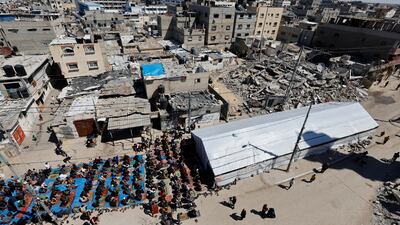
Palestinians perform the first Friday prayers of Ramadan near the ruins of a mosque in Rafah, southern Gaza. Reuters -
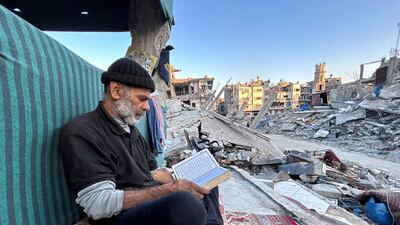
A Palestinian man reads the Quran as he waits to break his fast in Beit Lahia, northern Gaza. Reuters -
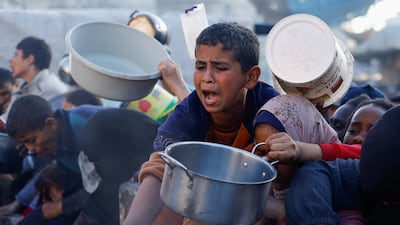
Children wait to receive food in Rafah. The UN has warned that many in Gaza are facing famine. Reuters -

Palestinians break their fast amid the rubble of their destroyed home in Rafah. Reuters -

Displaced Palestinians in Rafah decorate their homes with sheets to mark the holy month. AFP -
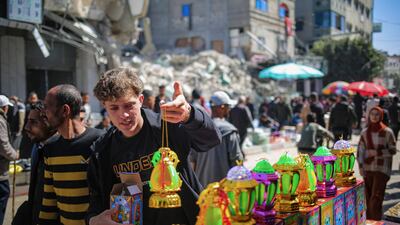
Palestinians shop for Ramadan lanterns in Rafah. AFP -
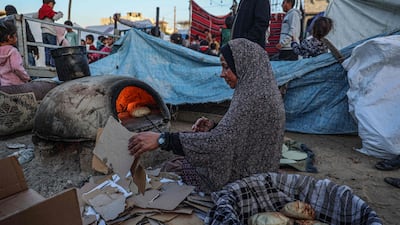
A displaced Palestinian woman bakes bread for iftar in Rafah. AFP -
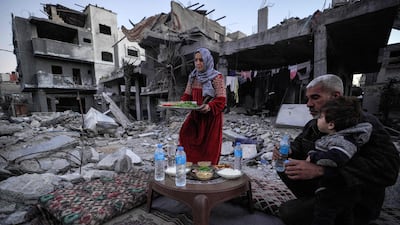
A family break fast amid the ruins of their home in Deir al-Balah, the central Gaza Strip. AFP -
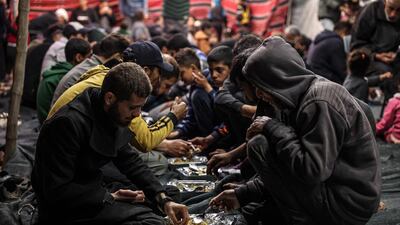
Palestinians share an iftar meal at a camp in Rafah, the southern Gaza Strip. AFP -
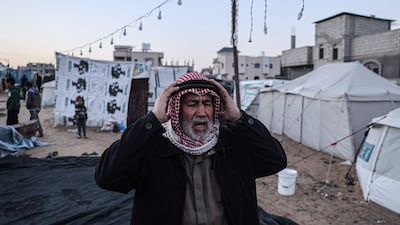
A displaced Palestinian man prays in Rafah, the southern Gaza Strip. AFP -
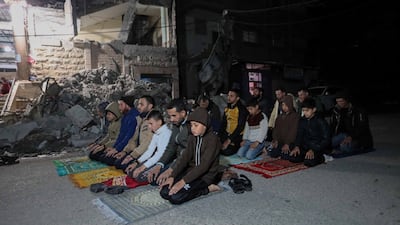
Palestinians pray taraweeh on the rubble of Rafah's Al Huda Mosque, which was destroyed in Israeli air strikes. Getty Images -

Palestinians walk past kiosks set up next to destroyed buildings in Al Nusairat refugee camp, the Gaza Strip EPA -
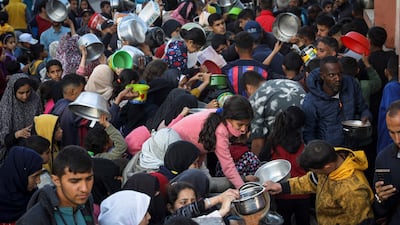
Palestinians collect food before the first iftar of Ramadan in Rafah. AFP -
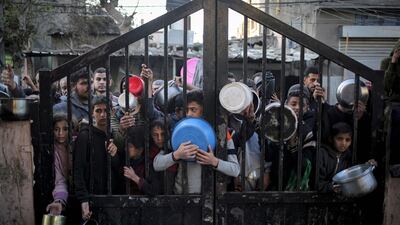
Palestinians gather to collect food in Rafah, the southern Gaza Strip. AFP -
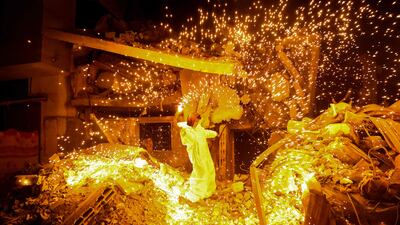
A Palestinian child plays with a sparkler in Rafah, in southern Gaza, on the eve of Ramadan. AFP -
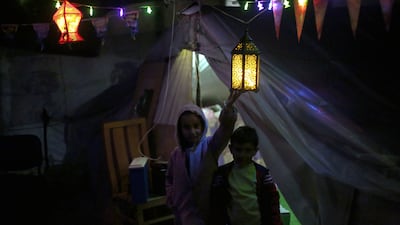
Displaced Palestinians in Rafah decorate their tent in preparation for Ramadan. Getty Images -
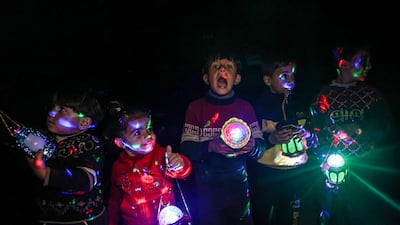
Palestinian children carry traditional lanterns in Rafah on the eve of Ramadan. AFP -
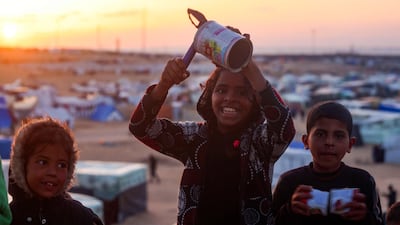
Children play at a camp for displaced Palestinians in Rafah. AFP -
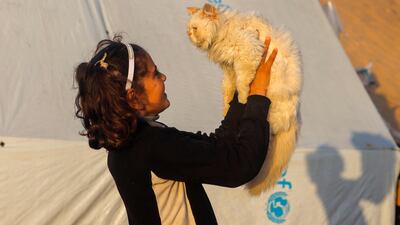
A girl plays with a cat at a camp in Rafah. AFP -
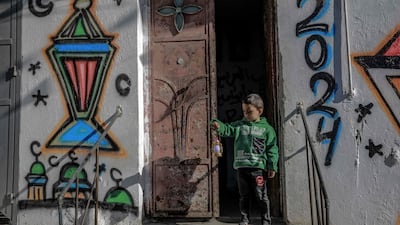
A child carries a small Ramadan lantern in Gaza city. AFP -
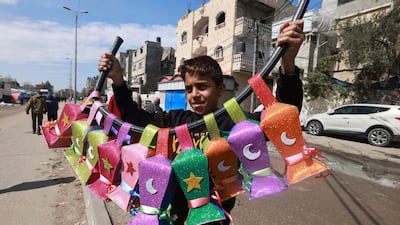
A displaced Palestinian child sells handmade Ramadan lanterns in Rafah. AFP -
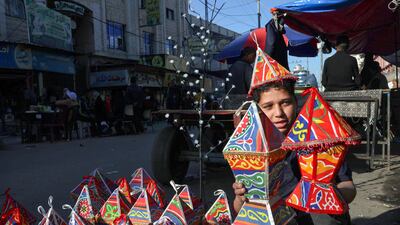
A Palestinian street vendor sells traditional 'fanous' lanterns in Rafah. AFP -
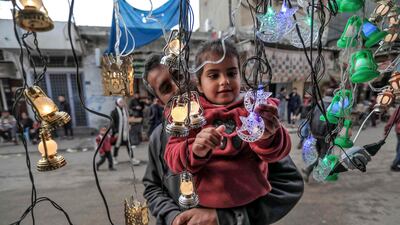
A child touches decorative lights and lanterns at a shop in Deir al-Balah in central Gaza. AFP



