


Live updates: Follow the latest news on Israel-Gaza
The response to attacks on commercial ships in the Red Sea by Iran-backed Houthis must be "multi-faceted", British and American admirals have said, as experts increasingly question the effectiveness of US and UK strikes against the Yemeni group.
"It has always been made really clear that no one single thing will persuade the Houthis to desist," Admiral Sir Ben Key, First Sea Lord of the UK Royal Navy, told a media briefing in Paris.
"It has to be part of a strategy, a number of factors, both external persuasion and an indication of the fact that the international community will not put up with this threat to the rules-based international system."
The US and the UK on Thursday for the first time issued sanctions against Houthi officials for their role in supporting or directing attacks on commercial shipping.
The sanctions come three weeks after Washington, with occasional support from London, launched a bombing campaign against Houthi military targets in Yemen.
Those sanctioned were Defence Minister Mohamed Nasser Al Atifi, commander of the Houthi Naval Forces Muhammad Fadl Abd Al Nabi, coastal defence forces chief Muhammad Ali Al Qadiri and Muhammed Ahmad Al Talibi, who the two governments described as the Houthi forces' director of procurement.
They will be subject to asset freezes, arms embargoes and travel bans.
-
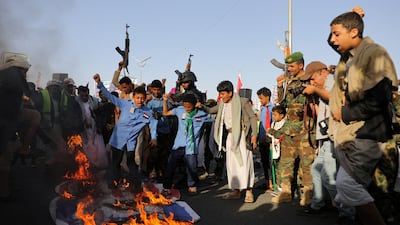
Israeli and US flags are burned at a rally in Sanaa, Yemen, as Houthi leaders denounced air strikes launched by America and Britain against the rebels. Reuters -
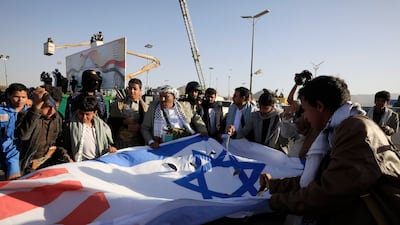
People prepare to burn the Israeli and US flags during the protest in Sanaa. EPA -

An aircraft takes off to join the US-led coalition carrying out air strikes on Houthi militia targets in Yemen. Reuters -

Mohammed Al Houthi, head of the Houthi supreme revolutionary committee, wields a gun as he speaks at a rally to denounce US-UK air strikes, in Sanaa. Reuters -
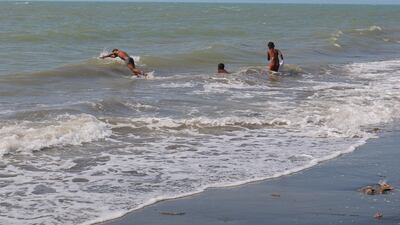
Yemeni children swim in sea at the Red Sea port of Hodeidah on the morning after US and British forces struck rebel-held targets in Yemen. AFP -
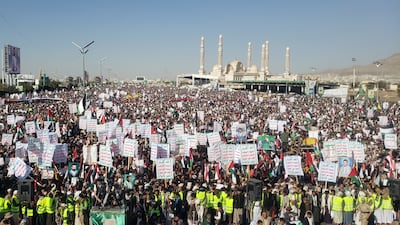
A protest against the US and UK military action, which followed Houthi attacks on Red Sea shipping, in Sanaa. EPA -
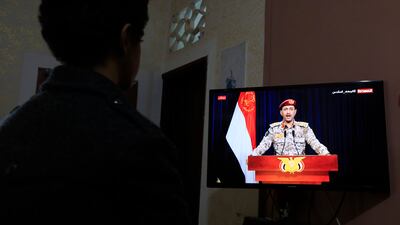
A viewer watches a TV statement by Houthi military spokesman Yahya Saree, who said five of the group's fighters were killed and six wounded in 73 air strikes carried out by the US and UK in Yemen. EPA


The group has conducted dozens of attacks against commercial ships since November but has so far given no indication that it intends to stop.
The war in Gaza is the reason for the attacks, says the group, which wants to pressure Israel into a ceasefire.
But analysts say that this is just a pretext to raise the Houthis' international profile.
"It really has to be the full-court press, whether it's diplomatic, whether it's the information space, military or economic," Admiral Lisa Franchetti, chief of naval operations at the US navy, told reporters at a naval conference organised by the French Institute of International Relations.
"The collective we can use all those levers of national power to really make them understand exactly the impact they're having and that it needs to stop right now," she said in response to a question from The National.
So far, the international community has failed to discourage Houthi attacks, raising fears of global trade disruption, wider inflation and copycat operations. The Red Sea normally carries more than 12 per cent of the world’s seaborne trade.
"It's not affordable to pass a message that any state or militia can blackmail international trade," said Alessandro Marrone, defence programme director at Italian think tank Istituto Affari Internazionali.
"It would be a huge problem for economic and energy security."
'Lightning rod'
Yet with its military response to the attacks, the US has become, once again, a "lightning rod" to increase the Houthis' popularity, said Kelly Grieco, senior fellow at US think tank the Stimson Centre.
"Unfortunately, the US can be a very effective lightning rod to galvanise these groups," Ms Grieco told The National. "We saw it in [the 2003 US invasion of] Iraq, and we're seeing it once again here."
Emma Salisbury, associate researcher at the UK think tank Council on Geostrategy, said: "The Houthis benefit from being in conflict with the West. Their political incentive is conflict and Gaza is their excuse."
Last week, US President Joe Biden recognised that striking Houthi positions on land had not deterred their attacks at sea, but said that his country would continue bombing the group.
“Are they stopping the Houthis? No. Are they going to continue? Yes,” Mr Biden told reporters.
Such statements have been widely interpreted as Washington indicating that it is unable to find a way out of its failed strategy in the Red Sea.
"It looks like we are escalating right now without actually being able to solve the military problem," said Ms Grieco.

Some western countries such as France have avoided joining US strikes, because of fears of further regional escalation.
Diplomacy, not military escalation, is the proper response to the crisis, said French President Emmanuel Macron last week.
The focus of diplomatic efforts should be on Iran, said Ms Salisbury. Tehran supports the Houthis militarily and is subject to western sanctions over its nuclear programme and human rights abuses.
"Sanctions is their historical issue. There is much we can build on diplomatically," she said.
"There is a need to pressure Iran to restrain the Houthis, to stop giving them money and tell them to calm down."
In December, Washington also launched a maritime coalition called Prosperity Guardian that includes more than 20 countries.
The EU is expected to soon follow suit with a parallel defensive naval mission. Bringing in non-western world powers such as China would boost the credibility of these missions, said Ms Grieco.
"It's a real opportunity for Washington and Europe to show how competition needs to be balanced with co-operation in areas where we have common interests," Ms Grieco told The National.
China has so far stayed out of the Middle East conflict but imports half of its crude oil from the region.
Europe can build on its previous experience in engaging with Iran in the Strait of Hormuz to de-escalate the tensions, said Mr Marrone.
Diplomats in Brussels are working out details to expand a pre-existing French-led naval mission named Agenor.
"They were able to present this initiative to Iran as de-escalatory to maintain safe and secure transit through the Strait of Hormuz," Mr Marrone said.
"If they were able to do so a few years ago, very close to Iranian shores, I think they can and should be able to do it again."

