President Joe Biden is welcomed by Israeli Prime Minster Benjamin Netanyahu to Tel Aviv on October 18. Reuters

Biden says Netanyahu is losing support and 'has to change'


Ellie Sennett
  • English
  • Arabic

Live updates: Follow the latest news on Israel-Gaza

US President Joe Biden on Tuesday warned that Israel is losing international support due to its “indiscriminate bombing” of Gaza, even as Washington looks to send additional military aid to its long-time ally.

Speaking at a fundraising event for his 2024 presidential re-election campaign, Mr Biden said Israeli Prime Minister Benjamin Netanyahu “has to change, and this government in Israel is making it very difficult for him to move”.

Israel's security can rest on the United States, but right now it has more than the United States. It has the European Union, it has Europe, it has most of the world supporting them,” he said.

“They’re starting to lose that support by indiscriminate bombing that takes place.”

The far-right government in Israel and the centre-left Biden administration have had a testy relationship that predates the war in Gaza.

“This is the most conservative government in Israel's history,” Mr Biden said. He added that the government “doesn't want a two-state solution”.

Earlier this year, when nationwide protests erupted across Israel over the government's plans to overhaul the judiciary, the White House expressed “deep concerns” and declined to say if it would invite Mr Netanyahu to Washington for an official visit.

But the October 7 Hamas attack on Israel and the ensuing war in Gaza briefly put the differences between Mr Biden and Mr Netanyahu to one side.

The US President quickly mobilised to send billions of dollars in additional funding to the Israeli military as it escalated its campaign in the Gaza Strip, where health authorities say more than 18,000 Palestinians have been killed and 90 per cent of the population has been displaced.

Last week, the State Department approved the sale of tank ammunitions to Israel that can be used in its ground campaign.

The scale of devastation in Gaza and the administration's continued support of Israel's operation despite rhetoric of “concern” have split a Congress that is normally unified in its support of Israel.

Key Democratic senators are working on a measure to require that the weapons received by any country “are used in accordance with US law, international humanitarian law and the law of armed conflict”.

Senator Elizabeth Warren, who is working on the legislation, said US support for Israel cannot come in the form of a “blank cheque” and accused the Netanyahu government of a “gross disregard” for Palestinian civilian life.

“US military aid always includes conditions, and there is no exception, even for our allies,” she said on X.

The US is the top donor to Israel and “almost all US bilateral aid to Israel is in the form of military assistance”, a March 2023 congressional report showed.

Latest from Israel-Gaza war – in pictures

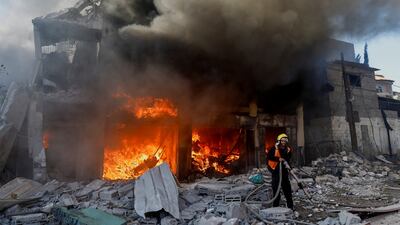
  • A Palestinian firefighter tackles a blaze at a house after an Israeli strike in Khan Younis, in the south of the Gaza Strip. Reuters
    A Palestinian firefighter tackles a blaze at a house after an Israeli strike in Khan Younis, in the south of the Gaza Strip. Reuters
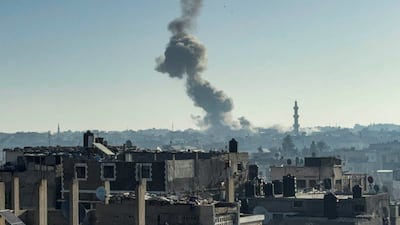
  • Smoke rises after an Israeli air strike in Khan Younis. Reuters
    Smoke rises after an Israeli air strike in Khan Younis. Reuters
  • A girl mourns during a funeral at Nasser hospital, in Khan Younis. Reuters
    A girl mourns during a funeral at Nasser hospital, in Khan Younis. Reuters
  • An Israeli fighter jet flies over an area in southern Israel, near the border with the Gaza Strip. AFP
    An Israeli fighter jet flies over an area in southern Israel, near the border with the Gaza Strip. AFP
  • Palestinians walk amid the rubble of buildings destroyed by an Israeli strike, in Khan Younis. Reuters
    Palestinians walk amid the rubble of buildings destroyed by an Israeli strike, in Khan Younis. Reuters
  • Wounded Palestinians sit on the floor at Nasser hospital following Israeli air strikes in Khan Younis. Reuters
    Wounded Palestinians sit on the floor at Nasser hospital following Israeli air strikes in Khan Younis. Reuters
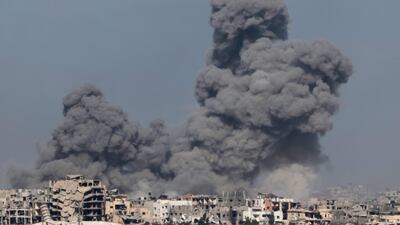
  • Smoke rises above buildings during an Israeli strike in Gaza. AFP
    Smoke rises above buildings during an Israeli strike in Gaza. AFP
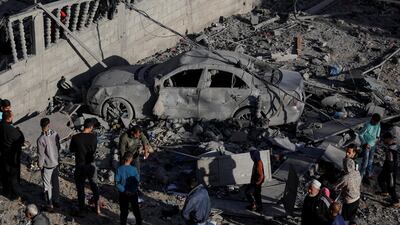
  • Children walk past a damaged car after an early morning Israeli strike in Rafah. AFP
    Children walk past a damaged car after an early morning Israeli strike in Rafah. AFP
  • Israeli soldiers prepare to launch a drone along the border with Gaza. AFP
    Israeli soldiers prepare to launch a drone along the border with Gaza. AFP
  • Palestinians inspect the damage at the site of an Israeli strike. Reuters
    Palestinians inspect the damage at the site of an Israeli strike. Reuters
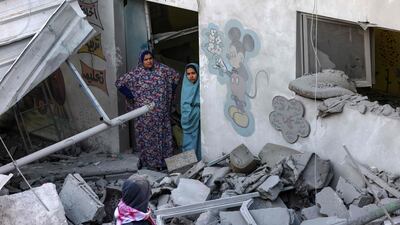
  • A woman and a child stand amid the rubble at a kindergarten hit by Israeli bombing in Rafah. AFP
    A woman and a child stand amid the rubble at a kindergarten hit by Israeli bombing in Rafah. AFP
Our legal consultant

Name: Dr Hassan Mohsen Elhais

Position: legal consultant with Al Rowaad Advocates and Legal Consultants.

Infiniti QX80 specs

Engine: twin-turbocharged 3.5-liter V6

Power: 450hp

Torque: 700Nm

Price: From Dh450,000, Autograph model from Dh510,000

Available: Now

Skoda Superb Specs

Engine: 2-litre TSI petrol

Power: 190hp

Torque: 320Nm

Price: From Dh147,000

Available: Now

Mercer, the investment consulting arm of US services company Marsh & McLennan, expects its wealth division to at least double its assets under management (AUM) in the Middle East as wealth in the region continues to grow despite economic headwinds, a company official said.

Mercer Wealth, which globally has $160 billion in AUM, plans to boost its AUM in the region to $2-$3bn in the next 2-3 years from the present $1bn, said Yasir AbuShaban, a Dubai-based principal with Mercer Wealth.

Within the next two to three years, we are looking at reaching $2 to $3 billion as a conservative estimate and we do see an opportunity to do so,” said Mr AbuShaban.

Mercer does not directly make investments, but allocates clients’ money they have discretion to, to professional asset managers. They also provide advice to clients.

“We have buying power. We can negotiate on their (client’s) behalf with asset managers to provide them lower fees than they otherwise would have to get on their own,” he added.

Mercer Wealth’s clients include sovereign wealth funds, family offices, and insurance companies among others.

From its office in Dubai, Mercer also looks after Africa, India and Turkey, where they also see opportunity for growth.

Wealth creation in Middle East and Africa (MEA) grew 8.5 per cent to $8.1 trillion last year from $7.5tn in 2015, higher than last year’s global average of 6 per cent and the second-highest growth in a region after Asia-Pacific which grew 9.9 per cent, according to consultancy Boston Consulting Group (BCG). In the region, where wealth grew just 1.9 per cent in 2015 compared with 2014, a pickup in oil prices has helped in wealth generation.

BCG is forecasting MEA wealth will rise to $12tn by 2021, growing at an annual average of 8 per cent.

Drivers of wealth generation in the region will be split evenly between new wealth creation and growth of performance of existing assets, according to BCG.

Another general trend in the region is clients’ looking for a comprehensive approach to investing, according to Mr AbuShaban.

“Institutional investors or some of the families are seeing a slowdown in the available capital they have to invest and in that sense they are looking at optimizing the way they manage their portfolios and making sure they are not investing haphazardly and different parts of their investment are working together,” said Mr AbuShaban.

Some clients also have a higher appetite for risk, given the low interest-rate environment that does not provide enough yield for some institutional investors. These clients are keen to invest in illiquid assets, such as private equity and infrastructure.

“What we have seen is a desire for higher returns in what has been a low-return environment specifically in various fixed income or bonds,” he said.

“In this environment, we have seen a de facto increase in the risk that clients are taking in things like illiquid investments, private equity investments, infrastructure and private debt, those kind of investments were higher illiquidity results in incrementally higher returns.”

The Abu Dhabi Investment Authority, one of the largest sovereign wealth funds, said in its 2016 report that has gradually increased its exposure in direct private equity and private credit transactions, mainly in Asian markets and especially in China and India. The authority’s private equity department focused on structured equities owing to “their defensive characteristics.”

HOSTS

T20 WORLD CUP 

2024: US and West Indies; 2026: India and Sri Lanka; 2028: Australia and New Zealand; 2030: England, Ireland and Scotland 

ODI WORLD CUP 

2027: South Africa, Zimbabwe and Namibia; 2031: India and
Bangladesh 

CHAMPIONS TROPHY 

2025: Pakistan; 2029: India  

Updated: December 13, 2023, 6:28 AM