


Henry Kissinger, the polarising statesman whose foreign policy decisions helped to define a decade of American military and political intervention around the globe, died on Wednesday aged 100, his geopolitical consultancy said in a statement.
The controversial Nobel Peace Prize winner and diplomatic powerhouse died at his home in Connecticut, Kissinger Associates Inc said.
His remarkable and long life saw him at the centre of key geopolitical moments in the 1970s under the administration of Richard Nixon.
Kissinger's actions have sparked intense academic and historical debate about his US foreign policy decisions that directly caused the killing of untold numbers of civilians in Cambodia and elsewhere.
Born in the Bavarian city of Fuerth on May 27, 1923, Kissinger remained active in foreign policy circles after leaving government in 1977, most recently giving his opinions on ways to end the war in Ukraine.
At an event celebrating his 100th birthday, Kissinger, who was secretary of state and national security adviser under Richard Nixon and Gerald Ford, said that at the end of the war, Ukraine should join Nato, something he had opposed when the Soviet Union collapsed three decades ago.
Over the years, Kissinger received prestigious US awards including the Presidential Medal of Freedom, the nation's top civilian honour.
But controversially, he also won the Nobel Peace Prize in 1973 for helping to oversee the Paris Peace Accords to end the Vietnam War – even though evidence suggests that he knew the deal was doomed.
And during the same conflict, Kissinger was the architect of the illegal carpet bombing of Cambodia that led to tens of thousands of civilian deaths, a historical horror that has led many critics to call him a war criminal.
He has been a vigorous self-promoter of his talents, detailed in three volumes of memoirs, but critics contend that his abilities as a statesman are overrated.
They say his actions in Vietnam, Cambodia, Bangladesh, East Timor and many other countries forever sullied America’s claim for a moral high ground.
“Whether one admires Henry Kissinger or not, there is no question that he was the most consequential secretary of state in modern American history,” said presidential historian Luke Nichter.
Kissinger's time as a statesman during the tumultuous 1970s is frequently defined by his approach to realpolitik, a pragmatic and largely amoral doctrine in which he sought to maximise US power by whatever means were most expedient.
He played a key role in Nixon's opening to China as the US sought to capitalise on the Soviet Union's rivalry with its fellow communist power.
Dr Nichter, a history professor and chairman in presidential studies at Chapman University in Orange, California, described Kissinger as a giant in “creative diplomacy”.
“Whether overt, covert, or shuttle. For better or worse, you could include in this China, Russia and Vietnam, but also Cambodia, Chile and the Middle East," Dr Nichter told The National.
"His government career is a reminder that creative diplomacy should always be a central feature of US foreign policymaking."
As secretary of state, Kissinger was deeply involved in the Middle East. He spent years negotiating deals between Israel and its Arab neighbours Egypt and Syria, cementing a regional order that persists today.
David Greenberg, a professor of history and journalism at Rutgers University, said Mr Kissinger has done many “unsavoury things”, including prolonging the Vietnam War and supporting the Chilean dictator, Gen Augusto Pinochet.
“But he was not a 'war criminal.' That term should be reserved for those who do barbaric things,” Prof Greenberg told The National.
“What Kissinger did was well within the norms of what any foreign policy adviser might do. It is open to severe criticism, but not to criminal prosecution.”
Prof Greenberg said that Kissinger's “greatest offence” was his role in the Nixon White House's use of listening bugs and dirty tricks during the time of the Watergate scandal.
"He was wildly overrated as a diplomat by both his admirers and detractors," Prof Greenberg said.
-
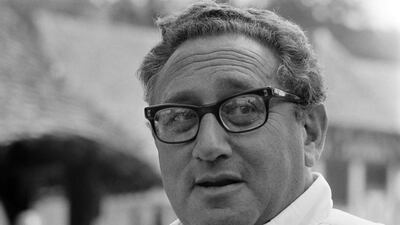
Henry Kissinger pictured in 1976, in France. The former US secretary of state, a key figure of 20th century American diplomacy, died on November 29, at the age of 100. AFP -
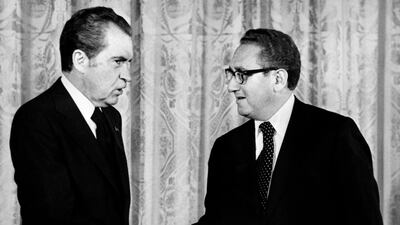
US president Richard Nixon with Mr Kissinger in 1973, in Washington. AFP -
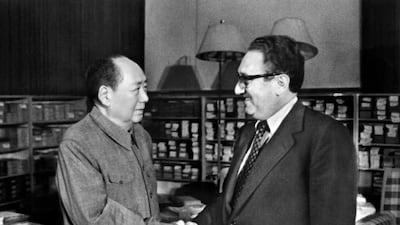
Mr Kissinger meets Chinese president Mao Zedong in 1973, in Beijing. AFP -
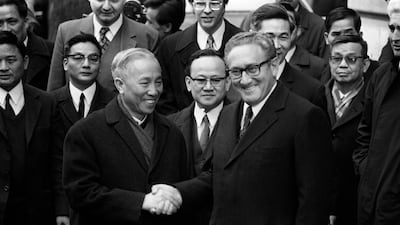
Mr Kissinger with Le Duc Tho, leader of North Vietnamese delegation, after signing a ceasefire agreement in the Vietnam War, in January 1973, in Paris. AFP -
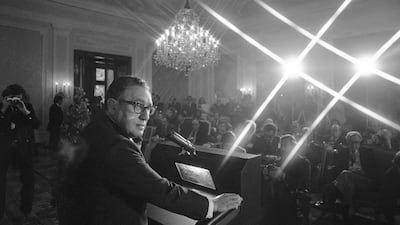
Henry Kissinger faces the press in Salzburg, Austria, in 1974. AP -
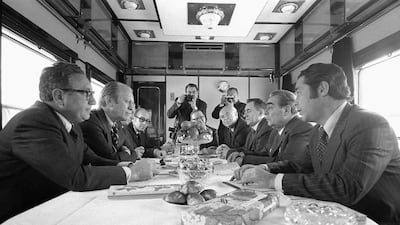
Mr Kissinger sits next to US president Gerald Ford during discussions with Soviet leader Leonid Brezhnev and other top officials, on a Russian train headed for Vladivostok, eastern Russia, in 1974. Reuters -
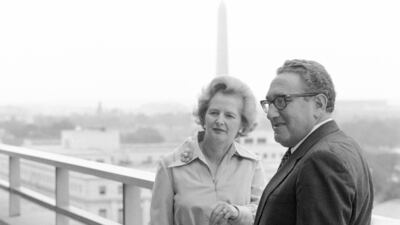
Future British prime minister Margaret Thatcher with Mr Kissinger in Washington, in 1975. AP -

Mikhail Gorbachev meets Mr Kissinger in Moscow in 1991, on the first working day of the last Soviet leader's new institution. AFP -
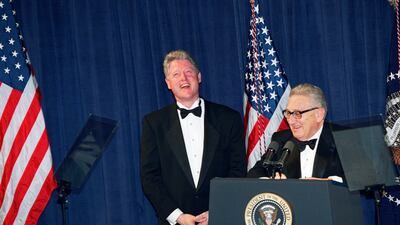
US president Bill Clinton and Mr Kissinger share a joke at a national policy conference in Washington, in 1995. AP -
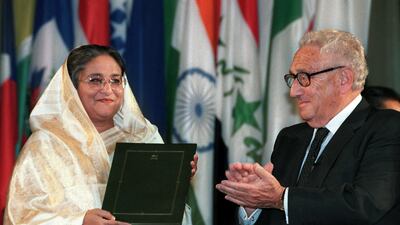
Mr Kissinger presents Bangladeshi Prime Minister Sheikh Hasina Wajed with the Unesco Felix Houphouet-Boigny Peace Prize, in Paris, in 1999. AFP -
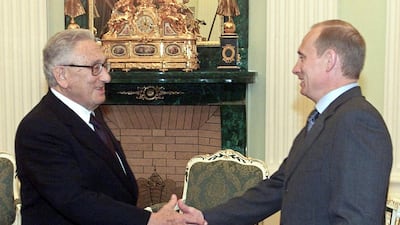
Russian President Vladimir Putin meets Mr Kissinger in the Kremlin, in 2001. AFP -
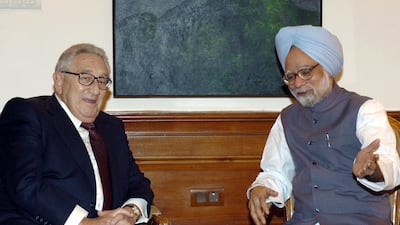
Indian prime minister Manmohan Singh with Mr Kissinger in New Delhi, in 2004. AFP -
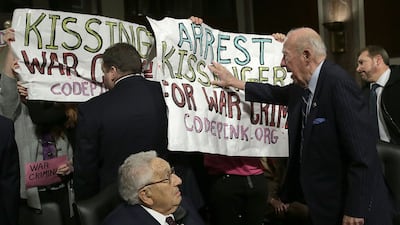
Former US secretary of state George Shultz pushes away protesters shouting 'Arrest Henry Kissinger for war crimes', as Mr Kissinger looks on, in Washington, in 2015. AFP -

Chinese president Jiang Zemin with Mr Kissinger in New York, in 1995. Reuters


Fleeing Nazi persecution
Kissinger was 10 when the Nazis came to power in his native Germany. In 1938, he fled with his family to the US to escape persecution, and they settled in New York.
He became a naturalised American citizen in 1943 and found himself back in Germany shortly afterwards, this time with the US Army, which used his German-language skills and assigned him to work in intelligence.
After the Second World War, he returned to his home town and learnt that most of his friends and relatives had been murdered in Nazi concentration camps.
Despite a lifetime in America, Kissinger’s deep, growling voice never lost its distinctive German accent.
“When I was with the Infantry Division nobody ever mentioned my accent, so I thought I had lost it. But going to Harvard cured me of that illusion,” he said at an event this year.
After the war, Kissinger studied at Harvard University, eventually earning a doctorate in 1954 and joining the faculty.
His keen interest in foreign affairs saw him join the presidential campaigns of Republican Nelson Rockefeller in 1960, 1964 and 1968 as a foreign policy adviser.
He once described Richard Nixon as “the most dangerous of all the men running to have as president”, yet he switched his allegiance to the Republican when he won the party’s 1968 primary.
The new president anointed Kissinger as his national security adviser.
Kissinger's enduring fame and the fascination he still projects on many scholars, pundits and foreign policy buffs is baffling to some.
“Once we scratch the surface of his invariably opaque and oracular prose, we discover that he has always been a fairly conventional thinker,” said Mario Del Pero a diplomatic history expert and professor at Sciences Po in Paris.
“Someone who – from limited nuclear wars to missile gaps, from transatlantic quarrels to US international credibility – has almost invariably followed the intellectual vogues of the time more than shaped or challenged them.”
Dr Del Pero told The National that Kissinger has long presented himself as a sage European realpolitiker, teaching a naive America the perennial, ruthless laws of international politics.
That “kind of message that has worked particularly well in times of crisis” when liberal internationalism and its globalist prescriptions appeared discredited, he said.

