

Live updates: Follow the latest news on Israel-Gaza
The US is in constant communication with Israel to discuss the possible consequences of a ground invasion of the Gaza Strip, a major military operation that could have widespread outcomes for the entire region.
Israel is amassing troops and weapons outside Gaza and has already conducted limited forays into the Hamas-controlled territory.
But before an all-out invasion, the families of hostages held in Gaza are pleading with Israel to pause and allow more time for negotiations.
The Pentagon, meanwhile, is sending military staff and equipment into the region to protect against attacks from anti-Israel militias, which are expected to increase following an invasion.
White House National Security spokesman John Kirby said on Monday Israel's army and political leadership will make the final decision on the timing and scope of any invasion.
“We are talking to them about all the kinds of consequences, second and third-order effects, that come from making decisions on the battlefield and what that means,” Mr Kirby said.
“We're curious to understand as best we can the how, the aims and the strategy that they're putting into the effort.”
Pentagon press secretary Brig Gen Pat Ryder said Defence Secretary Lloyd Austin was speaking on a near-daily basis to his Israeli equal, Yoav Gallant.
“Those conversations are on what are Israel's defence needs, which we're working urgently to meet,” Brig Gen Ryder said.
“Part of that also is talking about the importance of conducting operations in accordance with the law of war, most notably the protection of civilians.”
He declined to comment on operational timelines for any Israeli invasion but said the Pentagon was well aware of the risks of a ground incursion in terms of anti-Israel groups stepping up attacks.
“We recognise the potential for increased escalation and we want to do everything we need to do to ensure force protection for our troops, while also at the same time to turn in a broader regional conflict,” he said.
The Pentagon has detailed attacks on US forces thought to have been conducted by Iran-backed militias.
A senior US defence official said American military experts were offering assistance to Israeli partners.
"We have an entire generation of US military senior leaders who have experience in counter-terrorism and complex operations, especially in an urban environment like Gaza," the official told reporters.
"And we have consistently made our experts available to provide their best practices and lessons learnt to our Israeli counterparts."
Several US outlets said the Biden administration is pressuring Israel to delay an invasion, but Israel's ambassador to the US, Michael Herzog, denied this.
“Israel is a sovereign nation, and they do not ask us or tell us what to do. They understand the situation. So there is no real pressure," Mr Herzog told CNN on Sunday.
Israeli Prime Minister Benjamin Netanyahu has vowed to eliminate Hamas and Israel's troops could enter Gaza at any moment, but many families are urging him to focus solely on the hostages.
“This should be the top priority, not to destroy Hamas, not to control Gaza and not anything else,” said Noam Alon, the partner of Inbar Haiman, 27, an artist who was one of dozens abducted from a music festival, Reuters reported.
Hamas is holding more than 200 hostages, among them foreign citizens.
On Friday, the group freed two American hostages after mediation by Qatar.
Ten Americans are still unaccounted for, a “handful” of whom are believed to be held in Gaza, Mr Kirby said. Two more Israeli hostages were released on Monday.
Israel has been bombarding the Gaza Strip since October 7, when Hamas gunmen launched a surprise attack on parts of southern Israel, killing 1,400 people and taking more than 200 hostage.
In recent days, it also conducted limited overnight incursions into the besieged territory, intended to gather intelligence, the Israeli army said.
More than two weeks into the daily air strikes on Gaza that have so far killed more than 5,000 Palestinians, according to local tallies, it remains unclear when Israel will launch a full-scale invasion.
The prospects of a full-scale operation have raised fears of the war spreading beyond Gaza and Israel, which could see Iranian-backed groups in the region, such as Hezbollah, escalating a conflict that could spread in the Middle East.
Israel has been trading fire with Hezbollah in southern Lebanon and in recent days has conducted air strikes on the West Bank and Syria, too.
The US has also been advocating for the entry of humanitarian aid to Gaza, home to 2.3 million people.
On Saturday, 20 lorries carrying aid were allowed into the enclave for the first time since the latest conflict broke out. Two additional smaller convoys have since made their way in through Gaza's border with Egypt.
“We know the needs are acute, and we know they're significant, we know that two convoys of trucks is not enough,” Mr Kirby said.
The latest from the Israel-Gaza war – in pictures
-
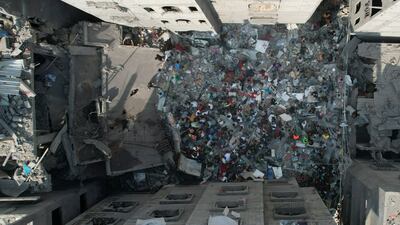
Palestinians look for survivors of Israeli bombardment of the Gaza Strip at Nusseirat refugee camp. AP -
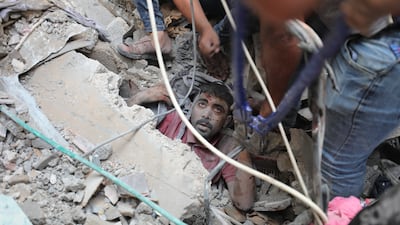
A survivor is found in the rubble in Nusseirat. AP -
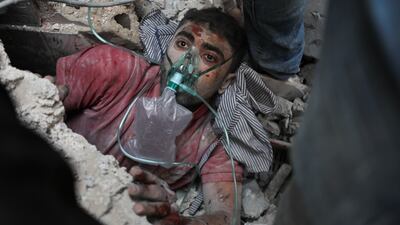
A man is given oxygen and pulled from the rubble in Nusseirat. AP -
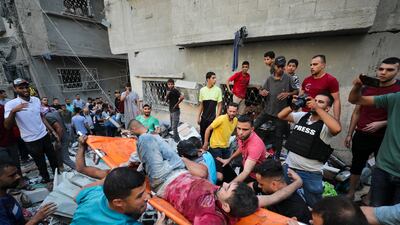
This desperate search for survivors is being replicated across the Gaza Strip. AP -

Yocheved Lifshitz speaks to the media outside a Tel Aviv hospital after being released by Hamas. EPA -
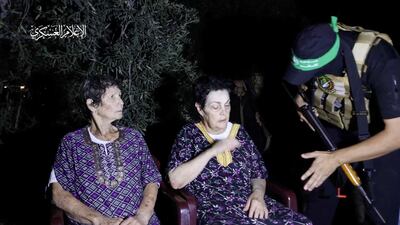
Israeli women who were held hostage by Palestinian Hamas militants, Yocheved Lifshitz and Nurit Cooper (also known as Nurit Yitzhak), are released by the militants. Reuters -

Israeli Prime Minister Benjamin Netanyahu, right, welcomes French President Emmanuel Macron before their talks in Jerusalem. AP -

Palestinians search for casualties at the site of an Israeli air strike on a house in Khan Younis, in the southern Gaza Strip. Reuters -

Palestinians inspect the damage of a destroyed house that was hit by an Israeli air strike in Khan Younis. AP -
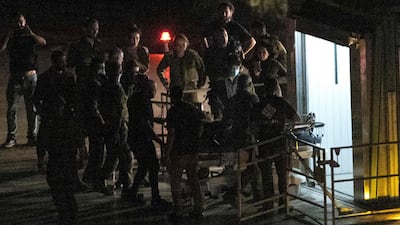
Ms Cooper and Ms Lifshitz arrive at the Tel Aviv Sourasky Medical Centre after being released by Hamas on Monday. AFP -
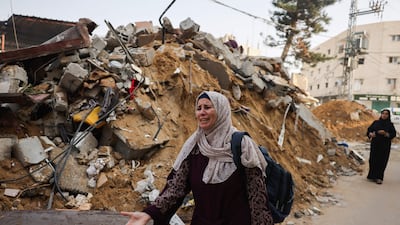
A woman cries next to the rubble of a building after Israeli strikes on Rafah in the south of the Gaza Strip. AFP -
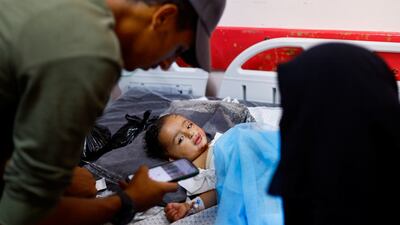
Wateen, a 14-month-old Palestinian baby, who was wounded in an Israeli strike that killed her mother and injured her twin brother Ahmed, recovers at Nasser hospital, in Khan Younis, Gaza Strip. Reuters -
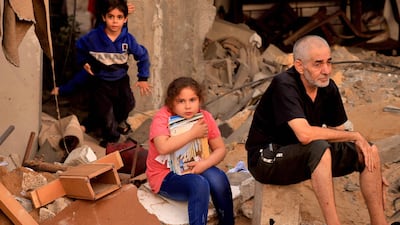
A Palestinian girl clutches salvaged books as people look for survivors in the rubble of a destroyed building hit in an Israeli strike in Khan Younis. AFP -
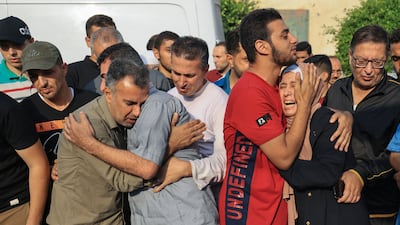
People mourn during the funeral of members of the Abu Morad family who died following Israeli strikes, in Khan Younis. AFP -
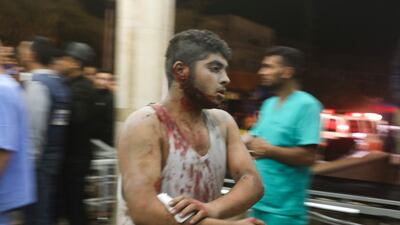
A wounded Palestinian man arrives at Nasser Medical Complex, following Israeli air strikes on the town of Khan Younis in the southern Gaza Strip. AP -
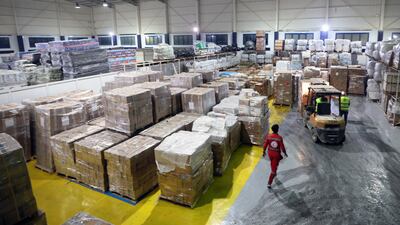
Red Crescent Society employees sort humanitarian aid bound for Palestinians in Gaza, at a warehouse in Arish, Egypt. EPA -

Ayman Abou Chamalah stands next to his daughter Mecca as she receives care inside an incubator at a hospital in Rafah. AFP -
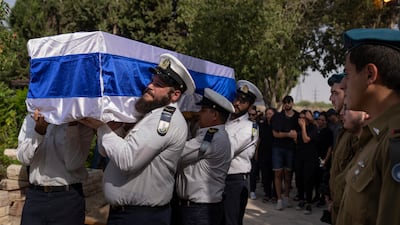
Israeli soldiers carry the coffin of Erik Kraunik, chief of security in the kibbutz of Be'eri, during his funeral at a cemetery in Yehud, Israel. AP -
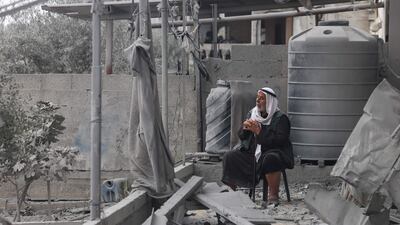
A man sits among the rubble of a building destroyed in Israel's bombardment of Rafah, in the southern Gaza Strip. AFP -
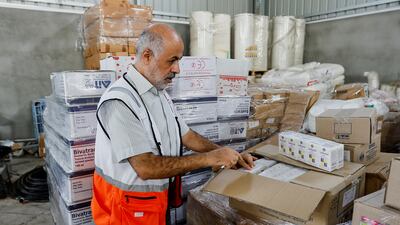
A Red Crescent worker sorts aid for Palestinians in Khan Younis, in the southern part of the blockaded enclave. Reuters -
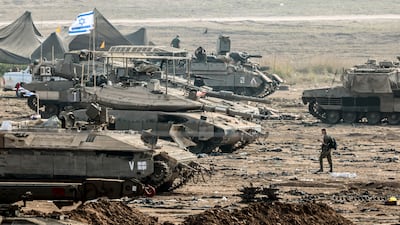
Israeli soldiers take part in a drill near the border with Gaza ahead of an expected ground invasion. EPA -
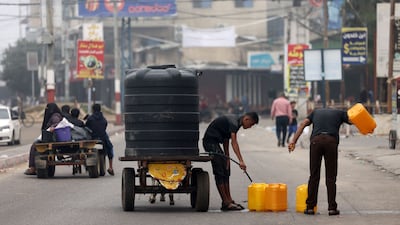
Men fill fuel containers with drinking water in Rafah. AFP -

Smoke billows over Gaza after an air strike, as seen from southern Israel. AP -
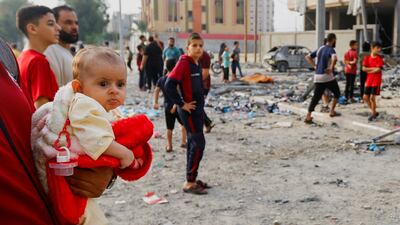
A person holds a child as Palestinians gather in Khan Younis at the site of a house destroyed during an Israeli bombardment. Reuters -
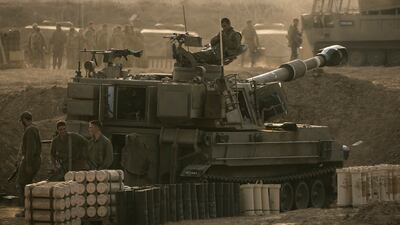
Israeli soldiers sit on top of a tank near the border with Gaza. Getty Images -
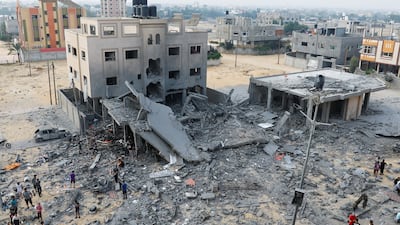
Buildings destroyed by Israeli air strikes in Khan Younis. Reuters -
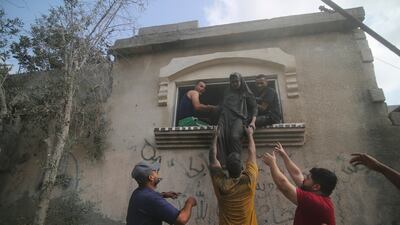
Palestinians are evacuated from a building in Rafah that was hit during Israel's bombardment. AP -
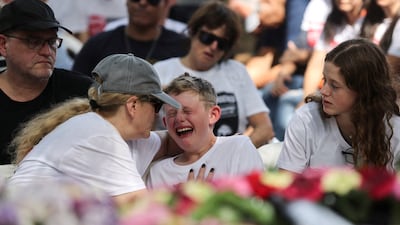
Shahar Idan, 9, mourns during the funeral of his brother Maayan, 18, who was killed by Hamas gunmen in the kibbutz of Nahal Oz. His father Tzahi is being held hostage in Gaza. Reuters -

Palestinian doctors treat a premature baby at Al Aqsa Hospital in Deir Al Balah, Gaza. AP -
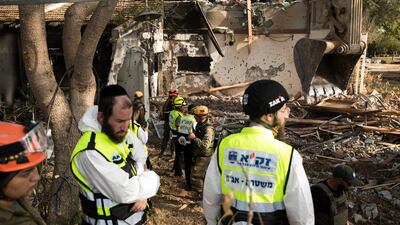
Rescue crews search for bodies after Hamas militants attacked the kibbutz of Be'eri in Israel. Getty Images -
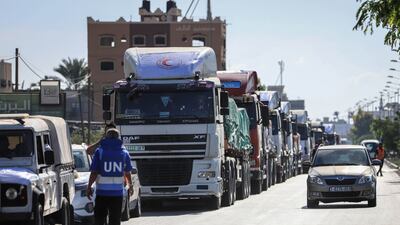
Lorries carrying humanitarian aid head to Deir Al Balah after crossing from Egypt through Rafah. Bloomberg -
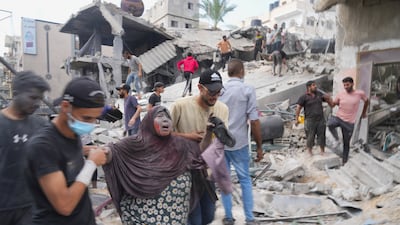
Palestinians evacuate survivors in Deir Al Balah after an Israeli bombardment. AP -
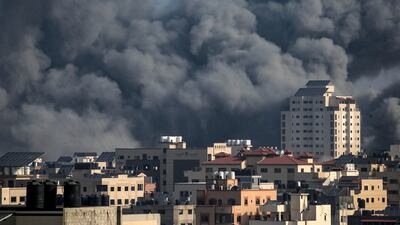
Smoke rises after Israeli air strikes on Gaza. EPA -
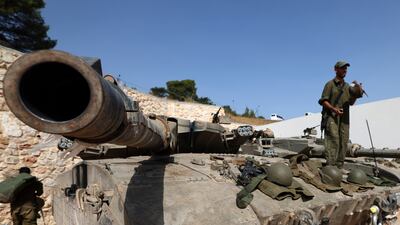
Israeli soldiers at a position along the border with Lebanon. EPA -
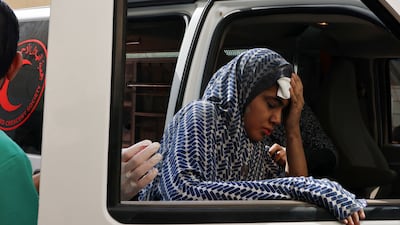
A woman leans against the window of an ambulance outside Kuwait Hospital after an Israeli strike in Rafah. AFP -
A Palestinian cries as the body of his daughter is recovered from beneath the rubble of a building destroyed during an Israeli air strike on Rafah. AFP -
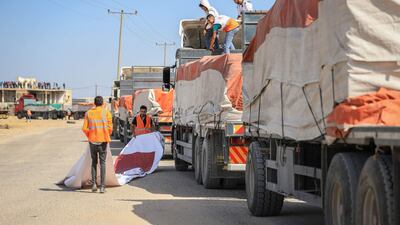
A convoy carrying humanitarian aid arrives in Rafah after crossing into the Gaza Strip from Egypt. Bloomberg -

The pictures of more than 1,000 people abducted or killed during the attack by Hamas militants are displayed on empty seats at Tel Aviv University. Getty -
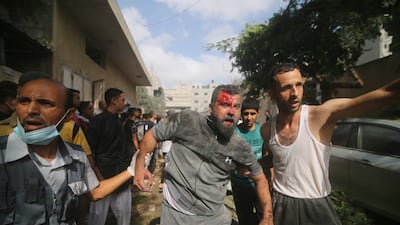
Palestinians are evacuated from buildings in Rafah after the bombardment of the Gaza Strip. AP -
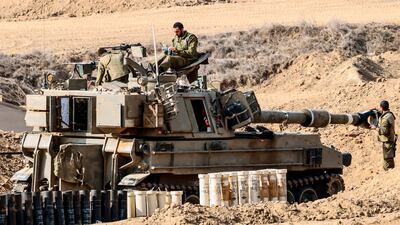
Israeli soldiers gather at an undisclosed location near the border with Gaza. EPA -
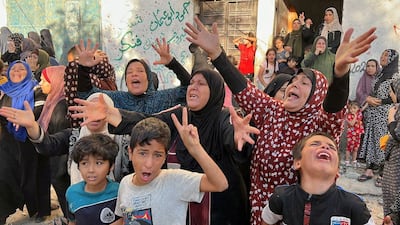
Palestinians mourn outside a house in Gaza struck by Israel. Reuters -
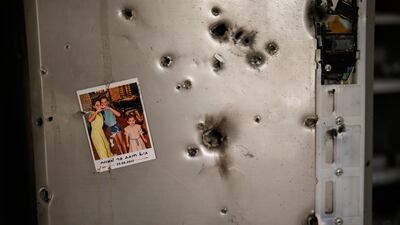
A bullet-riddled fridge in a house in the kibbutz of Kissufim in southern Israel, where 14 people were killed and four were abducted by Hamas militants on October 7. AP -
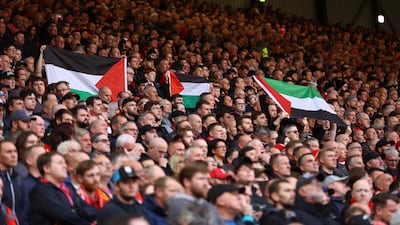
Football fans inside Anfield stadium hold up Palestine flags during the Liverpool-Everton derby on Saturday. Reuters -
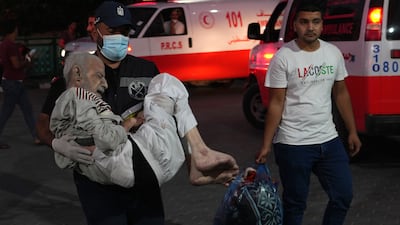
Palestinians wounded in the bombardment of Gaza are taken to Al Asa Hospital in Deir Al Balah. AP -
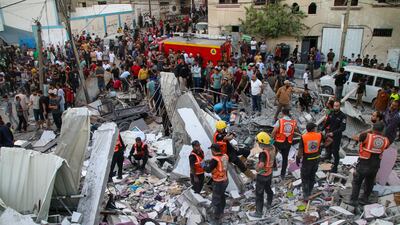
Rescuers search for victims and survivors in buildings destroyed by air strikes in Khan Younis, Gaza. Getty -

Residents of Tel Aviv show support for the families of hostages being held in Gaza by Hamas. Reuters



