


The congressman behind a new law requiring US government agencies to address the Middle East’s Captagon crisis says America must be prepared to play “bad cop” to compel Syria to staunch the flow of the highly addictive drug.
Passed last year, the Captagon Act mandates that the State Department, the Pentagon and other federal agencies devise a strategy against narcotics production and trafficking networks linked to Syrian President Bashar Al Assad's regime.
Representative French Hill, a Republican who sponsored the legislation, said the US could help to counter the pills that have become a vital source of funding for Mr Al Assad.
“Because of our strategy and our desire to cut off the funding to Assad … we should be the bad cop here,” Mr Hill told The National.
Arab countries allowed Damascus back into the Arab League in May after a 12-year absence in hopes of addressing Syria's many woes, including its refugee crisis.
They said isolation yielded few results. Western powers remain largely opposed to any “normalisation” of Mr Al Assad's regime.
“Maybe those [Arab] countries can be good cop on how they're going to compel change,” Mr Hill said.
The US counter-Captagon strategy does not put Washington at odds with regional partners increasing engagement with the Assad regime, Mr Hill stressed.
But he voiced concerns about Syria's readmission into the Arab League “without any conditionality.”
“It would be my goal that the United States lead in discussions with the neighbouring countries to take our Captagon strategy … and use that as additional leverage and a big stick to compel change in Damascus,” he said.
Mr Hill said he was cautiously optimistic about Washington taking the lead in countering Syria's drug trade.
“The United States can be a real leader," he said. "Captagon is just one piece of that leadership to be a force for measurable change, actionable change, and we hope that we are an aid to our Arab League allies, who say they want that change."
Captagon smuggling - in pictures
-

The Captagon pills were hidden inside plastic lemons. Photo: Dubai Police -

The shipment was then concealed in a consignment of real lemons. Photo: Dubai Police -

The shipment had an estimated street value of $15.8 million. Photo: Dubai Police -
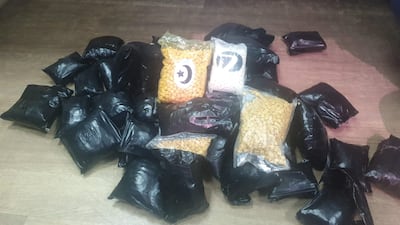
Dubai Customs at the Hatta border foiled an attempt to smuggle 14.5kg of Captagon into the emirate. Photo: Dubai Customs


Mr Hill recently returned from a Middle East trip to discuss the new counter-Captagon strategy.
While on a tour of Iraqi Kurdistan, Iraq, Jordan and Saudi Arabia, he met local and US officials familiar with the drugs trade to discuss Washington's renewed efforts to combat it.
US “sanctions are going up, not going down", Mr Hill said.
"Intelligence exposure about who in Syria is engaging in this [drug trade] are becoming more public, not less public.
"The damage being done to families in Saudi Arabia and Jordan and Baghdad is going to be more publicised, not less publicised."
The National spoke to the congressman after the House of Representatives passed the 2024 National Defence Authorisation Act along partisan lines.
“This bill fully reflects Republican priorities on countering ISIS and Al Qaeda in the [Shiite] militia and Iranian political infiltration in the Middle East,” Mr Hill said.
An NDAA amendment builds on Washington's counter-Captagon efforts, asking for a “classified report on Iranian involvement in the narcotics trade, the entities associated with the trade, and an assessment on the financial benefits of involvement in the trade".
The US government is focusing its Captagon efforts on “addressing the illicit drug supply chain, including production, trafficking and money laundering, to dismantle the narcotics distribution infrastructure outside of Syria that benefits the Assad regime", the State Department said in June.
It said its goal is for “the international community to prioritise combatting synthetic drugs, such as Captagon, as a top public health and security threat and drive action towards solutions".
Mr Hill singled out Jordan as one of the most important regional actors for Washington to work with.
Amman is seeking co-operation from the Assad regime to halt cross-border Captagon flows, as the kingdom supports re-establishing regional ties with Damascus.
“There'd be no better player then the head of security services or King Abdullah in Jordan. And I have no doubt that in their private meetings with their colleagues in the region, they're talking about it,” he said.
Secretary of State Antony Blinken last week convened an online ministerial meeting bringing together dozens of countries and international organisations to launch a Global Coalition to Address Synthetic Drug Threats.
Jordan, Saudi Arabia and Morocco were among the countries represented.
Amman's Foreign Minister Ayman Safadi, who recently met Mr Al Assad, spoke about Jordan's struggles with drug smuggling at its border with Syria.
“Jordan is at the forefront of this new war against synthetic drugs,” he told the online meeting.
Mr Safadi said the US-launched coalition is “an important step to address synthetic drugs … given the global dimension of this threat and the huge resources behind it, we need to face it together".

