

For tens of thousands of Afghans, the sudden end of the Afghanistan war marked the start of an unexpected odyssey.
It began with a frantic escape from their homeland and continues to this day in the comparative safety of the US, where many are still grappling with immigration issues.
Qasim Rahimi remembers August 15, 2021, like it was yesterday.
The former director of public awareness at Afghanistan's national environmental agency was busy at the office, despite it being a Sunday, when Taliban forces swept into Kabul.
Mr Rahimi is a former journalist and perhaps mostly critically a Hazara, the most persecuted ethnic group in Afghanistan.
He knew immediately that the Afghanistan he knew and had thrived in was no more. At the behest of his mother, he quickly fled the city and hatched a plan to leave the country.
Eventually, he was able to make it through the gates of Hamid Karzai International Airport and was put on a US military plane to Spain.
From there, he was sent to Germany and then on to Washington, where he was granted humanitarian parole and sent to Fort McCoy, a US Army base in Wisconsin.
“I was there for September, October and November, so about three months,” Mr Rahimi told The National.
With the help of Catholic Charities, a religious organisation that helps resettle refugees, he began navigating America's complex immigration system.
“They helped me with paperwork for the resettlement and with finding a job and some social services,” he said.
The final hours of the Afghanistan war – in pictures
-
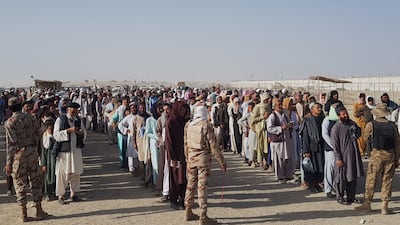
Pakistani soldiers stand guard as Afghan and Pakistani citizens queue to cross into Afghanistan at the border in Chaman, Pakistan. AFP -

Indonesians repatriated from Kabul, Afghanistan, arrive in Jakarta. Reuters -

Taliban fighters patrol Kabul. AP -

A Taliban fighter patrols the Wazir Akbar Khan district of Kabul. AP -
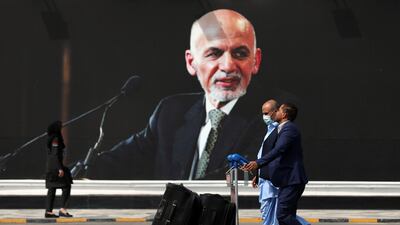
Passengers at the departure terminal of Hamid Karzai International Airport in Kabul. AP -

A US Air Force officer assists people aboard a C-17 Globemaster III plane at Hamid Karzai International Airport in Kabul. AFP -

A US Marine waits with a child at the airport in Kabul. AFP -
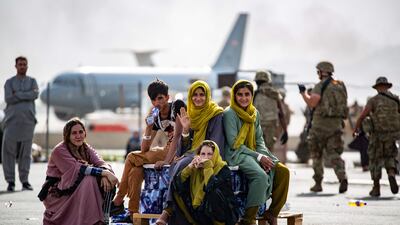
Children wait for the next flight at Hamid Karzai International Airport. AFP -
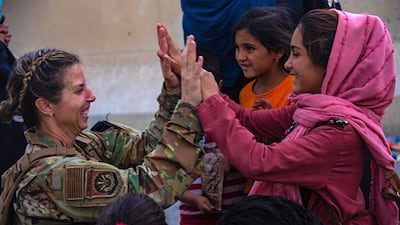
A US soldier with a reunited family at the airport in Kabul. AFP -

US troops provide assistance at Hamid Karzai International Airport. AFP -

A US C-17 aircraft transports US Marines to Afghanistan from an air base in Kuwait. Reuters -

US soldiers help a woman over a wall as crowds gather at Kabul airport. Reuters -
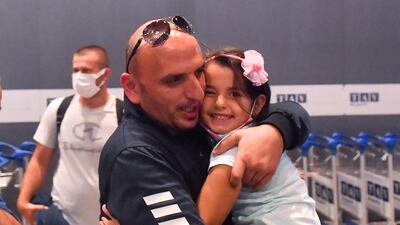
A daughter hugs her father at Skopje International Airport in North Macedonia, after he was repatriated from Afghanistan. EPA -
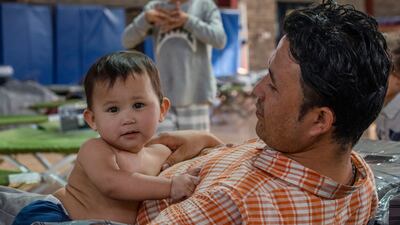
A man from Afghanistan with his son at an undisclosed location in the Middle East after being flown out of Kabul. AP


According to the State Department's Bureau of Population, Refugees and Migration, more than 97,000 Afghans have lawfully arrived in the US since August 2021.
Mr Rahimi's story mirrors those of thousands of his fellow compatriots that have become refugees.
Najeeb, an office administrator from Kabul, had mere hours to pack up his life and flee following the Taliban takeover of the Afghan capital.
Thanks to his connections to a western company, Najeeb was able to leave Kabul along with his family on a flight to Qatar under Operation Allies Welcome, the US-led evacuation operation. More than 83,000 Afghans came to the US as a result of the airlift.
After a transfer to the US airbase in Ramstein, Germany, where they spent 45 days, Najeeb and his family were eventually flown to another military base in the US in October 2021 and granted humanitarian parole for two years.

Under the temporary authorisation to live and work in the US, parolees like Najeeb and Mr Rahimi had to apply for asylum to permanently settle as refugees.
This process has been tough for many Afghans, who have had to navigate a complicated online system.
“Most Afghans are not familiar with these systems and the online submitting of applications or how to fill the form,” Najeeb told The National.
“You don't know how to answer those questions because most are not very clear. So that makes it a little bit complicated”.
Many Afghans have had to rely on lawyers volunteering their time or non-government groups and religious charities to help them navigate the asylum application process.
Najeeb was eventually able to file the forms for himself and his family, but after nearly eight months, he has not heard back from the US Citizenship and Immigration Services agency about the status of their asylum application.
Adjusting to life in Virginia, where Najeeb now lives, has not been easy. His qualifications are not recognised in the US and college classes are out of reach, as Afghans on temporary visas are forced to pay “out of state” tuition fees, which in America can quickly stretch into tens of thousands of dollars per year.
“We have a lot of issues related to our status,” Najeeb said. “It's not very convenient for us in this condition because we don't know what will happen or when they [immigration authorities] will approve our cases.”
Mr Rahimi has been more fortunate. His asylum was granted earlier in June, a huge relief for the 34-year-old.
But he, too, has struggled to adjust to life in America. Once a prominent journalist, he has found it difficult to work in the field after settling in Kansas City, Missouri.
“I am looking to find work in journalism,” Mr Rahimi said. “Because I have experience, my education is in journalism, but because English is not my first language, it has been difficult.”
While he works on his English, he has found fulfilling work as an immigrant specialist at the Jewish Vocational Services of Kansas City, a job that allows him to help others like him who are navigating the complex and at times exacerbating system.
As he has became more and more familiar with the system, he has come to the painful realisation that he has no path forward to bringing his mother to the US.
“There is no approach, there is not any law or authorisation, through which I can help my sister and I can help my mother,” he lamented.
Last month, US authorities extended by another two years the two-year “parole” period for Afghans in the US, to give them more time to apply for asylum.
A broader measure, called the Afghan Adjustment Act, that would offer people on humanitarian parole a path to US citizenship, is stalled in Congress amid Republican opposition.


