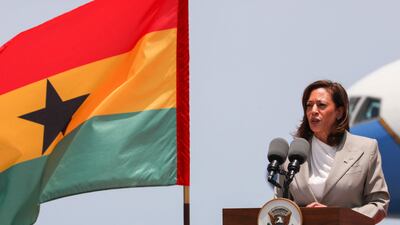
US Vice President Kamala Harris speaks with Ghanaian women entrepreneurs in Accra, Ghana, on March 29. AFP

Kamala Harris unveils $1 billion for African women's empowerment


  • English
  • Arabic

US Vice President Kamala Harris announced a more than $1 billion initiative to improve women's economic empowerment in Africa on Wednesday at the end of the first leg of a three-nation trip to the continent.

Ms Harris's office revealed the programme, a mixture of US government funding and private sector commitments, while in Ghana where she was visiting before travelling on to Tanzania and Zambia.

The tour follows up on a December summit held by President Joe Biden in Washington with African leaders as the US seeks to balance the growing influence of China and Russia on the continent.

Ms Harris has already announced $139 million in development and culture assistance for Ghana and a $100 million investment in stability and peace-building for coastal West African nations, who face the threat of violence spilling over from the Sahel.

Ms Harris meets with traditional leaders at Cape Coast Castle in Ghana on Tuesday, March 28. AP

The initiative for economic empowerment includes a $60 million fund for women in the digital economy and nearly $400 million from the private sector "to support closing the gender digital divide".

"Advancing the economic status of women and girls is not only a matter of human rights, justice, and fairness — it is also a strategic imperative that reduces poverty and promotes sustainable economic growth," her office said on Wednesday.

Another $528 million in private sector financing will help support women's economic empowerment in Africa, the statement said.

Closing the digital gap refers to programmes that will improve digital access and affordability for women, improve digital literacy and skills, as well as promote online security.

The US vice president on Tuesday visited Ghana's Cape Coast Castle, a Unesco World Heritage Site from where slaves were shipped to North and South America and the Caribbean.

She laid a wreath in honour of those who died during the slave trade, saying the horror of what happened there should always be remembered.

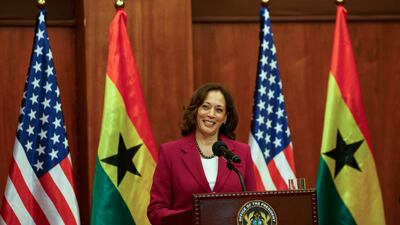
On Tuesday, in Ghana's capital Accra, Ms Harris called for more investments in innovation in Africa during a speech underlining her optimism for the continent.

She noted three areas of focus Washington believes could benefit from more investments: women's empowerment, the digital economy and good governance and democracy.

"We are all in on Africa," she added, repeating what Mr Biden said at the US-Africa leaders' summit last year.

Ms Harris left for Tanzania on Wednesday and will be in Zambia later in the week.

  • US Vice President Kamala Harris starts a three-country tour of Africa, promoting the White House's positive vision of the continent as the 'future of the world'. AFP
    US Vice President Kamala Harris starts a three-country tour of Africa, promoting the White House's positive vision of the continent as the 'future of the world'. AFP
  • Ms Harris's trip to Ghana, Tanzania and Zambia, is the latest salvo in deepening US engagement with a continent largely ignored under the previous administration. AFP
    Ms Harris's trip to Ghana, Tanzania and Zambia, is the latest salvo in deepening US engagement with a continent largely ignored under the previous administration. AFP
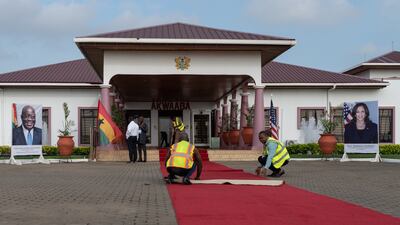
  • Workers roll out a red carpet as Ms Harris visits the African continent for the first time in an official capacity. Getty Images
    Workers roll out a red carpet as Ms Harris visits the African continent for the first time in an official capacity. Getty Images
  • Ms Harris is on a seven-day African visit that will also take her to Tanzania and Zambia. AP
    Ms Harris is on a seven-day African visit that will also take her to Tanzania and Zambia. AP
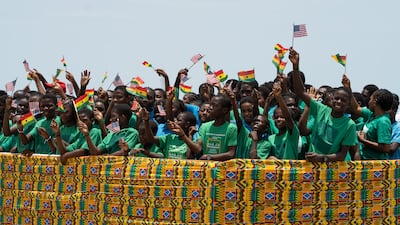
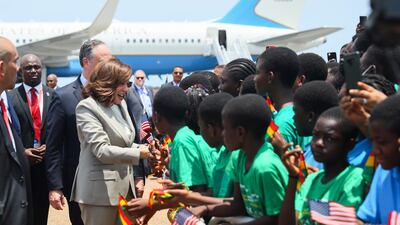
  • Schoolchildren wave Ghanaian and US flags to welcome Ms Harris. Getty Images
    Schoolchildren wave Ghanaian and US flags to welcome Ms Harris. Getty Images
  • Ms Harris takes time to shake hands with some of the children. AFP
    Ms Harris takes time to shake hands with some of the children. AFP
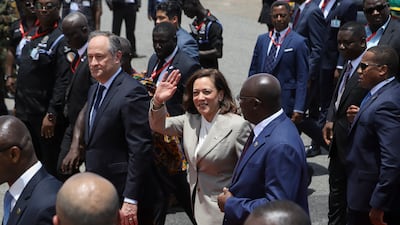
  • Ms Harris is welcomed by Minister for Foreign Affairs and Regional Integration of Ghana Shirley Ayorkor Botchwey. AFP
    Ms Harris is welcomed by Minister for Foreign Affairs and Regional Integration of Ghana Shirley Ayorkor Botchwey. AFP
  • Ms Harris poses with President of Ghana Nana Akufo-Addo as she arrives for their meeting at the Jubilee House presidential palace in Accra. AFP
    Ms Harris poses with President of Ghana Nana Akufo-Addo as she arrives for their meeting at the Jubilee House presidential palace in Accra. AFP
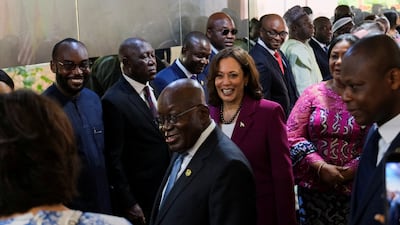
  • Mr Akufo-Addo introduces Ms Harris to some of the country's ministers upon her arrival. Reuters
    Mr Akufo-Addo introduces Ms Harris to some of the country's ministers upon her arrival. Reuters
  • Ms Harris's trip comes after a December summit hosted by President Joe Biden in Washington with US leaders and counterparts from Africa, a continent where China and Russia are enjoying rising influence. AFP
    Ms Harris's trip comes after a December summit hosted by President Joe Biden in Washington with US leaders and counterparts from Africa, a continent where China and Russia are enjoying rising influence. AFP
  • Ms Harris addresses a news conference. AP
    Ms Harris addresses a news conference. AP
Call of Duty: Black Ops 6

Developer: Treyarch, Raven Software
Publisher:  Activision
Console: PlayStation 4 & 5, Windows, Xbox One & Series X/S
Rating: 3.5/5

Top 10 in the F1 drivers' standings

1. Sebastian Vettel, Ferrari 202 points

2. Lewis Hamilton, Mercedes-GP 188

3. Valtteri Bottas, Mercedes-GP 169

4. Daniel Ricciardo, Red Bull Racing 117

5. Kimi Raikkonen, Ferrari 116

6. Max Verstappen, Red Bull Racing 67

7. Sergio Perez, Force India 56

8. Esteban Ocon, Force India 45

9. Carlos Sainz Jr, Toro Rosso 35

10. Nico Hulkenberg, Renault 26

UK%20record%20temperature
%3Cp%3E38.7C%20(101.7F)%20set%20in%20Cambridge%20in%202019%3C%2Fp%3E%0A

Sleep Well Beast
The National
4AD

The candidates

Dr Ayham Ammora, scientist and business executive

Ali Azeem, business leader

Tony Booth, professor of education

Lord Browne, former BP chief executive

Dr Mohamed El-Erian, economist

Professor Wyn Evans, astrophysicist

Dr Mark Mann, scientist

Gina MIller, anti-Brexit campaigner

Lord Smith, former Cabinet minister

Sandi Toksvig, broadcaster


What is the FNC?

The Federal National Council is one of five federal authorities established by the UAE constitution. It held its first session on December 2, 1972, a year to the day after Federation.
It has 40 members, eight of whom are women. The members represent the UAE population through each of the emirates. Abu Dhabi and Dubai have eight members each, Sharjah and Ras al Khaimah six, and Ajman, Fujairah and Umm Al Quwain have four.
They bring Emirati issues to the council for debate and put those concerns to ministers summoned for questioning. 
The FNC’s main functions include passing, amending or rejecting federal draft laws, discussing international treaties and agreements, and offering recommendations on general subjects raised during sessions.
Federal draft laws must first pass through the FNC for recommendations when members can amend the laws to suit the needs of citizens. The draft laws are then forwarded to the Cabinet for consideration and approval. 
Since 2006, half of the members have been elected by UAE citizens to serve four-year terms and the other half are appointed by the Ruler’s Courts of the seven emirates.
In the 2015 elections, 78 of the 252 candidates were women. Women also represented 48 per cent of all voters and 67 per cent of the voters were under the age of 40.
 

Mercer, the investment consulting arm of US services company Marsh & McLennan, expects its wealth division to at least double its assets under management (AUM) in the Middle East as wealth in the region continues to grow despite economic headwinds, a company official said.

Mercer Wealth, which globally has $160 billion in AUM, plans to boost its AUM in the region to $2-$3bn in the next 2-3 years from the present $1bn, said Yasir AbuShaban, a Dubai-based principal with Mercer Wealth.

Within the next two to three years, we are looking at reaching $2 to $3 billion as a conservative estimate and we do see an opportunity to do so,” said Mr AbuShaban.

Mercer does not directly make investments, but allocates clients’ money they have discretion to, to professional asset managers. They also provide advice to clients.

“We have buying power. We can negotiate on their (client’s) behalf with asset managers to provide them lower fees than they otherwise would have to get on their own,” he added.

Mercer Wealth’s clients include sovereign wealth funds, family offices, and insurance companies among others.

From its office in Dubai, Mercer also looks after Africa, India and Turkey, where they also see opportunity for growth.

Wealth creation in Middle East and Africa (MEA) grew 8.5 per cent to $8.1 trillion last year from $7.5tn in 2015, higher than last year’s global average of 6 per cent and the second-highest growth in a region after Asia-Pacific which grew 9.9 per cent, according to consultancy Boston Consulting Group (BCG). In the region, where wealth grew just 1.9 per cent in 2015 compared with 2014, a pickup in oil prices has helped in wealth generation.

BCG is forecasting MEA wealth will rise to $12tn by 2021, growing at an annual average of 8 per cent.

Drivers of wealth generation in the region will be split evenly between new wealth creation and growth of performance of existing assets, according to BCG.

Another general trend in the region is clients’ looking for a comprehensive approach to investing, according to Mr AbuShaban.

“Institutional investors or some of the families are seeing a slowdown in the available capital they have to invest and in that sense they are looking at optimizing the way they manage their portfolios and making sure they are not investing haphazardly and different parts of their investment are working together,” said Mr AbuShaban.

Some clients also have a higher appetite for risk, given the low interest-rate environment that does not provide enough yield for some institutional investors. These clients are keen to invest in illiquid assets, such as private equity and infrastructure.

“What we have seen is a desire for higher returns in what has been a low-return environment specifically in various fixed income or bonds,” he said.

“In this environment, we have seen a de facto increase in the risk that clients are taking in things like illiquid investments, private equity investments, infrastructure and private debt, those kind of investments were higher illiquidity results in incrementally higher returns.”

The Abu Dhabi Investment Authority, one of the largest sovereign wealth funds, said in its 2016 report that has gradually increased its exposure in direct private equity and private credit transactions, mainly in Asian markets and especially in China and India. The authority’s private equity department focused on structured equities owing to “their defensive characteristics.”

Updated: March 29, 2023, 11:13 PM