


The new chairman of Washington's House Foreign Affairs Committee has used his first hearing to warn of China's expanding global influence.
Republican Michael McCaul on Tuesday told the committee the US was embroiled in an "ideological battle" with the government in Beijing.
“We are living through one of the most dangerous periods in American foreign policy in a generation [in] a struggle for the global balance of power … we are also falling behind on the ideological battle,” Mr McCaul told the committee on Tuesday.
Among the 6.3 billion people who live outside the world's “liberal democracies”, 70 per cent feel positively towards China and 66 per cent towards Russia, a 2021 poll by the Centre for the Future of Democracy of the University of Cambridge showed.
Daniel Kritenbrink, assistant secretary at the State Department's Bureau of East Asian and Pacific Affairs, said Beijing represents Washington's “most consequential geopolitical challenge” as its only competitor with the intent and increased know-how to “reshape the international order".
“The scale and scope of the challenge posed by [China] as it becomes more repressive at home and more aggressive abroad will test American diplomacy like few issues we have seen,” he said.
The committee criticised Beijing's “coercive” expanding of foreign investment, including its historic Belt and Road Initiative.
Scott Nathan, chief executive of the US International Development Finance Corporation, told the committee that Beijing “burdens countries with unsustainable debt".
Mr Nathan proposed that Washington increase its efforts at private-sector investment in countries where Beijing operates, and agreed with some members' argument that countries are becoming disenchanted over China's navigation of the vast investment project.
“They often bring their own workers rather than create local jobs and show little respect for community environmental labour standards,” he said. "When the workers go home to projects left behind, [they] are often inappropriate for local conditions and are poor quality."
To date, 147 countries — accounting for two thirds of the world’s population and 40 per cent of global gross domestic product — have signed on to Belt and Road projects or indicated an interest in doing so, according to the Washington-based Council on Foreign Relations.
Mr McCaul, who has hinted that he believes the US could be at war with China by 2025, called for the hearing in the aftermath of the spy balloon scandal and on the heels of a bilateral meeting between China's President Xi Jinping and Russian President Vladimir Putin.
Suspected Chinese spy balloon shot down - in pictures
-
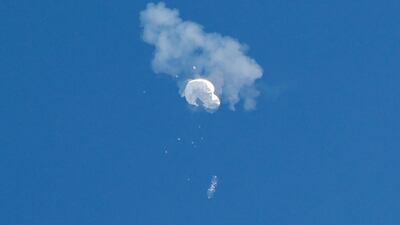
The suspected Chinese spy balloon drifts to the ocean after being shot down off the US coast, as seen from South Carolina. Reuters -
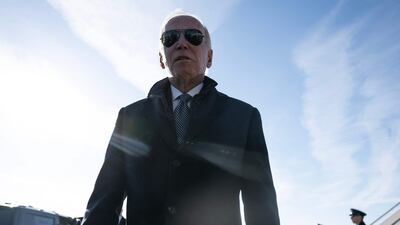
President Joe Biden congratulated fighter pilots for taking down the suspected spy balloon. AFP -

The balloon seen from Holden Beach. Reuters -
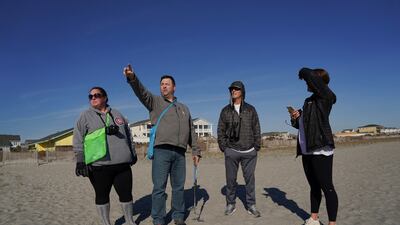
Spectators watch from the coast. Reuters -
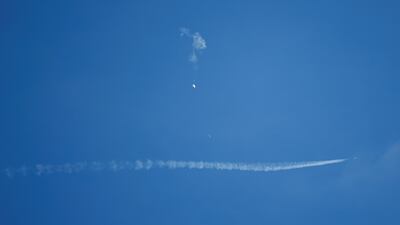
A jet flies by the balloon. Reuters -

Another spectator watches after the balloon was shot down. Reuters -
The suspected Chinese spy balloon over Billings, Montana. AFP


The committee chairman warned that that meeting would “strengthen their unholy alliance”, and condemned recent reports that Beijing is to send lethal weapons to Moscow as its war on Ukraine grinds into its second year.
China last week called for a ceasefire between Kyiv and Moscow, presenting a 12-point proposal to end the fighting.
Beijing insists it remains neutral on the conflict despite having refused to criticise the invasion of Ukraine or even refer to it as such.
Mr McCaul recently returned from a trip to Ukraine, where he led a congressional delegation to mark the war's sombre anniversary.
Tuesday's hearing, for which most seats available for observers were filled, demonstrated bipartisan concern for Chinese Communist Party influence and its possible assistance to Moscow, but a partisan divide over President Joe Biden's record on combating it.
Republicans called for a strengthening of export controls and criticised the administration over Department of Commerce approvals of tech sales with links to designated companies.
Democratic ranking member on the committee Gregory Meeks said the point highlighted by Republicans were “misleading and politicised without adequate context” and Democrats were set to later provide their own “explanatory document".
He said the Biden administration “deserves credit” for combating Beijing through the strengthening of Washington's political alliances.
“Our alliances and partnerships are our superpower and something Beijing cannot replicate,” Mr Meeks said. "Instead of taking unilateral steps that will be less effective and alienate us from our allies and partners, we must focus on working collectively to isolate Beijing."
-
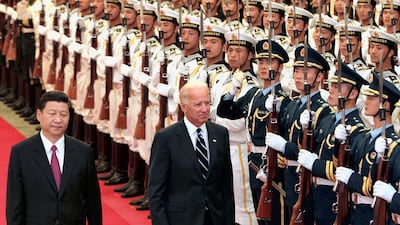
Chinese President Xi Jinping hosted US President Joe Biden in Beijing in 2011 when both men were vice presidents. Getty -
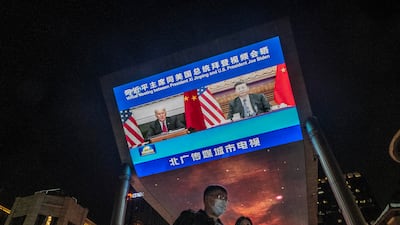
In 2021, the two leaders met for more than three hours and discussed trade, climate change, Taiwan and other issues. Getty -
The Pentagon said on February 2 it was tracking a suspected Chinese spy balloon flying high over the US, reviving tension between the two countries. AFP -
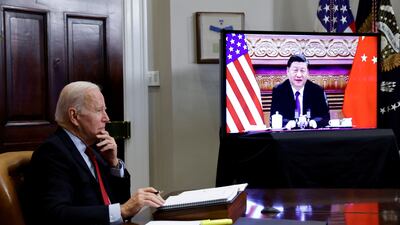
Mr Biden speaks virtually with Mr Jinping from the White House in Washington in November 2021. Reuters -
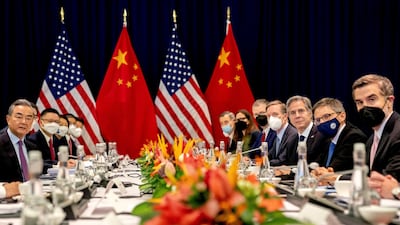
US Secretary of State Antony Blinken, centre right, and Chinese Foreign Minister Wang Yi, centre left, attend a meeting in Nusa Dua, Bali, Indonesia, in 2022. Reuters -
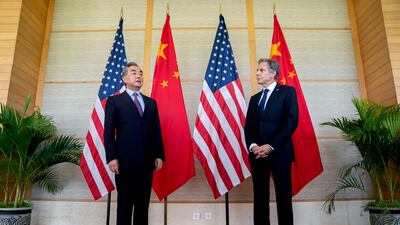
Mr Blinken and Mr Yi in 2022 in Bali. AFP -
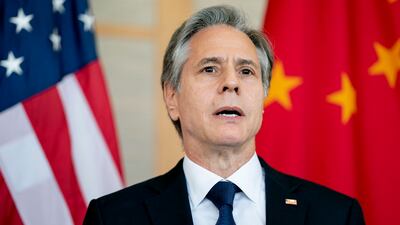
Mr Blinken scrapped a long-planned Beijing trip due to a suspected Chinese spy balloon hovering over Montana. AFP -
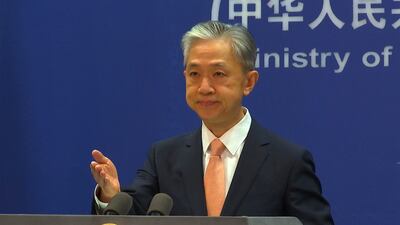
Chinese Ministry of Foreign Affairs spokesman Wang Wenbin criticised a speech made by Mr Blinken in May last year focused on countering China economically and militarily, saying the US was seeking to smear Beijing's reputation. AP



