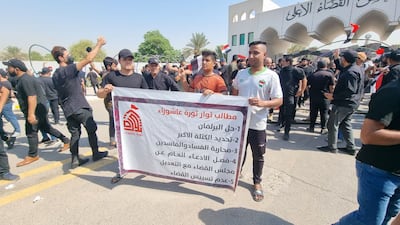
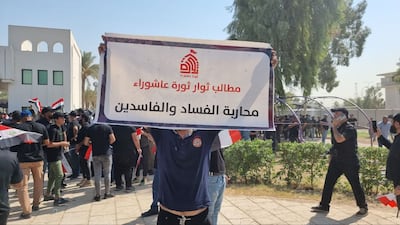
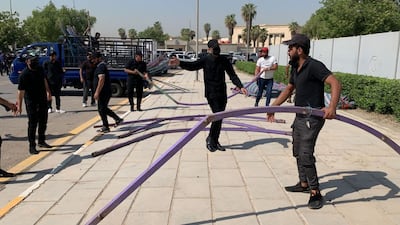
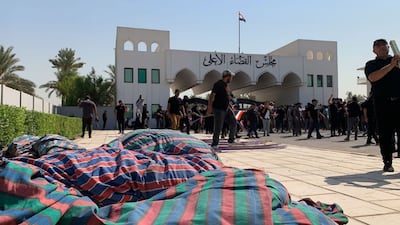
President Joe Biden's administration is finding its hands increasingly tied in Baghdad after violent clashes this week over the Iraqi government stalemate left at least 30 people dead and hundreds more injured.
Various US agencies are monitoring the violence as concerns grow of a return to internal armed conflict in Iraq, but there is no clear strategy from Washington on how to prevent it.
For nine months, the US has called on Iraqi parties to break the political impasse, form a government and protect state institutions. But US officials have refrained from direct engagement in negotiations over a cabinet formation.
Barbara Leaf, Assistant Secretary of State for Near East Affairs, this month told Congress that Iraqi leaders had urged Washington to enter the fray "for us to sort things out, to put the thumb on the scale in this standoff over government formation”.
“That's not something we're going to do,” Ms Leaf said.
On Tuesday, followers of Iraq's Shiite cleric Moqtada Al Sadr left Baghdad's heavily fortified Green Zone after he called for their withdrawal, ending violence at least for the moment.
Iraq’s government has been in deadlock since Mr Al Sadr’s party won the largest share of seats in parliamentary elections last October, but not enough to secure a majority government.
State Department deputy spokesman Vedant Patel on Monday said there were no Biden administration calls to Baghdad that he could outline, even as rockets were fired close to the US embassy compound in the Green Zone.
“The reports of unrest throughout Iraq today are disturbing, as Iraqi institutions are not being allowed to function,” he said, while denying reports that the American embassy had been evacuated.
"This in turn increases the risk of violence, and Iraq’s security, stability and sovereignty should not be put at risk.
“Now is the time for dialogue, and we urge all those involved to remain calm and pursue peaceful avenues of redress.”
Al Sadr followers gather outside Supreme Judiciary Council building in Baghdad – in pictures
Sarhang Hamasaeed, a scholar on Iraq and the director of Middle East Programmes at the US Institute of Peace, predicted a waning US influence on shaping politics in Baghdad.
“While the US is interested in a stable and democratic Iraq, it has very low influence and [low] desire to intervene in Iraq’s politics these days,” he told The National.
Washington’s options remain limited, he said, “because none of the actors that are party to the current escalation would heed its advice and it does not have leverage points to pressure them”.
The US does not have a strong rapport with the main stakeholders in the Baghdad troubles, namely the followers of cleric Moqtada Al Sadr and Iran’s allies in Iraq.
Working with the United Nations and Iraqi authorities to help protect state institutions may be the extent of Washington's efforts to calm the situation, Mr Hamasaeed said.
Avoiding becoming a party to the conflict and preventing a resurgence of ISIS by exploiting the potential vacuum define Washington’s priorities, he argued.
David Schenker, a senior fellow at the Washington Institute for Near East Policy, and a former assistant secretary of state, said the US government was late to the game and now faced an increasingly volatile situation.
“The Biden administration has not been seen as playing much of a role during the government formation process in the last year,” Mr Schenker told The National.
“Other than calling for calm, it’s not clear the US can do much right now to mitigate the crisis."
The former US official said the current volatility could strengthen Iran's hand, despite its proxies losing a majority to the Al Sadr camp in the 2021 elections.
“Despite having lost the elections, Iran and its allies are likely to emerge from this crisis in a strengthened position,” Mr Schenker said.
Both experts said Baghdad’s descent into a full-scale cycle of violence would be detrimental to US interests, especially if the political void dragged on and state institutions were weakened.

Avatar: Fire and Ash
Director: James Cameron
Starring: Sam Worthington, Sigourney Weaver, Zoe Saldana
Rating: 4.5/5
Ten tax points to be aware of in 2026
1. Domestic VAT refund amendments: request your refund within five years
If a business does not apply for the refund on time, they lose their credit.
2. E-invoicing in the UAE
Businesses should continue preparing for the implementation of e-invoicing in the UAE, with 2026 a preparation and transition period ahead of phased mandatory adoption.
3. More tax audits
Tax authorities are increasingly using data already available across multiple filings to identify audit risks.
4. More beneficial VAT and excise tax penalty regime
Tax disputes are expected to become more frequent and more structured, with clearer administrative objection and appeal processes. The UAE has adopted a new penalty regime for VAT and excise disputes, which now mirrors the penalty regime for corporate tax.
5. Greater emphasis on statutory audit
There is a greater need for the accuracy of financial statements. The International Financial Reporting Standards standards need to be strictly adhered to and, as a result, the quality of the audits will need to increase.
6. Further transfer pricing enforcement
Transfer pricing enforcement, which refers to the practice of establishing prices for internal transactions between related entities, is expected to broaden in scope. The UAE will shortly open the possibility to negotiate advance pricing agreements, or essentially rulings for transfer pricing purposes.
7. Limited time periods for audits
Recent amendments also introduce a default five-year limitation period for tax audits and assessments, subject to specific statutory exceptions. While the standard audit and assessment period is five years, this may be extended to up to 15 years in cases involving fraud or tax evasion.
8. Pillar 2 implementation
Many multinational groups will begin to feel the practical effect of the Domestic Minimum Top-Up Tax (DMTT), the UAE's implementation of the OECD’s global minimum tax under Pillar 2. While the rules apply for financial years starting on or after January 1, 2025, it is 2026 that marks the transition to an operational phase.
9. Reduced compliance obligations for imported goods and services
Businesses that apply the reverse-charge mechanism for VAT purposes in the UAE may benefit from reduced compliance obligations.
10. Substance and CbC reporting focus
Tax authorities are expected to continue strengthening the enforcement of economic substance and Country-by-Country (CbC) reporting frameworks. In the UAE, these regimes are increasingly being used as risk-assessment tools, providing tax authorities with a comprehensive view of multinational groups’ global footprints and enabling them to assess whether profits are aligned with real economic activity.
Contributed by Thomas Vanhee and Hend Rashwan, Aurifer
War 2
Director: Ayan Mukerji
Stars: Hrithik Roshan, NTR, Kiara Advani, Ashutosh Rana
Rating: 2/5
Classification of skills
A worker is categorised as skilled by the MOHRE based on nine levels given in the International Standard Classification of Occupations (ISCO) issued by the International Labour Organisation.
A skilled worker would be someone at a professional level (levels 1 – 5) which includes managers, professionals, technicians and associate professionals, clerical support workers, and service and sales workers.
The worker must also have an attested educational certificate higher than secondary or an equivalent certification, and earn a monthly salary of at least Dh4,000.
The National Archives, Abu Dhabi
Founded over 50 years ago, the National Archives collects valuable historical material relating to the UAE, and is the oldest and richest archive relating to the Arabian Gulf.
Much of the material can be viewed on line at the Arabian Gulf Digital Archive - https://www.agda.ae/en
Jeff Buckley: From Hallelujah To The Last Goodbye
By Dave Lory with Jim Irvin
More on animal trafficking
More on Quran memorisation:
Founders: Ines Mena, Claudia Ribas, Simona Agolini, Nourhan Hassan and Therese Hundt
Date started: January 2017, app launched November 2017
Based: Dubai, UAE
Sector: Private/Retail/Leisure
Number of Employees: 18 employees, including full-time and flexible workers
Funding stage and size: Seed round completed Q4 2019 - $1m raised
Funders: Oman Technology Fund, 500 Startups, Vision Ventures, Seedstars, Mindshift Capital, Delta Partners Ventures, with support from the OQAL Angel Investor Network and UAE Business Angels
Timeline
1947
Ferrari’s road-car company is formed and its first badged car, the 125 S, rolls off the assembly line
1962
250 GTO is unveiled
1969
Fiat becomes a Ferrari shareholder, acquiring 50 per cent of the company
1972
The Fiorano circuit, Ferrari’s racetrack for development and testing, opens
1976
First automatic Ferrari, the 400 Automatic, is made
1987
F40 launched
1988
Enzo Ferrari dies; Fiat expands its stake in the company to 90 per cent
2002
The Enzo model is announced
2010
Ferrari World opens in Abu Dhabi
2011
First four-wheel drive Ferrari, the FF, is unveiled
2013
LaFerrari, the first Ferrari hybrid, arrives
2014
Fiat Chrysler announces the split of Ferrari from the parent company
2015
Ferrari launches on Wall Street
2017
812 Superfast unveiled; Ferrari celebrates its 70th anniversary
Company%20profile
%3Cp%3E%3Cstrong%3ECompany%20name%3A%20%3C%2Fstrong%3EXare%C2%A0%3C%2Fp%3E%0A%3Cp%3E%3Cstrong%3EStarted%3A%20%3C%2Fstrong%3EJanuary%2018%2C%202021%C2%A0%3C%2Fp%3E%0A%3Cp%3E%3Cstrong%3EFounders%3A%20%3C%2Fstrong%3EPadmini%20Gupta%2C%20Milind%20Singh%2C%20Mandeep%20Singh%C2%A0%3C%2Fp%3E%0A%3Cp%3E%3Cstrong%3EBased%3A%20%3C%2Fstrong%3EDubai%C2%A0%3C%2Fp%3E%0A%3Cp%3E%3Cstrong%3ESector%3A%20%3C%2Fstrong%3EFinTech%C2%A0%3C%2Fp%3E%0A%3Cp%3E%3Cstrong%3EFunds%20Raised%3A%20%3C%2Fstrong%3E%2410%20million%C2%A0%3C%2Fp%3E%0A%3Cp%3E%3Cstrong%3ECurrent%20number%20of%20staff%3A%20%3C%2Fstrong%3E28%C2%A0%3C%2Fp%3E%0A%3Cp%3E%3Cstrong%3EInvestment%20stage%3A%20%3C%2Fstrong%3Eundisclosed%3C%2Fp%3E%0A%3Cp%3E%3Cstrong%3EInvestors%3A%20%3C%2Fstrong%3EMS%26amp%3BAD%20Ventures%2C%20Middle%20East%20Venture%20Partners%2C%20Astra%20Amco%2C%20the%20Dubai%20International%20Financial%20Centre%2C%20Fintech%20Fund%2C%20500%20Startups%2C%20Khwarizmi%20Ventures%2C%20and%20Phoenician%20Funds%3C%2Fp%3E%0A
Citizenship-by-investment programmes
United Kingdom
The UK offers three programmes for residency. The UK Overseas Business Representative Visa lets you open an overseas branch office of your existing company in the country at no extra investment. For the UK Tier 1 Innovator Visa, you are required to invest £50,000 (Dh238,000) into a business. You can also get a UK Tier 1 Investor Visa if you invest £2 million, £5m or £10m (the higher the investment, the sooner you obtain your permanent residency).
All UK residency visas get approved in 90 to 120 days and are valid for 3 years. After 3 years, the applicant can apply for extension of another 2 years. Once they have lived in the UK for a minimum of 6 months every year, they are eligible to apply for permanent residency (called Indefinite Leave to Remain). After one year of ILR, the applicant can apply for UK passport.
The Caribbean
Depending on the country, the investment amount starts from $100,000 (Dh367,250) and can go up to $400,000 in real estate. From the date of purchase, it will take between four to five months to receive a passport.
Portugal
The investment amount ranges from €350,000 to €500,000 (Dh1.5m to Dh2.16m) in real estate. From the date of purchase, it will take a maximum of six months to receive a Golden Visa. Applicants can apply for permanent residency after five years and Portuguese citizenship after six years.
“Among European countries with residency programmes, Portugal has been the most popular because it offers the most cost-effective programme to eventually acquire citizenship of the European Union without ever residing in Portugal,” states Veronica Cotdemiey of Citizenship Invest.
Greece
The real estate investment threshold to acquire residency for Greece is €250,000, making it the cheapest real estate residency visa scheme in Europe. You can apply for residency in four months and citizenship after seven years.
Spain
The real estate investment threshold to acquire residency for Spain is €500,000. You can apply for permanent residency after five years and citizenship after 10 years. It is not necessary to live in Spain to retain and renew the residency visa permit.
Cyprus
Cyprus offers the quickest route to citizenship of a European country in only six months. An investment of €2m in real estate is required, making it the highest priced programme in Europe.
Malta
The Malta citizenship by investment programme is lengthy and investors are required to contribute sums as donations to the Maltese government. The applicant must either contribute at least €650,000 to the National Development & Social Fund. Spouses and children are required to contribute €25,000; unmarried children between 18 and 25 and dependent parents must contribute €50,000 each.
The second step is to make an investment in property of at least €350,000 or enter a property rental contract for at least €16,000 per annum for five years. The third step is to invest at least €150,000 in bonds or shares approved by the Maltese government to be kept for at least five years.
Candidates must commit to a minimum physical presence in Malta before citizenship is granted. While you get residency in two months, you can apply for citizenship after a year.
Egypt
A one-year residency permit can be bought if you purchase property in Egypt worth $100,000. A three-year residency is available for those who invest $200,000 in property, and five years for those who purchase property worth $400,000.
Source: Citizenship Invest and Aqua Properties
Key findings of Jenkins report
- Founder of the Muslim Brotherhood, Hassan al Banna, "accepted the political utility of violence"
- Views of key Muslim Brotherhood ideologue, Sayyid Qutb, have “consistently been understood” as permitting “the use of extreme violence in the pursuit of the perfect Islamic society” and “never been institutionally disowned” by the movement.
- Muslim Brotherhood at all levels has repeatedly defended Hamas attacks against Israel, including the use of suicide bombers and the killing of civilians.
- Laying out the report in the House of Commons, David Cameron told MPs: "The main findings of the review support the conclusion that membership of, association with, or influence by the Muslim Brotherhood should be considered as a possible indicator of extremism."