

US President Joe Biden on Tuesday, surrounded by Democratic leaders, signed into law the Inflation Reduction Act, one of the most consequential pieces of economic policy in recent history.
"With this law, the American people won and the special interests lost," said Mr Biden. "Today offers further proof that the soul of America is vibrant, the future of America is bright, and the promise of America is real and just beginning."
The spending bill is aimed at tackling climate change and the high cost of prescription drugs as well as lowering Washington's deficit by about $300 billion.
Democrats have called it “the fourth leg” of the Biden administration's legislative agenda, the most recent success after a string of key bills from the majority party.
The president plans to host a larger “celebration” on September 6 once members of Congress return to Washington from work in their districts.
In a memo to congressional Democrats obtained by The National, House Speaker Nancy Pelosi urged party members to use their district work weeks to emphasise the major bill as critical midterm elections approach.
"From the kitchen table to the Arctic Circle, the impacts of our Inflation Reduction Act will be wide-reaching, long-lasting and life-changing ... tomorrow, we continue our ferocious fight until the planet is saved for generations to come," Ms Pelosi wrote.

But the Inflation Reduction Act's journey to the White House was not without opposition, gaining no support from the Republican Party.
US conservatives have called the bill the “Inflation Expansion Act” and have raised alarm over its multibillion-dollar expansion of the federal taxation department, the Internal Revenue Service.
Health care
The Inflation Reduction Act delivers on two major Democratic election promises on health care: the expansion of cheaper care for millions of Americans and allowing Medicare to negotiate the costs of prescription drugs.
“As a result of this legislation, Medicare will finally have the tools and authority to negotiate with manufacturers to lower the prices of certain high-cost prescription drugs for the first time ever,” House Majority Leader Steny Hoyer told reporters at a press conference before the Friday House vote.
This measure has a 76 per cent approval rating among American voters, according to a Morning Consult/Politico survey.
The law has also capped insulin costs for those insured by Medicare, the national health insurance programme for low-income Americans, at $35 a month.
Democrats had hoped to expand that to include Americans with private insurance as well, but Republicans blocked the wider protections.
Climate
Democrats are celebrating what they call “the biggest investment to combat climate change ever”, with the Inflation Reduction Act aiming to reduce carbon emissions by about 40 per cent by 2030.
But this falls short of Mr Biden’s goal of cutting US emissions by at least 50 to 52 per cent below 2005 levels by 2030.
The bill has offered a series of tax incentives on wind, solar, hydropower and other renewables as well as a push towards electric vehicle ownership.
For example, buyers of new electric vehicles would receive a $7,500 tax credit applied at the point of purchase.
It also extended the Black Lung Disability Trust Fund, which has covered benefits for about 25,000 coal miners suffering from black lung disease.
-

An Audi e-tron at the Electric Vehicle Innovation Summit (EVIS) being held at the Abu Dhabi National Exhibition Centre. All photos by Antonie Robertson / The National -

A Nissan Ariya electric model at EVIS. -

Visitors check out an electric vehicle at the show. -
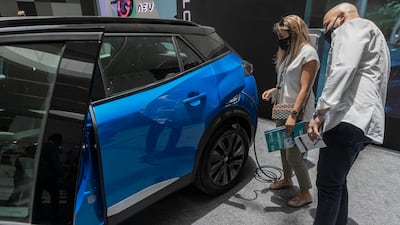
An electric Peugeot model at EVIS. -

Visitors watch as an electric car is charged at EVIS. -

Visitors check out the UAE's first locally produced electric car, Al Damani. The vehicle is manufactured by the M Glory Group. -

The Ferrari stand at the electric vehicle car show. -

The Emirates Global Motor Electric stand. The UAE is seeking to position itself as a leader in the next generation of transport. -
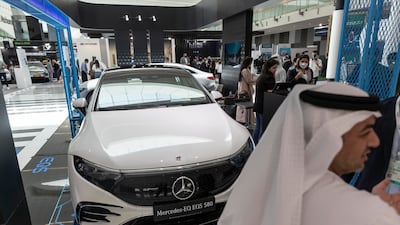
A Mercedes Benz electric car on display at the show. -
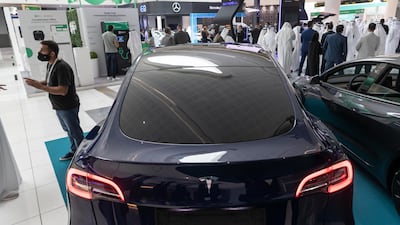
Tesla is also exhibiting its cars at the show, the Mena region's first exhibition focused on electric vehicles. -

The interior of an Audi e-tron.


But Senate Democrats were forced to make climate concessions due to a member of their own party, Joe Manchin from West Virginia. To earn his critical vote, Democrats agreed to mandate new oil and gas leasing, and backed future permits for oil pipelines and other infrastructure.
Climate activists such as the Sunrise Movement, which has lobbied for a more-aggressive “Green New Deal”, have said the Inflation Reduction Act is an important step that does not go far enough.
“It is both a historic investment in climate action that would have been unimaginable just a few years ago, and contains massive handouts to fossil fuel millionaires,” Varshini Prakash, the Sunrise Movement's executive director, said in a memo.
Deficit, inflation and taxation
The Congressional Budget Office projected the Inflation Reduction Act would result in a net deficit decrease of $102bn between 2022 and 2031.
And the non-partisan Committee for a Responsible Federal Budget estimated that over a 20-year period, the bill will result in about $900bn in spending and tax cuts, $2.4 trillion in offsets, and roughly $400bn in net interest savings.
Under the new law, businesses making more than $1bn a year will face a 15 per cent corporate minimum tax. Republicans have said that the measure will hurt the US economy and raise consumer prices as Americans face fears of recession and the highest inflation rate in more than 40 years.
The Congressional Budget Office concluded in their analysis that the law would have a “negligible” impact on inflation in the next two years.
Republicans on the House floor pointed to the University of Pennsylvania's Penn Wharton Budget Model, which concluded that over the next decade, “the impact on inflation is statistically indistinguishable from zero”.
IRS expansion and Republican claims
Republicans have repeatedly decried the Inflation Reduction Act's nearly $80bn in new funding for the IRS over nine years, which would increase the agency's annual spending by an estimated $14.6bn by 2031, the budget office analysis showed.
Scepticism has mounted into outright conspiracy theory, with Republican Lauren Boebert echoing right-wing claims on the House floor that the legislation will send 87,000 “armed” IRS agents to “use deadly force if necessary” against Americans.
This claim has been debunked by independent fact checkers.

Democrats asserted the increased financing will increase crackdowns on high-income tax cheats and will provide the department with critical infrastructure updates, but will not be used to increase auditing of everyday Americans.
But US conservatives have largely rejected the notion that an emboldened IRS will not increase the number of audits.
“If the Inflation Reduction Act … is signed into law, get ready to dust off your copy of the 7,000-page tax code and 14,000 pages of IRS regulations,” senior tax policy analyst at conservative think tank The Heritage Foundation wrote.
But US Treasury Secretary Janet Yellen wrote in an August 10 letter that: “I direct that any additional resources — including any new personnel or auditors that are hired — shall not be used to increase the share of small business or households below the $400,000 threshold that are audited relative to historical levels.”
The letter said that “audit rates will not rise relative to recent years for households making under $400,000 annually” and that “enforcement resources will focus on high-end non-compliance”.
Animals being wiped out by climate change — in pictures
-

Some of the planet’s most stunning creatures, including giraffes and parrots, are at risk from global warming and other human-induced environmental change, the UN has warned. Photo: AFP -

Giraffes stand by the shade of a tree in Murchison Falls National Park, Uganda. Photo: AP -

Some analysts have concluded that the likes of toucans, puffins and hummingbirds may face particularly uncertain futures. Photo: EPA -

A hummingbird flies at a garden in Caracas, the capital of Venezuela. Photo: AFP -

Wildfires in southern France. Tree species are facing several threats including an increase in the frequency of wildfires due to climate change and deforestation because of industry, agriculture and firewood. Photo: AFP



