Thanks largely to falling gas prices, the US inflation report for July showed that consumer price inflation fell to 8.5 per cent from 9.1 per cent in June. AP

US inflation eases in July as petrol prices dip


  • English
  • Arabic

The rate of US inflation fell in July, government data showed, with falling petrol prices providing some relief for Americans who dealt with price increases in June.

Consumer prices were up 8.5 per cent year-on-year in July, the US Labour Department reported, down from a 9.1 per cent rise in June.

Besides petrol, other consumer prices which sank from June to July were airfares, which dropped nearly 8 per cent. Hotel room costs fell 2.7 per cent and used car prices dropped 0.4 per cent. Such items had previously delivered some of the economy’s steepest price jumps.

Those declines lowered so-called core inflation, a measure that excludes the volatile food and energy categories to provide a clearer picture of underlying inflation. Core prices rose 0.3 per cent from June, the smallest month-to-month increase since April.

Wednesday's report raised hopes that the Federal Reserve will announce a less-aggressive interest rate increase at its meeting in September. The central bank has raised the key interest rate by 75 basis points in back-to-back meetings in an attempt to cool down the nation's 40-year high inflation.

President Joe Biden said the report was “some good economic news” that showed the “kind of economy we’ve been building”. But he acknowledged that the work is “far from over”.

Last week's job report, which showed that the economy added 528,000 jobs in July, heightened expectations the Fed would issue another three-quarter-point increase.

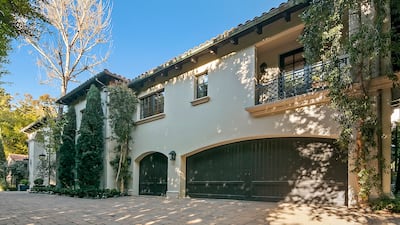
What $20 million can buy you in California — in pictures

The White House has pointed to lowering gas prices as a sign that its policies are easing costs that have strained Americans' finances, while the topic has become a central issue for Republicans as they look to gain control of at least one chamber of Congress in the midterm elections.

Mr Biden's approval rating has jumped to its highest in two months, data from a recent Reuters/Ipsos poll showed. Approval rose to 40 per cent, while disapproval fell to 55 per cent.

The president's modest poll boost comes as he has scored several notable victories, including passing a multibillion dollar semiconductor bill, expanding healthcare access for veterans and conducting a successful drone strike on Al Qaeda leader Ayman Al Zawahiri.

On Friday, the US House is expected to approve a renewed economic and climate package pushed by Mr Biden and top Democratic politicians.

Some analysts have said the legislation, named the Inflation Reduction Act, would have a negligible effect on soaring consumer prices.

Agencies contributed to this report

Mercer, the investment consulting arm of US services company Marsh & McLennan, expects its wealth division to at least double its assets under management (AUM) in the Middle East as wealth in the region continues to grow despite economic headwinds, a company official said.

Mercer Wealth, which globally has $160 billion in AUM, plans to boost its AUM in the region to $2-$3bn in the next 2-3 years from the present $1bn, said Yasir AbuShaban, a Dubai-based principal with Mercer Wealth.

Within the next two to three years, we are looking at reaching $2 to $3 billion as a conservative estimate and we do see an opportunity to do so,” said Mr AbuShaban.

Mercer does not directly make investments, but allocates clients’ money they have discretion to, to professional asset managers. They also provide advice to clients.

“We have buying power. We can negotiate on their (client’s) behalf with asset managers to provide them lower fees than they otherwise would have to get on their own,” he added.

Mercer Wealth’s clients include sovereign wealth funds, family offices, and insurance companies among others.

From its office in Dubai, Mercer also looks after Africa, India and Turkey, where they also see opportunity for growth.

Wealth creation in Middle East and Africa (MEA) grew 8.5 per cent to $8.1 trillion last year from $7.5tn in 2015, higher than last year’s global average of 6 per cent and the second-highest growth in a region after Asia-Pacific which grew 9.9 per cent, according to consultancy Boston Consulting Group (BCG). In the region, where wealth grew just 1.9 per cent in 2015 compared with 2014, a pickup in oil prices has helped in wealth generation.

BCG is forecasting MEA wealth will rise to $12tn by 2021, growing at an annual average of 8 per cent.

Drivers of wealth generation in the region will be split evenly between new wealth creation and growth of performance of existing assets, according to BCG.

Another general trend in the region is clients’ looking for a comprehensive approach to investing, according to Mr AbuShaban.

“Institutional investors or some of the families are seeing a slowdown in the available capital they have to invest and in that sense they are looking at optimizing the way they manage their portfolios and making sure they are not investing haphazardly and different parts of their investment are working together,” said Mr AbuShaban.

Some clients also have a higher appetite for risk, given the low interest-rate environment that does not provide enough yield for some institutional investors. These clients are keen to invest in illiquid assets, such as private equity and infrastructure.

“What we have seen is a desire for higher returns in what has been a low-return environment specifically in various fixed income or bonds,” he said.

“In this environment, we have seen a de facto increase in the risk that clients are taking in things like illiquid investments, private equity investments, infrastructure and private debt, those kind of investments were higher illiquidity results in incrementally higher returns.”

The Abu Dhabi Investment Authority, one of the largest sovereign wealth funds, said in its 2016 report that has gradually increased its exposure in direct private equity and private credit transactions, mainly in Asian markets and especially in China and India. The authority’s private equity department focused on structured equities owing to “their defensive characteristics.”

Du Football Champions

The fourth season of du Football Champions was launched at Gitex on Wednesday alongside the Middle East’s first sports-tech scouting platform.“du Talents”, which enables aspiring footballers to upload their profiles and highlights reels and communicate directly with coaches, is designed to extend the reach of the programme, which has already attracted more than 21,500 players in its first three years.

The%20specs
%3Cp%3E%3Cstrong%3EEngine%3A%20%3C%2Fstrong%3E3.0-litre%20twin-turbo%20V6%0D%3Cbr%3E%3Cstrong%3ETransmission%3A%20%3C%2Fstrong%3E10-speed%20auto%0D%3Cbr%3E%3Cstrong%3EPower%3A%20%3C%2Fstrong%3E400bhp%0D%3Cbr%3E%3Cstrong%3ETorque%3A%20%3C%2Fstrong%3E563Nm%0D%3Cbr%3E%3Cstrong%3EPrice%3A%20%3C%2Fstrong%3EDh320%2C000%0D%3Cbr%3E%3Cstrong%3EOn%20sale%3A%3C%2Fstrong%3E%20Now%3C%2Fp%3E%0A

Russia's Muslim Heartlands

Dominic Rubin, Oxford

Two-step truce

The UN-brokered ceasefire deal for Hodeidah will be implemented in two stages, with the first to be completed before the New Year begins, according to the Arab Coalition supporting the Yemeni government.

By midnight on December 31, the Houthi rebels will have to withdraw from the ports of Hodeidah, Ras Issa and Al Saqef, coalition officials told The National. 

The second stage will be the complete withdrawal of all pro-government forces and rebels from Hodeidah city, to be completed by midnight on January 7.

The process is to be overseen by a Redeployment Co-ordination Committee (RCC) comprising UN monitors and representatives of the government and the rebels.

The agreement also calls the deployment of UN-supervised neutral forces in the city and the establishment of humanitarian corridors to ensure distribution of aid across the country.

Updated: August 10, 2022, 5:02 PM