



The Biden administration is providing $89 million in de-mining assistance to Ukraine to fund 100 teams to be sent to the country over the next year, a State Department official said on Tuesday.
The official said that the push, the largest de-mining effort for the US in Ukraine, is in direct response to the “overwhelming humanitarian needs caused by Russia's unlawful, unprovoked invasion".
The US accused Russian forces of using explosive munitions in irresponsible and brutal manner, “causing civilian casualties, extensive harm to vital civilian infrastructure and contaminating a massive amount of Ukraine's territory with unexploded ordnance".
The assistance will be sent within weeks. It will be used in areas where Russia retreated in Ukraine, an area as big as 160,000 square kilometres that may be scattered with landmines and unexploded ordnance.
-

Family members from three generations were huddled on the back of a pickup truck for what started as a joyful ride through the Syrian countryside for Abdulaziz al-Oqab and his relatives. All photos: AFP -
They were planning to sample the long-forgotten peacetime pleasure of a simple family picnic when a landmine brought a bloody end to their outing, and to the lives of 21 family members. -

Mr al-Oqab walked away with relatively light wounds that day in February 2019, but the blast killed his wife, two of his sons, four of his siblings, an uncle and other family members, and left others maimed. -
'It was a day of joy that turned into tragedy,' the man, 41, told AFP. 'I've come to hate going out since then. People live in fear of this faceless killer that could be anywhere.' -

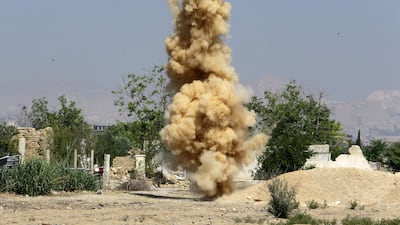
Remnants of explosives laid by all sides in the 11-year-old civil war are now claiming more lives in Syria than anywhere else in the world, says the United Nations. -
The UN Mine Action Service said 15,000 people have been killed or injured by explosive devices in Syria since 2015. -
This is a 'huge number', said Habibulhaq Javed, who heads Syria's UNMAS team. 'Currently, Syria is reporting the highest number of victims caused by explosive ordnance globally.' -

About 10.2 million people, or roughly half of all Syrians, live in areas contaminated with explosive devices, the UN says. -
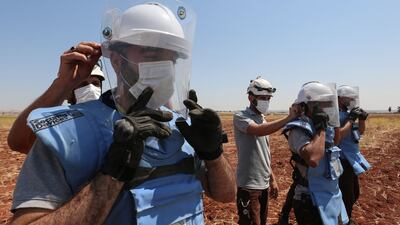
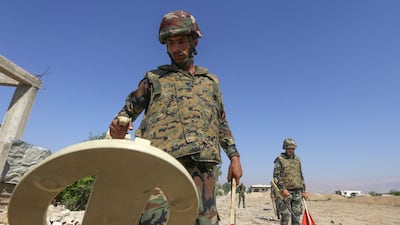
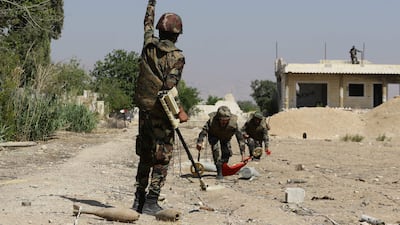
'Mines have a long lifespan,' said a Syrian army officer, who asked not to be named over security concerns. They stay lethal even longer if they are kept inside casings, he told AFP during a demining training exercise organised by the military near Damascus. -
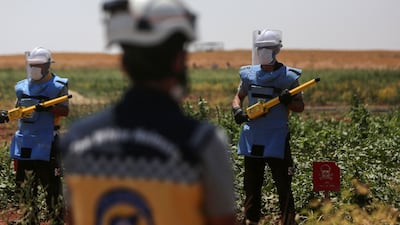
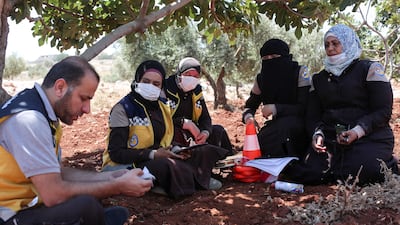
In Syria's rebel-held north, it is rescue workers who take on the daunting task of sweeping for landmines and detonating them, in the absence of state support. The White Helmets rescue group has even set up training and workshops to raise awareness on the dangers landmines pose. -

Raed Hassoun of the White Helmets heads a demining centre in Syria's north-west that has neutralised about 24,000 explosive devices since 2016. 'We deal with unexploded ordnance according to one principle,' he said. 'Your first mistake is your last.' -

A lack of resources is depriving most of Syria's towns and villages of vital mine clearance work. -

Agencies are struggling with limited funding for demining programmes and civilians often pay the price as a result. -
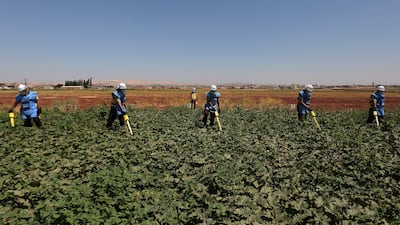
They include the family of Zakia al-Boushi who, on a fateful day in 2017, went out with eight relatives in Aleppo province searching for the precious white truffles that grow in the desert sands in winter. Only three of them returned alive.


“That's an area roughly the size of [the US states of] Virginia, Maryland and Connecticut combined,” the US official said.
The official said that same area included about 10 per cent of Ukraine's farmland, making this a hazardous problem directly contributing to food insecurity worldwide.
The official said that Ukraine would be leading the efforts, but that the US government was working with Kyiv to identify specific training sites and addressing the most contaminated areas.
The tactics that Russia has used are similar to those of ISIS in Syria and Iraq, the official said.
“This horrific use of improvised explosive devices by Russia’s forces is reminiscent of ISIS tactics in Iraq and Syria, where ISIS terrorists sought to inflict as many civilian casualties as possible and make people afraid to return home."
But the US effort will not involve sending American personnel to Ukraine for now, nor will it relate to areas that Russia now controls.
“We do not envision any US government personnel being on the ground providing hands-on assessment or explosive ordnance as part of this $89m assistance package," the official said.
"This assistance is going to be implemented exclusively by NGOs and contractors."
The official told The National that the US is already doing work with the Halo Trust charity, which has developed a unique system of tracking down live bombs.
According to Human Rights Watch, Russian forces have used at least seven types of anti-personnel mines in at least four regions of Ukraine: Donetsk, Kharkiv, Kyiv and Sumy.
“This marks an unusual situation in which a country that is not party to the 1997 Mine Ban Treaty uses the weapon on the territory of a party to the treaty,” the organisation said.

