

Journalist Farida Sial will always remember May 22 as the day her life at Tolo News changed completely.
Members of the Taliban’s Vice and Virtue Ministry visited the news station to enforce an order announced days before that required all female TV news presenters to cover their faces while on air.
“I remember that morning,” Sial, 26, told The National. “It was such a difficult time. It was shocking and a very sad day for us.”
Afghan women defy Taliban — in pictures
-

Zakia, an economics student who had to abandon her studies when the Taliban took control of Afghanistan in August, at her home in the capital Kabul, where women are coming together to stand against the hardline regime. All photos: AFP -
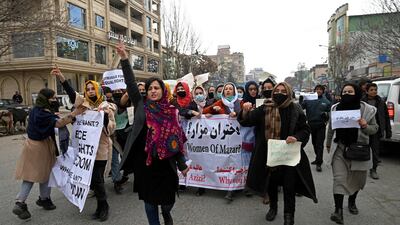
She is part of a growing group that started with 15 activists, mostly women in their 20s who already knew each other. Now a network of dozens of women work in secret to organise protests. -
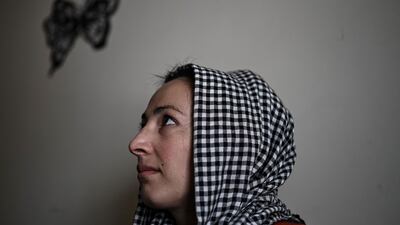
Hoda Khamosh, a published poet and former NGO worker who organised workshops to help empower women, vets newcomers to the group to ensure they can be trusted. -
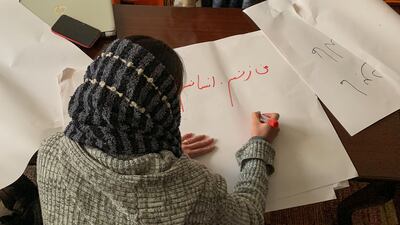
One test she sets is to ask them to prepare banners or slogans at short notice - she can sense passion for the cause from women who deliver quickly. -

Other tests yield even clearer results. Hoda says one potential recruit was given a fake date and time for a demonstration. The Taliban turned up ahead of the supposed protest, and all contact was cut with the woman suspected of tipping off officials. -

A core group of the activists use a dedicated phone number to co-ordinate on the day of a protest. That number is later disconnected to ensure it is not being tracked. -
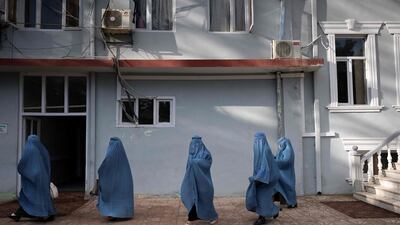
"We usually carry an extra scarf or an extra dress. When the demonstration is over, we change our clothes so we cannot be recognised," says Hoda. -

She has changed her phone number several times and her husband has received threats. "We could still be harmed, it's exhausting. But all we can do is persevere," she says.


The Information and Culture Ministry said the policy was “final and non-negotiable”.
“We are trying to adjust to wearing face coverings and present the news, but it is very difficult for me. It is not my choice,” Sial said.
“The Taliban is trying to remove us from public life. These orders have one aim: that women should be sitting at home.”
In an act of solidarity with their female colleagues, the channel’s male journalists and presenters, including the station’s main anchor, covered their faces with masks.
But speaking out against the regime comes with consequences. Sial said journalists could pay with their lives for complaining about the restrictions.
When the Taliban were last in power in Afghanistan from 1996-2001, they enacted harsh restrictions on women, requiring them to wear the burqa and barring them from public life.
After they seized power again in August 2021, the Taliban initially appeared to have moderated their stance.
They did not immediately announce a dress code for women and vowed to respect their rights within the norms of Islamic law.
But in recent months, the Taliban have made a sharp, hard-line turn, ordering women to wear head-to-toe clothing that leaves only their eyes visible.
The decree said they should leave the home only when necessary and that male relatives would face punishment for women’s dress code breaches.
Teenage girls have been barred from attending school.

This has left women journalists fearful they will soon be completely erased from TV screens.
“If they say we are obligated to wear a burqa, I’m sure we have lost our jobs,” Sial said.
“It is impossible being on screen wearing a burqa. This is not part of Afghan culture and also this is not part of Islam.”
She called on the international community to pressure the Taliban to guarantee women’s rights in Afghanistan.
“The US and their allies left Afghan people, especially women, in a very hard situation,” Sial said.
AP contributed to this report

