



US President Joe Biden may not bring home any term-defining wins from his historic Middle East tour, but the visit may be enough to assure regional leaders he still values America's partners in the Gulf.
Over four days, the US leader met counterparts from more than a dozen countries as he travelled to Israel, the occupied West Bank and Saudi Arabia. He was looking to shore up support, patch strained ties and tout the benefits of further integrating Israel with Arab states.
At Saturday's Jeddah Security and Development Summit, which brought together leaders of the GCC as well as Jordan, Egypt and Iraq, Mr Biden said he didn't always get things right but was “committed” to being an “engaged partner in the Middle East.”
The president's mere presence in Saudi Arabia, a country he once said he would make a “pariah” following the murder of Saudi dissident and US resident Jamal Khashoggi in 2018, has drawn rebuke in the US ― even though he said his stance was aimed at "reorienting" America's relationship with the kingdom, not "rupturing" it.
His fist bump with Crown Prince Mohammed bin Salman, upon arriving at Al Salam Palace here, was on the front page of every major US newspaper on Saturday.
“I think it’s a big win for the Saudis, no question,” said Bernard Haykel, a professor of Near Eastern Studies at Princeton University. “A big win for the crown prince.”
The fact that Biden chose to come to Jeddah “signals that the president and the United States are going to be much more present, much more active in the Middle East,” Professor Haykel told The National.
The president is currently lagging in the polls, with his approval rating in the low 30s.
-
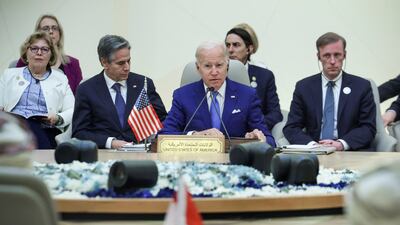
US President Joe Biden attends the GCC+3 summit in Jeddah, Saudi Arabia. Reuters -
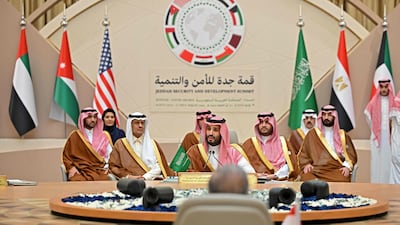
Saudi Crown Prince Mohammed bin Salman speaks during the Jeddah Security and Development Summit. AFP -
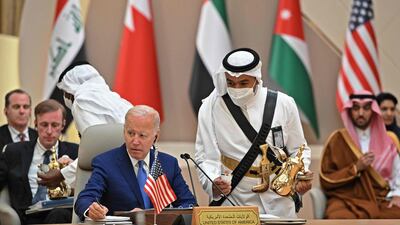
Mr Biden takes notes while an usher serves coffee during the Jeddah Security and Development Summit. AFP -
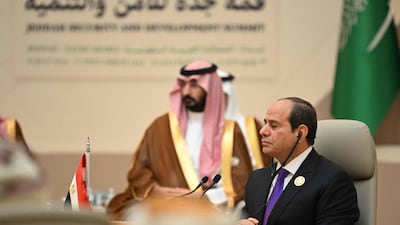
Egypt's President Abdel Fattah El Sisi attends the Jeddah Security and Development Summit. AFP -
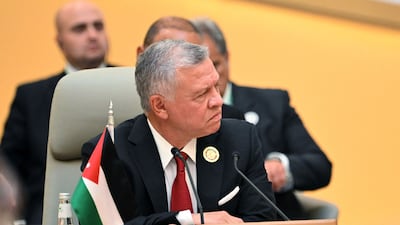
Jordan's King Abdullah II attends the Jeddah Security and Development Summit. AFP -
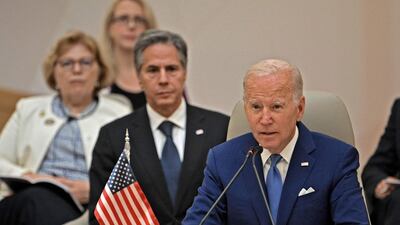
Mr Biden speaks during the GCC+3 meeting. AFP -
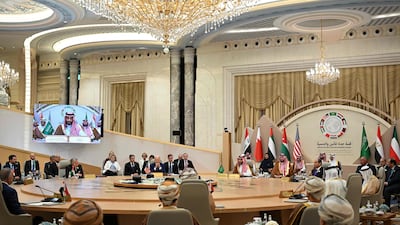
Leaders and representatives of the Gulf Co-operation Council countries, as well as the US, Egypt, Iraq, and Jordan, attend the Jeddah Security and Development Summit. AFP -
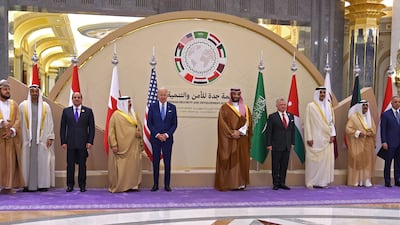
From left: Asa'ad bin Tariq Al Said, Deputy Prime Minister of Oman and Special Representative of the Sultan, the UAE's President, Sheikh Mohamed, Egypt's President Abdel Fattah El Sisi, Bahrain's King Hamad, US President Joe Biden, Saudi Crown Prince Mohammed bin Salman; Jordan's King Abdullah II, Qatar's Emir Sheikh Tamim bin Hamad Al Thani, Kuwait's Crown Prince Mishal Al Sabah, and Iraq's Prime Minister Mustafa Al Kadhimi, during the Jeddah Security and Development Summit. Photo: Jordanian Royal Palace / AFP -
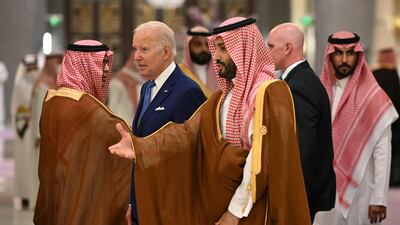
US President Joe Biden and Saudi Crown Prince Mohammed bin Salman arrive for the family photo. AP -
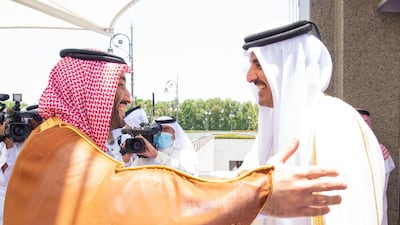
Crown Prince Mohammed receives Sheikh Tamim bin Hamad Al Thani, Emir of Qatar. SPA -
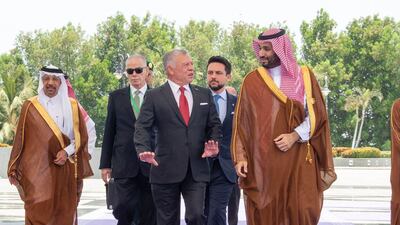
Crown Prince Mohammed bin Salman receives Jordan's King Abdullah II. SPA -
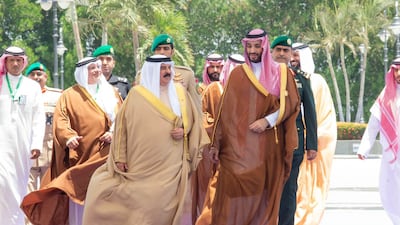
Bahrain's King Hamad is welcomed by Saudi Crown Prince Mohammed bin Salman, in Jeddah. SPA -
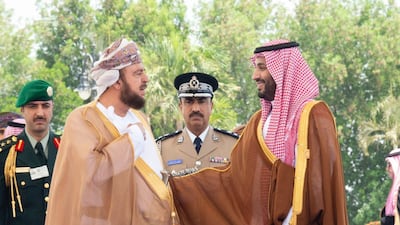
Saudi Arabia's Crown Prince Mohammed receives Asa'ad bin Tariq, Deputy Prime Minister and Special Representative of the Sultan of Oman, in Jeddah. SPA -
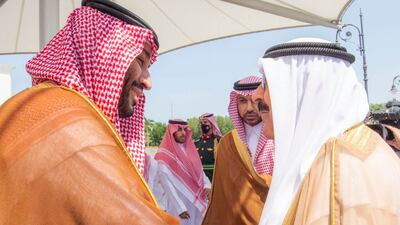
Saudi Crown Prince Mohammed bin Salman receives Sheikh Mishal Al Sabah, Crown Prince of Kuwait, before the Jeddah Security and Development Summit on Saturday. SPA -
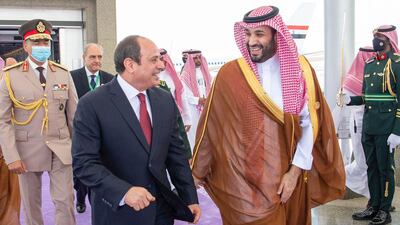
Egypt's President Abdel Fattah El Sisi speaks with Crown Prince Mohammed after arriving for the summit. SPA -
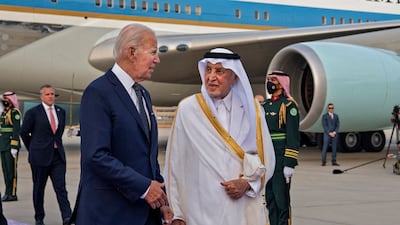
US President Joe Biden is received by Prince Khalid Al Faisal Al Saud, Governor of Makkah, in Jeddah. Photo: Media Office of the Governor of Mecca -
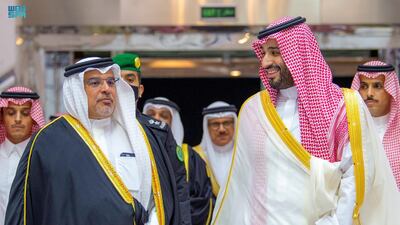
Crown Prince Mohammed receives Bahrain’s Crown Prince and Prime Minister Salman bin Hamad. SPA -
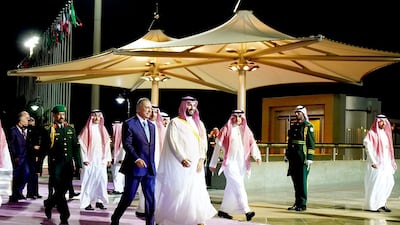
Iraq's Prime Minister Mustafa Al Kadhimi with Crown Prince Mohammed. AFP


But this trip is unlikely to win him any favour with voters, although he may have improved the US relationship and standing in the region and put Washington on a stronger footing going forward.
“I do think he should have gone,” said Sanam Vakil, deputy director of the Middle East and North Africa Programme at Chatham House, a UK-based think tank that focuses on international affairs. “I do believe that bringing the Gulf on-side is important.”
While in the Middle East, the president helped to convince Saudi Arabia to open its airspace to all civilian flights, meaning Israeli planes will be able to fly over the kingdom. In return, the US agreed to remove its long-established peacekeeping force from a remote Red Sea island, allowing Saudi Arabia to take full control of the coveted Tiran Island, which it seeks to develop as a tourist hub.
-
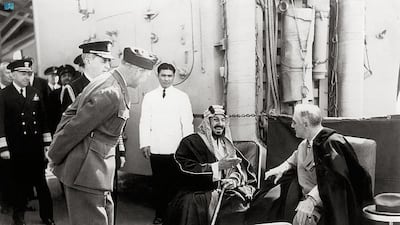
Franklin D Roosevelt, US president at the time, meets King Abdulaziz on board the 'USS Quincy' in the Suez Canal on February 14, 1945. Photo: Saudi Press Agency -
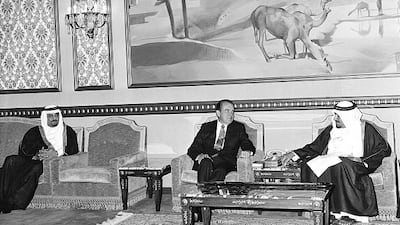
Richard Nixon, US president at the time, visits Saudi Arabia in 1974. Photo: Saudi Press Agency -

Mr Nixon meets King Faisal in 1974. Photo: Saudi Press Agency -

George HW Bush, US president at the time, is greeted by King Fahd as he arrives in Saudi Arabia on November 21, 1990. AP -
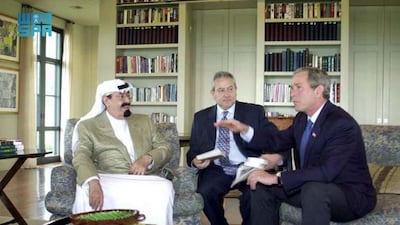
George W Bush, US president at the time, meets King Abdullah in 2008. Photo: Saudi Press Agency -
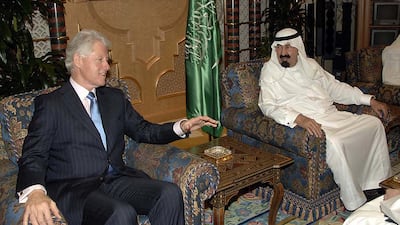
King Abdullah meets former US president Bill Clinton in Riyadh on April 7, 2010. Saudi Press Agency / AFP -
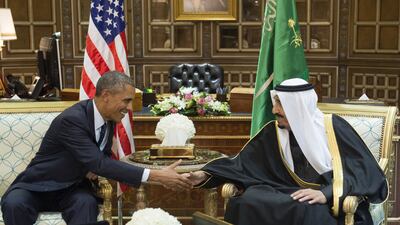
King Salman shakes hands with Barack Obama, US president at the time, at Erga Palace in Riyadh on January 27, 2015. AFP -
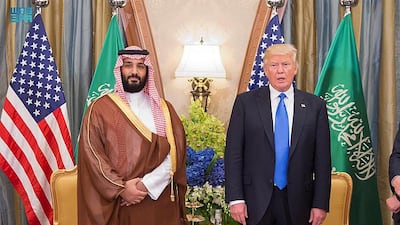
Donald Trump, US president at the time, meets Crown Prince Mohammed bin Salman in 2017. Photo: Saudi Press Agency -
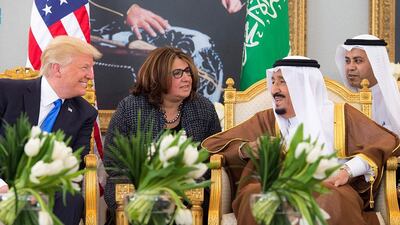
Mr Trump meets King Salman in 2017. Photo: Saudi Press Agency


While not earth-shattering achievements, the president hopes they are incremental steps to bringing Saudi Arabia and Israel closer together and help build a more unified front against Iran.
“I think they're very important, practical and symbolic steps that will over time, when Saudi Arabia is ready, set the countries for normalisation,” Ms Vakil told The National. “But the kingdom isn't going to normalise without having its own sort of package of demands and incentives.”
After the Abraham Accords gave rise to the UAE, Bahrain, Sudan and Morocco establishing ties with Israel, the kingdom reiterated that it was still committed to the 2000 Arab Initiative that sets a two-state peace agreement for Palestinians, with their capital in occupied East Jerusalem, as a condition for relations with Israel.
The US president also made it clear that he wanted the region to look West before it looks East.
“We will not walk away and leave a vacuum filled by China, Russia or wherever,” he said to the GCC+3 leaders.
Professor Haykel believes it may be too late for such binary geopolitics.
“What we’re seeing is structural. I think the world is moving away from one that is unipolar, where the Americans are, as the French say, the hyperpower,” he said.
While that could well be the case, Mr Biden may have done enough to reset or even advance US interests in the region.
Speaking to The National, Saudi Arabia’s Minister of State for Foreign Affairs Adel Al Jubeir said “everything is as it is supposed to be'' in terms of relations between the countries.
“But at the leadership level, because this is the first visit by President Biden as president, symbolically it's important,” he added.
Ms Vakil believes while the trip may not be a “panacea” it may “set up processes” that help lead to “greater confidence between the Biden administration and the Gulf states”.

