

Donald Trump's former right-hand man Steve Bannon has agreed to testify before the House committee investigating the attack on the Capitol January 6, 2021, adding more drama to a week poised for climactic public hearings.
Mr Trump has scorned the January 6 committee, which on Tuesday will reveal how the former president encouraged right-wing extremist groups to storm the Capitol. Thursday's expected prime-time hearing will examine Mr Trump's actions between the start of the riot and when he told his supporters to go home.
Mr Bannon was charged with contempt of Congress for previously refusing to give evidence, setting up a trial start date for July 18.
Memorable quotes from January 6 committee hearings - in pictures
-
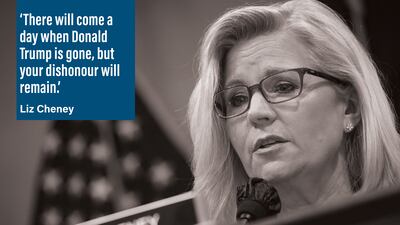
'There will come a day when Donald Trump is gone, but your dishonour will remain.' Congresswoman and January 6 committee vice chairwoman Liz Cheney to Republican colleagues who have defended Mr Trump's claims of election fraud. AFP -
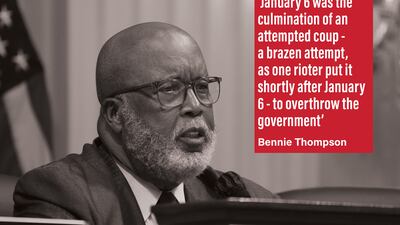
'January 6 was the culmination of an attempted coup - a brazen attempt, as one rioter put it shortly after January 6 - to overthrow the government.' Committee chairman Bennie Thompson. EPA -
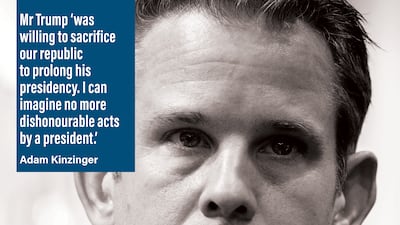
Mr Trump 'was willing to sacrifice our republic to prolong his presidency. I can imagine no more dishonourable acts by a president.' Republican Congressman Adam Kinzinger. AFP -
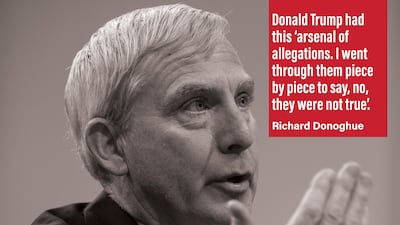
Donald Trump had this 'arsenal of allegations. I went through them piece by piece to say, no, they were not true'. Former acting deputy attorney general Richard Donoghue. EPA -

'There were no votes to find.' Georgia Secretary of State Brad Raffensperger after Donald Trump asked him and his deputy, Gabriel Sterling, to 'find 11,780' votes that could flip Georgia in the president's favour. AFP -

Competing against Donald Trump’s lies was like a 'shovel trying to empty the ocean'. Gabriel Sterling, Georgia Secretary of State chief operating officer. AFP -
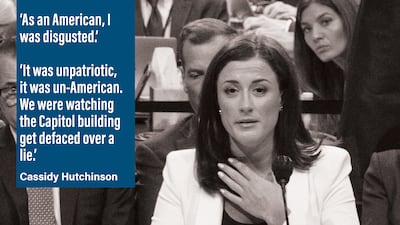
'As an American, I was disgusted. It was unpatriotic, it was un-American. We were watching the Capitol building get defaced over a lie.' Cassidy Hutchinson, an aide to then White House chief of staff Mark Meadows, speaking about the insurrection. AFP -
!['I told him [Donald Trump] that the stuff his people were shovelling out to the public was bull***t.' Former attorney general William Barr. AP](https://www.thenationalnews.com/resizer/v2/RLINK2AWKRFONAWRZ7TNQF6VI4.jpg?smart=true&auth=898bee20e87c352f4801c4275eab58720719d25c3b0343a94bb0b4d88c1d38f4&width=400&height=225)
'I told him [Donald Trump] that the stuff his people were shovelling out to the public was bull***t.' Former attorney general William Barr. AP -
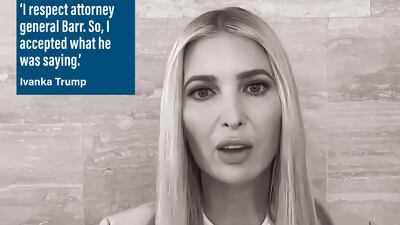
'I respect attorney general Barr. So, I accepted what he was saying.' Ivanka Trump, former White House senior adviser. AP -
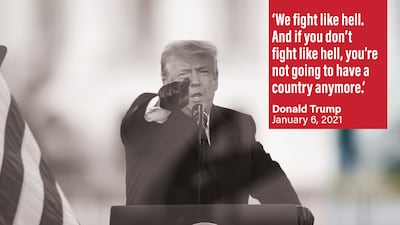
'We fight like hell. And if you don't fight like hell, you're not going to have a country any more.' Donald Trump on January 6, 2021. Reuters -
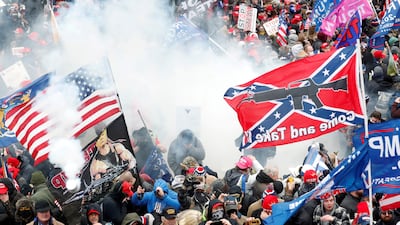
A Confederate battle flag that reads 'Come and Take It' and shows a military-style rifle flies as rioters storm the Capitol on January 6, 2001. Reuters -
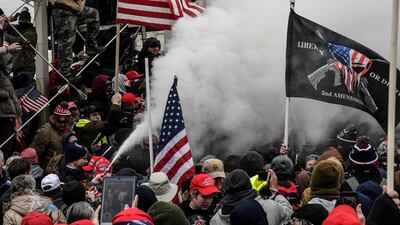
A Trump supporter sprays smoke. Reuters -
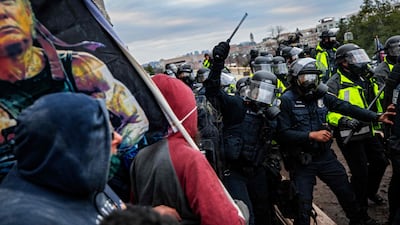
Police attempt to push the mob back. AFP -
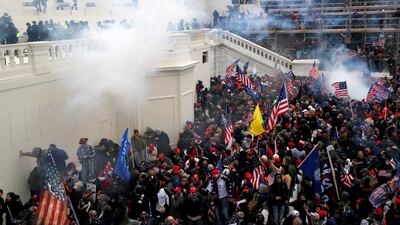
The pro-Trump mob swarms the Capitol as police release tear gas. Reuters -
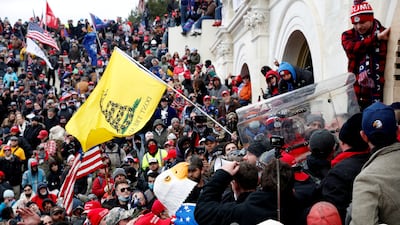
Protesters clash with police. Reuters -
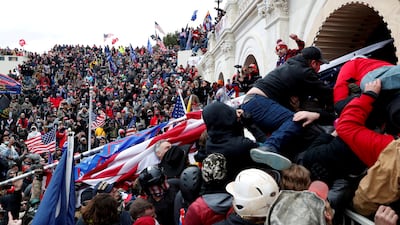
Pro-Trump protesters storm into the US Capitol. Reuters -
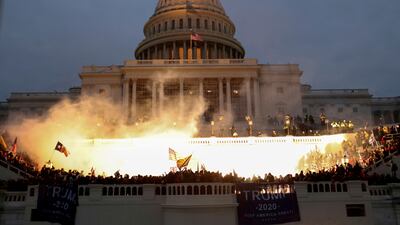
A police flash-bang blast lights up the Capitol. Reuters -
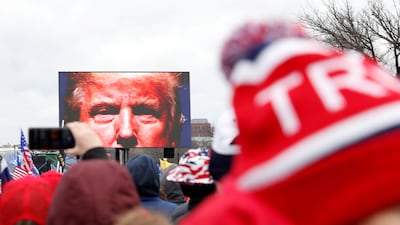
Before the insurrection, Mr Trump is seen on a screen speaking to supporters during a rally to contest the certification of the 2020 US presidential election results. Reuters -
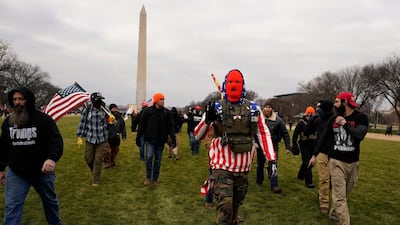
People march with those who say they are members of the Proud Boys as they attend a rally in Washington in support of former president Donald Trump. AP


!['I told him [Donald Trump] that the stuff his people were shovelling out to the public was bull***t.' Former attorney general William Barr. AP](https://www.thenationalnews.com/resizer/v2/RLINK2AWKRFONAWRZ7TNQF6VI4.jpg?smart=true&auth=898bee20e87c352f4801c4275eab58720719d25c3b0343a94bb0b4d88c1d38f4&width=800&height=450)


Panel members believe Mr Bannon and other advisers to Mr Trump could have information on links between the White House and the mob on the day that Congress was due to certify Joe Biden as the winner of the 2020 presidential election.
Lawyers for Mr Bannon had previously claimed that because he was protected by executive privilege he did not have to co-operate with the committee, even though he was not a White House official at the time of the riot.
Mr Trump's withdrawal of a claim of executive privilege to shield Mr Bannon means the former adviser could now provide revelations between him and the former president — or he could stonewall the committee.
Mr Bannon’s reversal of his refusal to testify was outlined in a letter from his lawyer Robert Costello to Bennie Thompson, US representative and committee chairman, late on Saturday.
“Mr Bannon is willing to, and indeed prefers, to testify at your public hearing,” it said.
Zoe Lofgren, US representative and January 6 committee member, said it was unlikely Mr Bannon would give evidence at a public hearing.
“Ordinarily we do depositions,” Ms Lofgren told CNN’s State of the Union. “We want to get all our questions answered and you can’t do that in a live format.”
Adam Kinzinger, one of two Republicans on the committee, said Thursday's hearing would focus on Mr Trump's actions between the start of the assault on the Capitol and until he tweeted, asking his supporters to go home.
“The president obviously had to have known there was an insurrection,” Mr Kinzinger said on ABC’s This Week on Sunday. “So where was he? What was he doing? It’s a very important hearing. Pay attention.”
Bloomberg contributed to this report

