

Happy the elephant will stay at the Bronx Zoo after New York state's highest court on Tuesday ruled against an animal rights group that said she deserved some of the same rights as humans and should be freed.
In a 5-2 decision, the Albany-based Court of Appeals said the writ of habeas corpus, which allows people to be released from illegal custody, did not apply to Happy despite claims that the 51-year-old elephant shared many of the same cognitive abilities as humans.
"While no one disputes that elephants are intelligent beings deserving of proper care and compassion, Happy, as a non-human animal, does not have a legally cognisable right to be at liberty under New York law," Chief Judge Janet DiFiore wrote.
Ms DiFiore said granting freedom to Happy would have "an enormous destabilising impact on modern society" and could generate a "flood" of petitions to free creatures, perhaps including pets and service animals.
She said it should be up to the legislature to decide whether to grant non-human animals the same legal rights as people.
-
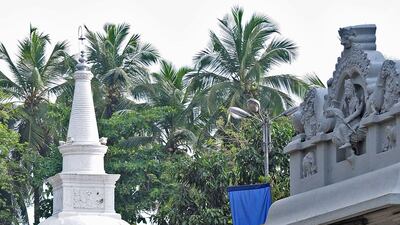
TO GO WITH AFP STORY BY MEL GUNASEKERA, Sri Lanka-environment-wildlife-elephant, FOCUS (FILES) This April 15, 2009 file photo shows a Sri Lankan mahout and a temple elephant taking part in a religious ritual at a temple in the Bellanvila suburb of Colombo as part of the traditional new year rituals. Wildlife groups in Sri Lanka are threatening to boycott the country's first national survey of wild elephants after a minister said it would be used to identify animals for use at temples. AFP PHOTO / Lakruwan WANNIARACHCHI *** Local Caption *** 583030-01-08.jpg -
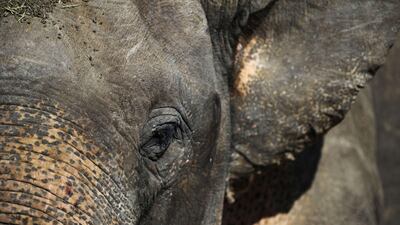
August 12, 2011: A lone Sri Lankan elephant is seen at a wildlife sanctuary in Minneriya. Sri Lanka began surveying its wild elephant population living in national parks as part of a conservation drive to protect the dwindling animals. AFP PHOTO/Ishara S.??? -
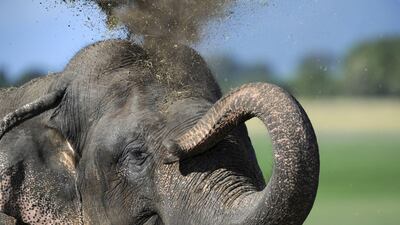
August 12, 2011: A Sri Lankan elephant blows dirt over its head at a wildlife sanctuary in Minneriya. Sri Lanka's elephant population has dwindled to some 4,000 from a high of 12,000 recorded in 1900s, according to the Department of Wildlife Conservation.??? -
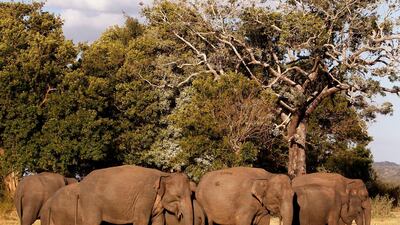
August 11, 2011: A herd of Asiatic wild elephants gather at a national park in Minneriya. Thousands of wildlife officials and volunteers have taken up positions on treetop huts near reservoirs and watering holes for Sri Lanka's first national count of its??? -
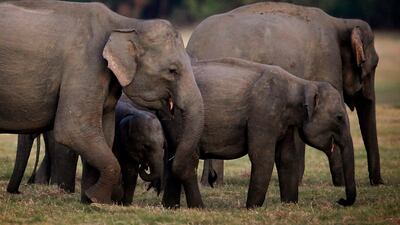
August 11, 2011: A herd of Asiatic wild elephants gather at a national park in Minneriya. The Wildlife Department says the three-day census through Sunday night is aimed at gathering information to help the government formulate a plan to protect the eleph??? -
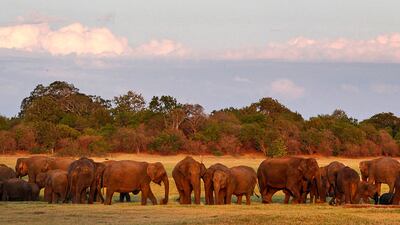
August 11, 2011: A herd of Asiatic wild elephants gather at a national park in Minneriya. AP Photo/Chamila Karunarathne -

August 11, 2011: Wildlife officials count as they monitor a herd of Asiatic wild elephants gather at a national park in Minneriya, some 200 kilometers (125 miles) from Colombo, Sri Lanka. AP Photo/Chamila Karunarathne


Tuesday's decision is a defeat for the Non-human Rights Project, which began asking New York courts four years ago to release Happy to one of two US elephant sanctuaries.
The Florida-based group had objected to what it regarded as Happy's imprisonment in a 0.4 hectare enclosure at the zoo, segregated from other elephants.
The group said it would continue pushing for her release.
"This is not just a loss for Happy, whose freedom was at stake in this case," the group said.
It's also a loss for everyone who cares about upholding and strengthening our most cherished values and principles of justice."
The Bronx Zoo did not respond to requests for comment.
Two lower courts had previously sided with the zoo, which maintained that Happy is well cared for.
In spirited opinions, the dissenting judges empathised with the elephant.
"When the majority answers, 'No, animals cannot have rights,' I worry for that animal," Judge Rowan Wilson wrote.
"But I worry even more greatly about how that answer denies and denigrates the human capacity for understanding, empathy and compassion."

