


Disgraced celebrity lawyer Michael Avenatti was on Thursday sentenced to four years behind bars following his conviction for defrauding a former client, adult entertainer Stormy Daniels, during her suits against former US president Donald Trump.
Jurors in February convicted Avenatti, 51, of wire fraud and embezzling up to $300,000 of an $800,000 payout to Daniels for her autobiography, spending some of the money on his company’s payroll and personal expenses.
US District Judge Jesse Furman imposed the sentence in federal court in Manhattan as Avenatti, 51, wearing tan prison garb, blue trainers and a white face mask, looked on.
The California lawyer is already serving a 2.5-year sentence stemming from his 2020 conviction for trying to extort $25 million from sportswear giant Nike. Part of the new sentence will run concurrently, meaning Avenatti faces a combined five years in prison.
"I have destroyed my career, my relationships and my reputation," Avenatti told the judge before sentencing.
Fighting back tears, he admitted he “failed in a cataclysmic way” and will “forever be branded a disgraced lawyer.”
Prosecutors showed that Avenatti spent the stolen money on personal expenses, including payments on his Ferrari, while convincing Daniels in text messages that the publisher was to blame for her missing payments.
Assistant US Attorney Matthew Podolsky called this an “incredible personal betrayal” of Daniels’s trust. The performer was proud of her book deal and needed the cash advances to make payments on her home, the prosecution said.
Daniels, whose real name is Stephanie Gregory Clifford, was the star witness in the trial, testifying that Avenatti stole her money and lied to her about it for months.
Avenatti, representing himself at trial, added to the courtroom drama by grilling Daniels about her belief in the paranormal and her “visions” of ghosts, seeking to discredit her.
Avenatti rose to cable news stardom in 2018 by defending Daniels in her high-profile lawsuits against Mr Trump over claims in her autobiography, Full Disclosure, which was published that autumn.
Daniels is known for receiving $130,000 from Mr Trump’s former lawyer, Michael Cohen, in exchange for staying quiet before the 2016 election about an affair she says she had with Mr Trump, then a celebrity property tycoon.
Mr Trump denies the encounters took place. Shortly after the payment, he won the presidency.
Avenatti successfully freed Daniels from her non-disclosure deal with Mr Trump.
Donald Trump's year out of office — in pictures
-
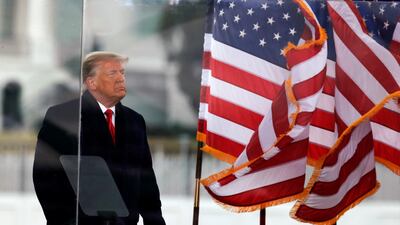
Donald Trump after his speech at a rally to contest the certification of the 2020 US presidential election results by Congress, in Washington, January 6, 2021. Reuters -

A pro-Trump mob breaks into the US Capitol on January 6, 2021 in Washington, DC. AFP -

Donald Trump and his wife Melania prepare to leave the White House on Marine One on January 20, 2021. AFP -

Donald Trump and Melania at Joint Base Andrews before boarding Air Force One for the last time as president on January 20, 2021. AFP -
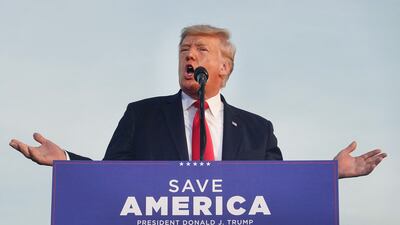
Donald Trump speaks during a rally at the Lorain County Fairgrounds on June 26, 2021 in Wellington, Ohio. AFP -
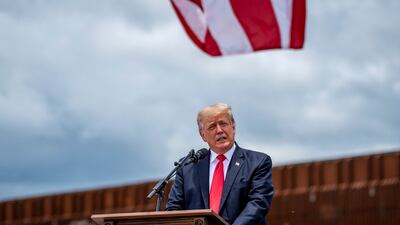
Donald Trump speaks during a visit to the border wall near Pharr, Texas on June 30, 2021. AFP -

Donald Trump at a press conference announcing a class action lawsuit against big tech companies at the Trump National Golf Club Bedminster, New Jersey on July 7, 2021. AFP -
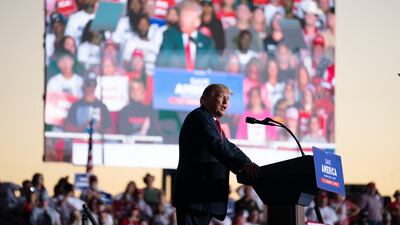
The former president addresses a rally on September 25, 2021 in Perry, Georgia. AFP -
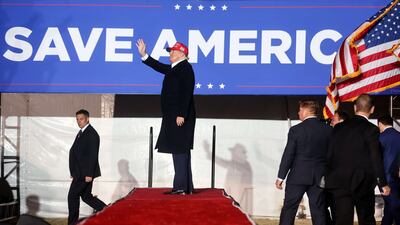
At a rally at the Canyon Moon Ranch festival grounds on January 15, 2022 in Florence, Arizona. AFP -

Trump supporters listen to speakers prior to an appearance by the former president at a rally on January 15, 2022, in Florence, Arizona. AP



