
The white man charged with murdering 10 black people at a supermarket in Buffalo appeared briefly in court on Thursday after a grand jury indicted him on a first-degree murder charge.
Assistant District Attorney Gary Hackbush said the indictment of Payton Gendron, 18, was handed up on Wednesday.
Mr Gendron, wearing an orange jail uniform and a mask, was silent throughout the one-minute proceeding attended by some relatives of the victims.
Someone shouted, “Payton, you’re a coward”, as he was led out.
He is being held in jail without bail.
In New York, prosecutors can charge a person with first-degree murder only under special circumstances, including when several people are killed in a single incident, such as the Buffalo shooting. The single count against Mr Gendron covers all 10 deaths at the supermarket.
Mr Gendron's court-appointed lawyer entered a plea of “not guilty” on his behalf at a court appearance last week. He is scheduled to return to court on June 9.
Thirteen people were shot at the Tops Friendly Market in Buffalo on Saturday. Police are investigating the possibilities of terrorism and hate crime charges.
All 10 of those who were killed in the supermarket shooting were black.
-
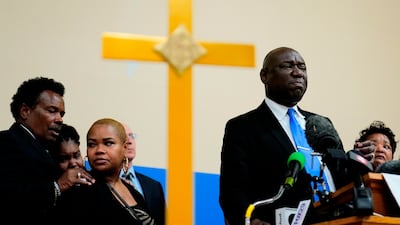
Attorney Benjamin Crump, accompanied by the family of Ruth Whitfield, a victim of shooting at a supermarket, speaks to the media during a news conference in Buffalo, New York. AP -

Vintage Firearms, the gun shop where Buffalo supermarket shooting suspect Payton Gendron legally purchased his weapon, in Endicott, New York. Reuters -
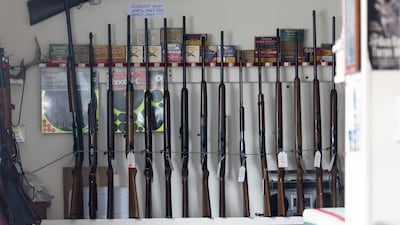
Vintage Firearms in Endicott, New York. Reuters -

A member of the FBI looks at bullet holes through the glass at the scene of a shooting at a TOPS supermarket in Buffalo, New York. Reuters -

People embrace near the scene of the fatal mass shooting in Buffalo. AP -

Police officers secure the scene after a shooting at TOPS supermarket in Buffalo. Reuters -
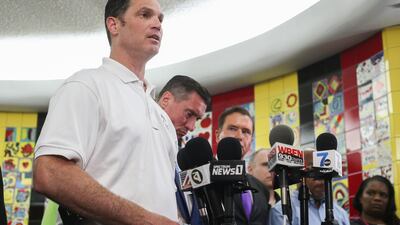
Buffalo Police Commissioner Joseph Gramaglia speaks at a press conference after the shooting. AP -
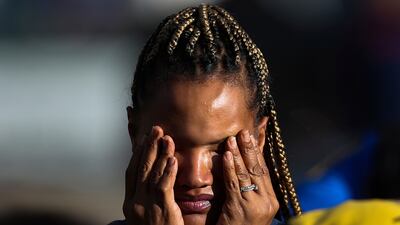
A woman is in shock, as police investigate the shooting. AP -

A man is detained after the mass shooting. Photo: BigDawg/ via Reuters -

Two people hug near the scene of the mass shooting. EPA -

Payton Gendron, 18, was arraigned on first-degree murder charges and detained without bail. AP -

A floral tribute and candles are laid. AP -

Stephanie Morris is overcome with emotions, after news of the fatal shooting had spread. AP -

Children walk hand-in-hand near the scene of the shooting. AP -

People pay their respects outside the supermarket. AP -

Mourners gather for a vigil for victims of the shooting. Reuters -

Sharon Doyle gathers with others outside the supermarket. AP -

Worshippers affected by the shooting pray at True Bethel Baptist Church in Buffalo. AP -

People march to the scene of the shooting in Buffalo. AP -

A person holds a flower as a group prays near the scene of the shooting. AP
Mr Gendron also “planned to attack more than one store” if he had escaped the scene, said the Buffalo police commissioner.
Shortly before the attack, Mr Gendron reportedly posted a 180-page racist diatribe that contained specific plans to attack black people, citing a conspiracy that white people are being “replaced”.
The suspect kept his diary in the online platform Discord, which on Wednesday confirmed that an invitation to gain access to it was sent to a handful of people 30 minutes before the shooting began.
Mr Gendron then live-streamed the rampage. It is unknown whether anyone attempted to contact law enforcement.
New York Governor Kathy Hochul on Wednesday authorised the state's attorney general, Letitia James, to investigate social media platforms used by Mr Gendron to determine if they were liable for “providing a platform to plan and promote violence”.
The Associated Press contributed to this report

Ten tax points to be aware of in 2026
1. Domestic VAT refund amendments: request your refund within five years
If a business does not apply for the refund on time, they lose their credit.
2. E-invoicing in the UAE
Businesses should continue preparing for the implementation of e-invoicing in the UAE, with 2026 a preparation and transition period ahead of phased mandatory adoption.
3. More tax audits
Tax authorities are increasingly using data already available across multiple filings to identify audit risks.
4. More beneficial VAT and excise tax penalty regime
Tax disputes are expected to become more frequent and more structured, with clearer administrative objection and appeal processes. The UAE has adopted a new penalty regime for VAT and excise disputes, which now mirrors the penalty regime for corporate tax.
5. Greater emphasis on statutory audit
There is a greater need for the accuracy of financial statements. The International Financial Reporting Standards standards need to be strictly adhered to and, as a result, the quality of the audits will need to increase.
6. Further transfer pricing enforcement
Transfer pricing enforcement, which refers to the practice of establishing prices for internal transactions between related entities, is expected to broaden in scope. The UAE will shortly open the possibility to negotiate advance pricing agreements, or essentially rulings for transfer pricing purposes.
7. Limited time periods for audits
Recent amendments also introduce a default five-year limitation period for tax audits and assessments, subject to specific statutory exceptions. While the standard audit and assessment period is five years, this may be extended to up to 15 years in cases involving fraud or tax evasion.
8. Pillar 2 implementation
Many multinational groups will begin to feel the practical effect of the Domestic Minimum Top-Up Tax (DMTT), the UAE's implementation of the OECD’s global minimum tax under Pillar 2. While the rules apply for financial years starting on or after January 1, 2025, it is 2026 that marks the transition to an operational phase.
9. Reduced compliance obligations for imported goods and services
Businesses that apply the reverse-charge mechanism for VAT purposes in the UAE may benefit from reduced compliance obligations.
10. Substance and CbC reporting focus
Tax authorities are expected to continue strengthening the enforcement of economic substance and Country-by-Country (CbC) reporting frameworks. In the UAE, these regimes are increasingly being used as risk-assessment tools, providing tax authorities with a comprehensive view of multinational groups’ global footprints and enabling them to assess whether profits are aligned with real economic activity.
Contributed by Thomas Vanhee and Hend Rashwan, Aurifer
The Internet
Hive Mind
four stars
More from Neighbourhood Watch
While you're here
Joyce Karam: Chaotic first debate unlikely to swing undecideds
Hussein Ibish: Donald Trump's 3-step plan to cling to power
Sulaiman Hakemy: Make America lose again
The%20specs
Essentials
The flights: You can fly from the UAE to Iceland with one stop in Europe with a variety of airlines. Return flights with Emirates from Dubai to Stockholm, then Icelandair to Reykjavik, cost from Dh4,153 return. The whole trip takes 11 hours. British Airways flies from Abu Dhabi and Dubai to Reykjavik, via London, with return flights taking 12 hours and costing from Dh2,490 return, including taxes.
The activities: A half-day Silfra snorkelling trip costs 14,990 Icelandic kronur (Dh544) with Dive.is. Inside the Volcano also takes half a day and costs 42,000 kronur (Dh1,524). The Jokulsarlon small-boat cruise lasts about an hour and costs 9,800 kronur (Dh356). Into the Glacier costs 19,500 kronur (Dh708). It lasts three to four hours.
The tours: It’s often better to book a tailor-made trip through a specialist operator. UK-based Discover the World offers seven nights, self-driving, across the island from £892 (Dh4,505) per person. This includes three nights’ accommodation at Hotel Husafell near Into the Glacier, two nights at Hotel Ranga and two nights at the Icelandair Hotel Klaustur. It includes car rental, plus an iPad with itinerary and tourist information pre-loaded onto it, while activities can be booked as optional extras. More information inspiredbyiceland.com
MATCH INFO
Syria v Australia
2018 World Cup qualifying: Asia fourth round play-off first leg
Venue: Hang Jebat Stadium, Malayisa
Kick-off: Thursday, 4.30pm (UAE)
Watch: beIN Sports HD
* Second leg in Australia on October 10
The specs: 2018 Opel Mokka X
Price, as tested: Dh84,000
Engine: 1.4L, four-cylinder turbo
Transmission: Six-speed auto
Power: 142hp at 4,900rpm
Torque: 200Nm at 1,850rpm
Fuel economy, combined: 6.5L / 100km
Jiu-jitsu calendar of events for 2017-2018:
August 5:
Round-1 of the President’s Cup in Al Ain.
August 11-13:
Asian Championship in Vietnam.
September 8-9:
Ajman International.
September 16-17
Asian Indoor and Martial Arts Games, Ashgabat.
September 22-24:
IJJF Balkan Junior Open, Montenegro.
September 23-24:
Grand Slam Los Angeles.
September 29:
Round-1 Mother of The Nation Cup.
October 13-14:
Al Ain U18 International.
September 20-21:
Al Ain International.
November 3:
Round-2 Mother of The National Cup.
November 4:
Round-2 President’s Cup.
November 10-12:
Grand Slam Rio de Janeiro.
November 24-26:
World Championship, Columbia.
November 30:
World Beach Championship, Columbia.
December 8-9:
Dubai International.
December 23:
Round-3 President’s Cup, Sharjah.
January 12-13:
Grand Slam Abu Dhabi.
January 26-27:
Fujairah International.
February 3:
Round-4 President’s Cup, Al Dhafra.
February 16-17:
Ras Al Khaimah International.
February 23-24:
The Challenge Championship.
March 10-11:
Grand Slam London.
March 16:
Final Round – Mother of The Nation.
March 17:
Final Round – President’s Cup.
Mercer, the investment consulting arm of US services company Marsh & McLennan, expects its wealth division to at least double its assets under management (AUM) in the Middle East as wealth in the region continues to grow despite economic headwinds, a company official said.
Mercer Wealth, which globally has $160 billion in AUM, plans to boost its AUM in the region to $2-$3bn in the next 2-3 years from the present $1bn, said Yasir AbuShaban, a Dubai-based principal with Mercer Wealth.
“Within the next two to three years, we are looking at reaching $2 to $3 billion as a conservative estimate and we do see an opportunity to do so,” said Mr AbuShaban.
Mercer does not directly make investments, but allocates clients’ money they have discretion to, to professional asset managers. They also provide advice to clients.
“We have buying power. We can negotiate on their (client’s) behalf with asset managers to provide them lower fees than they otherwise would have to get on their own,” he added.
Mercer Wealth’s clients include sovereign wealth funds, family offices, and insurance companies among others.
From its office in Dubai, Mercer also looks after Africa, India and Turkey, where they also see opportunity for growth.
Wealth creation in Middle East and Africa (MEA) grew 8.5 per cent to $8.1 trillion last year from $7.5tn in 2015, higher than last year’s global average of 6 per cent and the second-highest growth in a region after Asia-Pacific which grew 9.9 per cent, according to consultancy Boston Consulting Group (BCG). In the region, where wealth grew just 1.9 per cent in 2015 compared with 2014, a pickup in oil prices has helped in wealth generation.
BCG is forecasting MEA wealth will rise to $12tn by 2021, growing at an annual average of 8 per cent.
Drivers of wealth generation in the region will be split evenly between new wealth creation and growth of performance of existing assets, according to BCG.
Another general trend in the region is clients’ looking for a comprehensive approach to investing, according to Mr AbuShaban.
“Institutional investors or some of the families are seeing a slowdown in the available capital they have to invest and in that sense they are looking at optimizing the way they manage their portfolios and making sure they are not investing haphazardly and different parts of their investment are working together,” said Mr AbuShaban.
Some clients also have a higher appetite for risk, given the low interest-rate environment that does not provide enough yield for some institutional investors. These clients are keen to invest in illiquid assets, such as private equity and infrastructure.
“What we have seen is a desire for higher returns in what has been a low-return environment specifically in various fixed income or bonds,” he said.
“In this environment, we have seen a de facto increase in the risk that clients are taking in things like illiquid investments, private equity investments, infrastructure and private debt, those kind of investments were higher illiquidity results in incrementally higher returns.”
The Abu Dhabi Investment Authority, one of the largest sovereign wealth funds, said in its 2016 report that has gradually increased its exposure in direct private equity and private credit transactions, mainly in Asian markets and especially in China and India. The authority’s private equity department focused on structured equities owing to “their defensive characteristics.”
What can victims do?
Always use only regulated platforms
Stop all transactions and communication on suspicion
Save all evidence (screenshots, chat logs, transaction IDs)
Report to local authorities
Warn others to prevent further harm
Courtesy: Crystal Intelligence
Have you been targeted?
Tuan Phan of SimplyFI.org lists five signs you have been mis-sold to:
1. Your pension fund has been placed inside an offshore insurance wrapper with a hefty upfront commission.
2. The money has been transferred into a structured note. These products have high upfront, recurring commission and should never be in a pension account.
3. You have also been sold investment funds with an upfront initial charge of around 5 per cent. ETFs, for example, have no upfront charges.
4. The adviser charges a 1 per cent charge for managing your assets. They are being paid for doing nothing. They have already claimed massive amounts in hidden upfront commission.
5. Total annual management cost for your pension account is 2 per cent or more, including platform, underlying fund and advice charges.
The%20specs%20
While you're here
C Uday Bhaskar: What is India's Indo-Pacific strategy?
Sholto Byrnes: How US and China can get along in Indo-Pacific
Brahma Chellaney: Trump's unpredictability is making China great again

