

The US on Thursday marked a once unimaginable milestone: one million deaths from Covid-19.
President Joe Biden and first lady Jill Biden paid tribute to those who had died since the US recorded its first death from the coronavirus in early 2020, saying each life represented an “irreplaceable loss".
“Each leaving behind a family, a community, and a nation forever changed because of this pandemic. Jill and I pray for each of them,” Mr Biden said in a statement on Thursday, in which he urged Americans not to “grow numb” to such sorrow.
“I know the pain of that black hole in your heart. It is unrelenting.”
As of Thursday morning, the Covid death toll stood at 999,053, according to a widely referenced Johns Hopkins University database. The nation's health agency on Thursday tallied 995,747 deaths.
The US is the only country to reach one million recorded deaths — though most tallies around the world are expected to be undercounts.
Mr Biden ordered flags to be flown at half mast, said the White House, which will on Thursday also host a second global Covid-19 Summit virtually.
“I can't think about it. It's so horrible. I just can't, I can't, I can't comprehend it,” Hilary Krieger of Brooklyn, New York, told The National.
Her father, Neil Krieger, died from Covid-19 after spending weeks in hospital in Boston, Massachusetts, in April 2020.
“I can't let myself think about it. It's so staggering. It's tragic for all of those families, but also for us as a society that we let this happen.”
Several hundred people continue to die each day and others who have overcome the disease are grappling with its long-term effects.
“It's a very cold, unnatural way to be ill or die,” Patricia Serafino of Massachusetts told The National.
Her husband, Michael, was admitted to hospital for two weeks before passing away in October 2021.
“It was the worst experience of my life,” she said of the day she learnt of his death.
“It breaks my heart to know that Michael was a 'victim' of the whole Covid thing.”
The one million Covid deaths outnumber those that occurred during the 1918 flu pandemic, both World Wars and the HIV/Aids epidemic in the US, making it the deadliest mass casualty event and health crisis in the country's history.
Throughout the pandemic, the US has had to contend with various issues in addition to the high number of deaths: uncontrolled spread, politicisation of the disease, a lack of access to care in an overwhelmed and privatised health system, misinformation and a refusal by many to get vaccinated.
“I feel history should judge us harshly [with] the one million known fatalities from Covid-19,” Dr Syra Madad, senior director of the special pathogens programme at New York City's Health + Hospitals system, told The National.
The hardest hit
Severe illness and death have greatly affected elderly Americans, with those over 65 years of age representing about three quarters of US Covid-19 deaths, data from the US Centres for Disease Control and Prevention (CDC) show.
Communities of colour — particularly Hispanic and black populations — have reported disproportionately more Covid-19 deaths than white communities, the CDC reports.
For example, one study cited by the CDC showed that non-Hispanic black people made up 34 per cent of deaths in the US, though the group makes up only 12 per cent of the US population.
And people living in lower-income areas died at two times the rate of those in richer areas, a Poor People's Campaign report in April said, showing the impact of holding in-person jobs without access to affordable health care.
“[History] should judge us on how many of those deaths were preventable from better public health policies and guidance to vaccination campaigns that should have done more to reach people,” Dr Madad said.
The US has a higher death rate than countries of comparable size and wealth despite having an arsenal of widely available, free vaccines. Johns Hopkins data show there have been at least 300 Covid-19 deaths per 100,000 people in the US.
The CDC says that 66.3 per cent of the US population have been fully vaccinated with two doses. All people over the age of 5 in the US are eligible to receive vaccines.
The US population is one of the most vaccine hesitant in the world, a Morning Consult survey of 15 countries found.
Unvaccinated people are more likely to suffer severe illness or death with Covid-19.
-
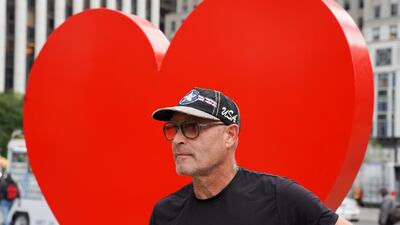
Italian sculptor Sergio Furnari poses for pictures in front of 'The Hero Monument' heart sculpture on October 25, 2021, in New York. AP -
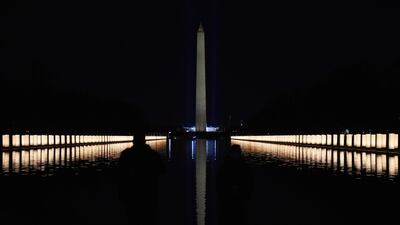
The Washington Monument where US President Joe Biden hosts a memorial to honour those who died from Covid-19 at the Lincoln Memorial in Washington, January 19, 2021. Reuters -
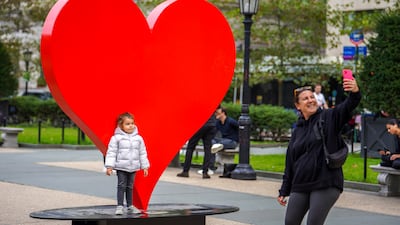
A woman takes selfies with her daughter in front of 'The Hero Monument' in New York. AP -
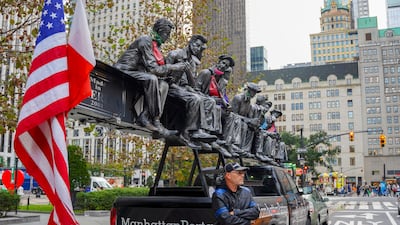
Italian sculptor Sergio Furnari stands next to his car near 'The Hero Monument' sculpture in Manhattan, New York. AP -
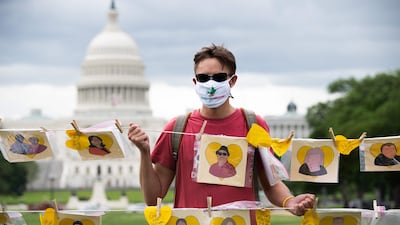
Christopher Edwards holds up a memorial to those who died from Covid-19, including his grandmother, Brenda Meadows, in Washington, May 5, 2021. AFP -
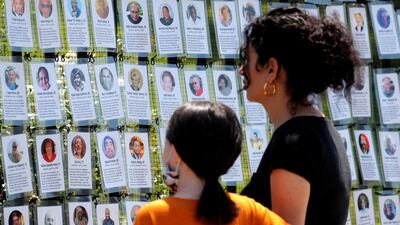
A woman and child look at the 'Naming the Lost Memorials' at the Green-Wood Cemetery in Brooklyn, New York. Reuters -
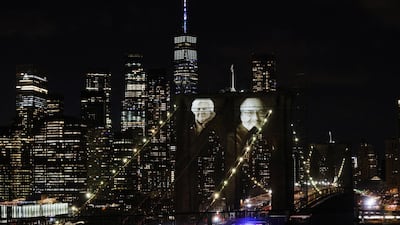
Faces of victims of Covid-19 are projected on to the Brooklyn Bridge on March 14, 2021, in New York. Getty Images via AFP -
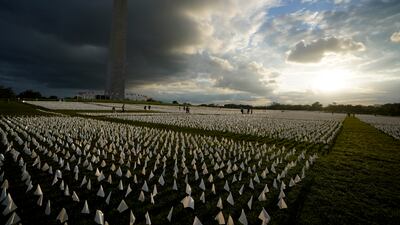
Artist Suzanne Firstenberg's temporary art installation, 'In America: Remember' in Washington, September 17, 2021. AP -
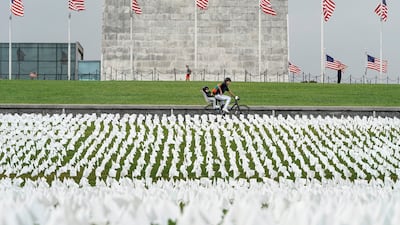
A cyclist rides past the 'In America: Remember' memorial. Reuters -
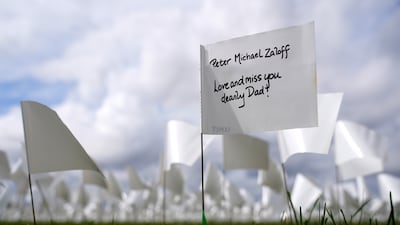
One of the flags that make up the 'In America: Remember' installation. AP -
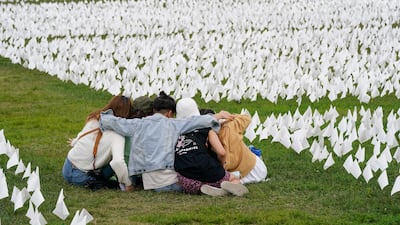
Visitors mourn at the 'In America: Remember' memorial. AP -
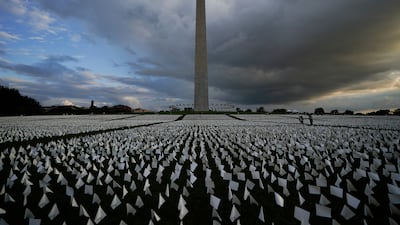
The memorial with the Washington Monument in the background. AP -
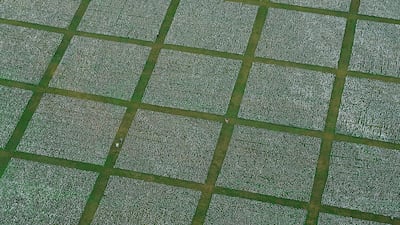
An aerial view of the memorial. AP -
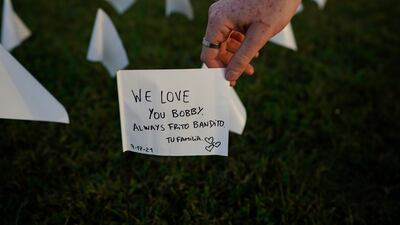
A flag with a message for a loved one. AP -

The installation consisted of more than 600,000 flags. AP -
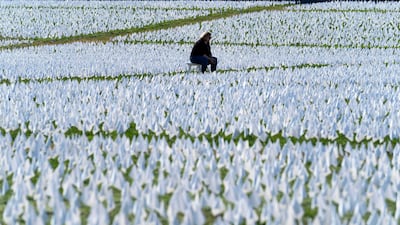
A mourner visits the memorial. AP -
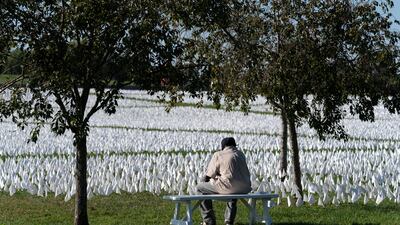
A visitor sits on a bench near the memorial. AP -
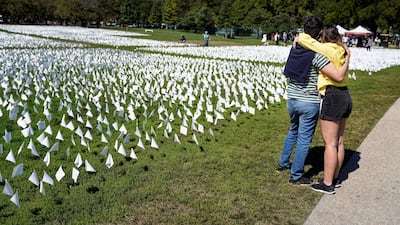
Two people hug as they look at the thousands of white flags. Reuters -
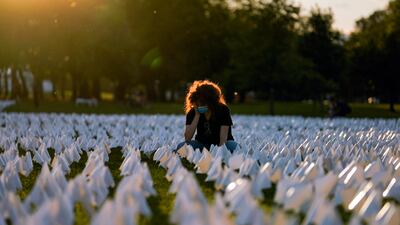
Part of artist Suzanne Firstenberg's temporary art installation. AP -
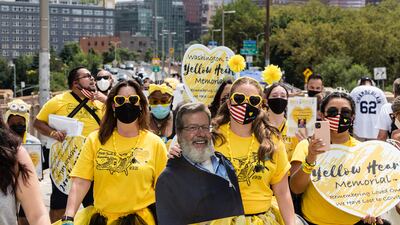
Hundreds of Covid survivors march across the Brooklyn Bridge on Saturday, August 7, 2021, in New York. AP -
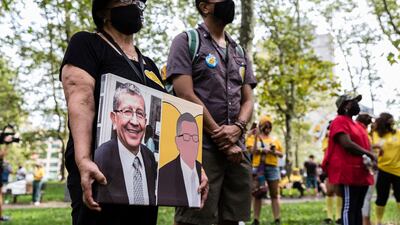
A woman holds an image of her husband as hundreds of Covid survivors gather at Cadman Plaza in Brooklyn. AP -
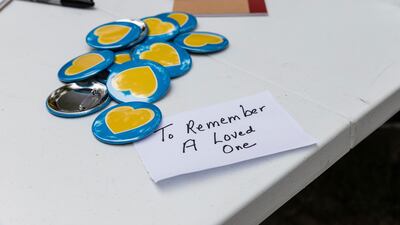
A sign at a Covid survivors' march in New York. AP -
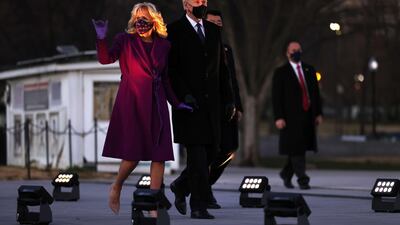
US President Joe Biden and first lady Jill Biden arrive for a memorial for victims of Covid-19 in Washington. Getty Images / AFP -
The Washington Covid-19 Memorial. Photo: National Parks Service -
The Washington Covid-19 Memorial. Photo: National Parks Service


A recent Kaiser Family Foundation study found that at least 230,000 US deaths since June 2021 could have been prevented with full vaccination. Even if these lives had been spared, the US would still lead the world in number of deaths.
“We lost people we shouldn't; there were too many victims,” Ms Serafino said.
The difficult days ahead
The US is now reporting a rise in cases driven by competing Omicron sub-variants, though it is not clear whether there will be a large surge in the weeks to come.
The country also leads the world in coronavirus infections, with Johns Hopkins data reporting more than 82 million.
And the US government estimates that up to 23 million Americans are suffering from long Covid, which causes chronic fatigue and cognitive impairment.
As more people leave their jobs due to disabilities linked to long Covid, the long-term effects on both the labour market and the economy are unknown.
“Everybody's running around now like it doesn't exist any more and I'm not so sure that's a good idea,” Ms Serafino said.
Though most in the US are desperate to move past the pandemic and return to normal, those mourning the loss of loved ones are finding the return to pre-Covid routines difficult.
“I still feel very much in the midst of his loss,” Ms Krieger said of her father.
“I don't know how much that's enhanced by the fact that … his death and the pandemic are intermingled and we're still not past it.”

