Juan Orlando Hernandez boards a plane to the US during his extradition. Reuters

Honduras ex-president Juan Orlando Hernandez to face charges in US court


  • English
  • Arabic

Former Honduran president Juan Orlando Hernandez was expected to make a virtual appearance in a federal court in New York on Friday to face drug trafficking and weapons charges.

Mr Hernandez was arrested in Honduras and extradited overnight to the US.

He boarded an aircraft in Honduras with agents from the US Drug Enforcement Administration on Thursday, only three months after leaving office.

US Attorney General Merrick Garland accused Mr Hernandez of abusing his position as president of Honduras “to operate the country as a narco-state".

Mr Hernandez, who served as president of the Central American nation from 2014 until this year, was charged in court documents with participating in a drug trafficking conspiracy, possession of machine guns and destructive devices and conspiracy to possess machine guns and destructive devices.

Mr Hernandez was arrested at his home in Tegucigalpa in February at the request of US authorities. Honduras’s Supreme Court rejected his appeal against a judge’s decision favouring extradition.

His court appearance on Friday in New York was expected to be virtual because of Covid-19 protocols, authorities said.

Mr Hernandez has denied any wrongdoing. In a video message released on Thursday, he said: “I am innocent. I have been and I am being unjustly subjected to prosecution.”

  • A fan cheers in the first half of the World Cup Qualifying game between Honduras and the United States at Allianz Field. AFP
    A fan cheers in the first half of the World Cup Qualifying game between Honduras and the United States at Allianz Field. AFP
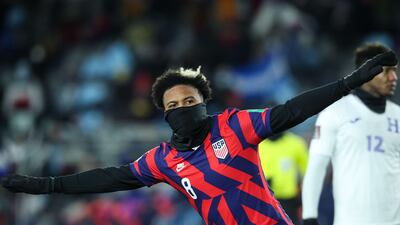
  • Weston McKennie of the United States celebrates after scoring a goal against Honduras. Getty Images / AFP
    Weston McKennie of the United States celebrates after scoring a goal against Honduras. Getty Images / AFP
  • The referee issues a yellow card to Wisdom Quaye of Honduras. Getty Images / AFP
    The referee issues a yellow card to Wisdom Quaye of Honduras. Getty Images / AFP
  • US forward Christian Pulisic (10) controls the ball between Honduras midfielder Alfredo Mejia (8) and Devron Garcia during the second half. AP Photo
    US forward Christian Pulisic (10) controls the ball between Honduras midfielder Alfredo Mejia (8) and Devron Garcia during the second half. AP Photo
  • A USA fan holds a flag during the World Cup qualifier Concacaf football match between USA and Honduras. AFP
    A USA fan holds a flag during the World Cup qualifier Concacaf football match between USA and Honduras. AFP
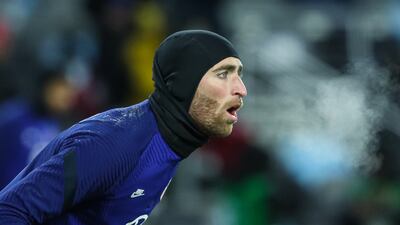
  • Matt Turner of the United States warms up before the start of a World Cup Qualifying game against Honduras. Getty Images / AFP
    Matt Turner of the United States warms up before the start of a World Cup Qualifying game against Honduras. Getty Images / AFP
  • Bryan Róchez of Honduras hits a header against the United States in the second half. Getty Images / AFP
    Bryan Róchez of Honduras hits a header against the United States in the second half. Getty Images / AFP
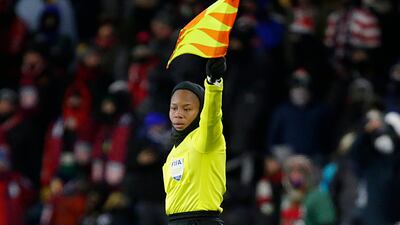
  • Stephanie-Dale Yee Sing works the sideline during the second half. AP Photo
    Stephanie-Dale Yee Sing works the sideline during the second half. AP Photo
  • Maynor Figueroa of Honduras looks on against the United States in the second half. Getty Images / AFP
    Maynor Figueroa of Honduras looks on against the United States in the second half. Getty Images / AFP
  • Honduras midfielder Juan Delgado (6) controls the ball in front US midfielder Luca de La Torre (17). AP Photo
    Honduras midfielder Juan Delgado (6) controls the ball in front US midfielder Luca de La Torre (17). AP Photo
MATCH INFO

Juventus 1 (Dybala 45')

Lazio 3 (Alberto 16', Lulic 73', Cataldi 90 4')

Red card: Rodrigo Bentancur (Juventus)

Mercer, the investment consulting arm of US services company Marsh & McLennan, expects its wealth division to at least double its assets under management (AUM) in the Middle East as wealth in the region continues to grow despite economic headwinds, a company official said.

Mercer Wealth, which globally has $160 billion in AUM, plans to boost its AUM in the region to $2-$3bn in the next 2-3 years from the present $1bn, said Yasir AbuShaban, a Dubai-based principal with Mercer Wealth.

Within the next two to three years, we are looking at reaching $2 to $3 billion as a conservative estimate and we do see an opportunity to do so,” said Mr AbuShaban.

Mercer does not directly make investments, but allocates clients’ money they have discretion to, to professional asset managers. They also provide advice to clients.

“We have buying power. We can negotiate on their (client’s) behalf with asset managers to provide them lower fees than they otherwise would have to get on their own,” he added.

Mercer Wealth’s clients include sovereign wealth funds, family offices, and insurance companies among others.

From its office in Dubai, Mercer also looks after Africa, India and Turkey, where they also see opportunity for growth.

Wealth creation in Middle East and Africa (MEA) grew 8.5 per cent to $8.1 trillion last year from $7.5tn in 2015, higher than last year’s global average of 6 per cent and the second-highest growth in a region after Asia-Pacific which grew 9.9 per cent, according to consultancy Boston Consulting Group (BCG). In the region, where wealth grew just 1.9 per cent in 2015 compared with 2014, a pickup in oil prices has helped in wealth generation.

BCG is forecasting MEA wealth will rise to $12tn by 2021, growing at an annual average of 8 per cent.

Drivers of wealth generation in the region will be split evenly between new wealth creation and growth of performance of existing assets, according to BCG.

Another general trend in the region is clients’ looking for a comprehensive approach to investing, according to Mr AbuShaban.

“Institutional investors or some of the families are seeing a slowdown in the available capital they have to invest and in that sense they are looking at optimizing the way they manage their portfolios and making sure they are not investing haphazardly and different parts of their investment are working together,” said Mr AbuShaban.

Some clients also have a higher appetite for risk, given the low interest-rate environment that does not provide enough yield for some institutional investors. These clients are keen to invest in illiquid assets, such as private equity and infrastructure.

“What we have seen is a desire for higher returns in what has been a low-return environment specifically in various fixed income or bonds,” he said.

“In this environment, we have seen a de facto increase in the risk that clients are taking in things like illiquid investments, private equity investments, infrastructure and private debt, those kind of investments were higher illiquidity results in incrementally higher returns.”

The Abu Dhabi Investment Authority, one of the largest sovereign wealth funds, said in its 2016 report that has gradually increased its exposure in direct private equity and private credit transactions, mainly in Asian markets and especially in China and India. The authority’s private equity department focused on structured equities owing to “their defensive characteristics.”

Updated: April 22, 2022, 6:07 PM