



Live updates: follow the latest news on Russia-Ukraine
Nearly a month after US President Joe Biden promised to take in up to 100,000 Ukrainian refugees, his administration on Thursday detailed how it plans to accept the influx of people.
The move comes as more than five million Ukrainians have fled the devastating conflict to neighbouring countries in Europe, according to the UN.
-
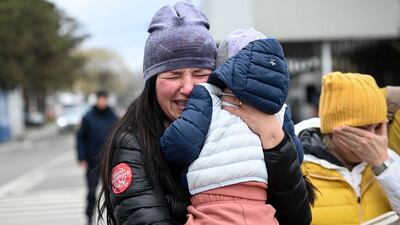
A Ukrainian refugee clings to her child, unable to hold back the despair of upheaval as she arrives at the Romanian border. The number of Ukrainian refugees who have fled has exceeded the 5 million mark as the war enters its ninth week, UN data has indicated. AFP -

Children who fled the war take a break at a railway station in Bucharest, Romania, a country which has taken in more than 757,000 Ukrainian refugees to date. AFP -

A woman gives a wave after crossing the border from Ukraine into Medyka, Poland. Reuters -

An Ukrainian refugee woman sews in Strasbourg, France, as part of a job scheme for people who have fled the war with Russia. AFP -

A giant photograph of a young refugee is unveiled as part of an art installation by French contemporary artist JR to show solidarity with Ukraine, in Venice, Italy. Reuters -

Vladimir and Avigeja Radionow with Kseniia Temcheniuk, who fled war-torn Ukraine, prepare an Easter basket at a cultural centre in Halle, Germany. Getty Images -

Refugees at the border crossing in Medyka, Poland, a country which has to date taken in more than 2,825,000 people from Ukraine. AP Photo -
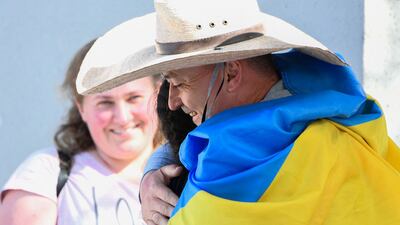
Oleksii Yeromin hugs a Ukrainian refugee at the US-Mexico border. AFP -
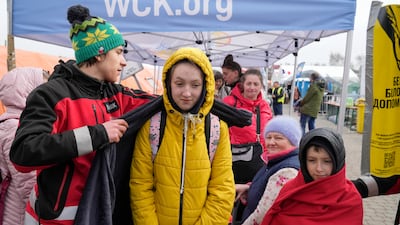
A volunteer covers a refugee with a blanket as she queues at the border crossing in south-eastern Poland. AP Photo


The State Department will expand its capacity at embassies and consulates across Europe to help facilitate Ukrainian visa applications and the refugee resettlement process.
Starting on April 25, “Uniting for Ukraine” will provide Ukrainian citizens who were residents of the country as of February 11, 2022 a streamlined process to apply for humanitarian parole.
According to the White House, to be eligible Ukrainians must meet vaccination and public health requirements and undergo extensive security checks.
Under the plan, US citizens and organisations may apply through the Department of Homeland Security (DHS) to sponsor refugees.
“We are proud to deliver on President Biden’s commitment to welcome 100,000 Ukrainians and others fleeing Russian aggression to the United States,” said Secretary of Homeland Security Alejandro Mayorkas in a statement.
“DHS will continue to provide relief to the Ukrainian people, while supporting our European allies who have shouldered so much as the result of Russia’s brutal invasion of Ukraine.”
Since the Russian invasion on February 24, thousands of Ukrainians have travelled to Mexico and crossed into the US on foot. The Biden administration has warned that from next week that will no longer be an option.
“Ukrainians who present at land US ports of entry without a valid visa or without pre-authorisation to travel to the United States through Uniting for Ukraine will be denied entry and referred to apply through this programme,” the administration said in a statement.
So many Ukrainians have fled to Mexico in the hope of crossing into the US that Mexican authorities have provided a sports complex in the northern city of Tijuana to refugees while they wait to enter the US.

