

The US Congress has passed a bill that will make lynching a federal hate crime after more than a century of failed attempts to introduce such legislation.
The bill is named after Emmett Till, an African-American teenager whose brutal killing galvanised the US civil rights movement in the 1950s.
The Senate voted unanimously on Monday to pass the bill, which will now be sent to President Joe Biden to be signed into law.
The maximum sentence under the law will be 30 years.
“After 100-plus years and 200-plus failed attempts to outlaw lynching, the Senate took long-overdue action by passing the Emmett Till Anti-Lynching Act,” said Democratic Senate Majority Leader Chuck Schumer.
“This is an important step, but that it's taken so long is a stain on America,” he tweeted.
Till, a 14-year-old from Chicago, was abducted and murdered in August 1955 while visiting relatives in the southern state of Mississippi.
His mutilated body was found three days later in a local river.
Till's mother infamously insisted that her son's remains be displayed in an open casket to show the world what had been done to her boy.
Till was murdered several days after a white woman, Carolyn Bryant, claimed that he had propositioned her in a store and touched her on the arm, hand and waist.
Two white men, Carolyn's husband Roy Bryant and J W Milam, his half-brother, were arrested for Till's murder but acquitted by an all-white jury.
The pair later admitted in a magazine interview that they had killed the boy.
Roy Bryant died in 1994 and Milam died in 1981.
-
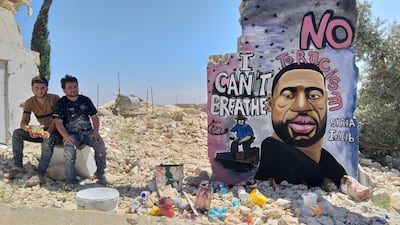
Aziz Asmar, right, and Anis Hamdoun, sitting in front of their mural of George Floyd in Idlib, Syria. 'When we draw on the walls of destroyed buildings, we are telling the world that underneath these buildings there are people who have died or who have left their homes... there was injustice here, just like there's injustice in America'. Aziz Asmar -
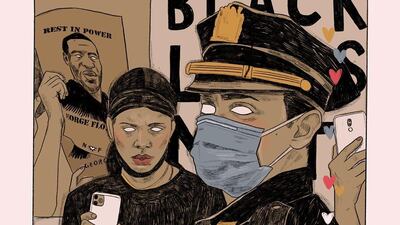
An illustration by Lebanese artist Nouri Flayhan: 'I created this illustration to stand in solidarity with black people, to say we are all watching across the world.' Nouri Flayhan -

An illustration by Lebanese artist Nouri Flayhan reads: "Let's not pretend that racism doesn't exist in the Arab region." ... 'We need to acknowledge the racism issues we have in the Arab region, have uncomfortable conversations about them.' Nouri Flayhan -
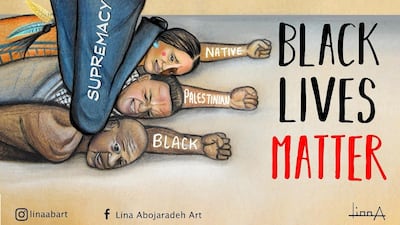
Artwork by Palestinian artist Lina Abojaradeh: 'Standing up for one type of injustice is also standing up for every type of injustice,' she says. Lina Aboujaradeh -
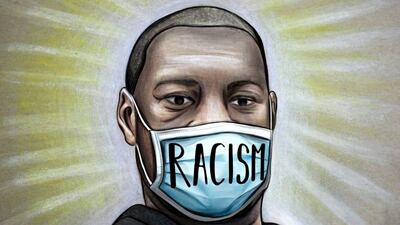
Palestinian artist Lina Abojaradeh depicts George Floyd in new artwork that compares racism to a virus. Lina Abojaradeh -
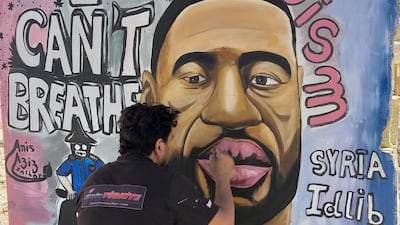
Aziz Asmar painting a mural of George Floyd on a destroyed building wall in Idlib, Syria, with the words 'I can't breathe' and 'No to racism'. Aziz Asmar -
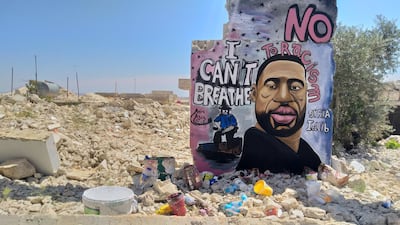
A mural of George Floyd in Idlib, Syria, by Syrian artists Aziz Asmar and Anis Hamdoun. Aziz Asmar


The Justice Department reopened its investigation into Till's murder in 2018 after Carolyn Bryant, now known as Carolyn Donham, had recanted portions of the evidence she had given in interviews with an author of a book on the case.
But the Justice Department said Ms Donham “denied to the FBI that she ever recanted her testimony and provided no information beyond what was uncovered during the previous federal investigation".
In December, the department ended its investigation into the murder.
“The government's reinvestigation found no new evidence suggesting that either the woman or any other living person was involved in Till's abduction and murder,” it said.
Democrat Cory Booker, who introduced legislation in the Senate to make lynching a federal crime in 2018, said on Monday that lynching was “a shameful instrument of terror used to intimidate and oppress black Americans".
“This legislation is a necessary step America must take to heal from the racialised violence that has permeated its history,” his statement read.

