


Six months after the Taliban retook the Afghan capital Kabul with barely a shot being fired, aid groups are warning of a deepening humanitarian crisis in a country once again firmly under the control of the religious hardliners.
Afghanistan’s battered and heavily sanctioned economy is teetering on the brink of collapse. The UN seeks $5 billion this year to feed 1 million Afghan children who are in danger of starving and the 90 per cent of the population that lives in poverty.
Half a year since the Taliban swept back to power, western donors are still grappling over whether to recognise the hardliners as legitimate rulers, lift sanctions and boost humanitarian support — at the risk of cementing the group’s grip on power.
The Taliban, for their part, have committed widespread abuses but avoided the wholesale purges of opponents that were initially feared. They have trodden carefully on curbing women’s rights, while dangling the prospect of co-operation against terrorist groups such as ISIS-K and Al Qaeda.
Chris Murphy, a US Democratic senator, recently told Congress about the “moral hazard” faced by American donors in propping up an economy that relied largely on foreign cashflows and has shrunk by 40 per cent since the Taliban takeover.
“We can do our best to route it around the Taliban, but there is no doubt that the partial effect of aid is to save the Taliban from itself,” he said.
Aid agencies were on Monday describing a worsening humanitarian crisis, with sub-zero winter temperatures in mountainous and remote regions making their work harder and deepening suffering across a nation of some 39 million people.
Almost one fifth of families in Afghanistan have been forced to send children out to work because incomes have plummeted these past six months, the aid group Save the Children said.
Some families are so broke they have resorted to selling children, said Medair, another charity.
Shugofa, a mother-of-five living in a camp in northern Afghanistan since her husband was killed, told aid workers she was heartbroken at the notion of sending her daughter out to “work cleaning people’s rubbish and dirt”.
"Not having a breadwinner and having five children without a father, you can imagine how difficult it is," she told Save The Children.
The group's Afghanistan director, Chris Nyamandi, an aid worker since the 1990s in Zimbabwe, Nigeria and other fragile regions, said he had “never seen anything like the desperate situation” unfolding in Afghanistan.
International sanctions have frozen some $9 billion of Afghanistan’s central bank assets, according to a World Bank study in October.
Foreign aid, which bankrolled 75 per cent of the ousted western-backed government, has mostly dried up.
Taliban envoys have in recent weeks met former donors in Oslo, aiming to unlock funds.
A delegation arrived in the Qatari capital Doha on Sunday to convince the international community to restart aid flows. A Taliban spokesman did not answer The National's interview requests.
US President Joe Biden last week directed American financial institutions to unfreeze $7 billion of Afghan central bank funds. Half is to be freed up for aid to Afghans, half to compensate relatives of victims of the 9/11 attacks, which were in part blamed on the Taliban.
UN spokesman Stephane Dujarric said the move was welcome but insufficient.
He said “humanitarian assistance alone” would not feed hungry Afghans and said the country's cash-strapped economy needed a "restart".
Pakistan's President Imran Khan echoed these fears on CNN on Sunday, saying sanctions and cancelled foreign aid were pushing his landlocked South Asian neighbour “into chaos”.
Graeme Smith, an aid consultant and analyst for the International Crisis Group think tank, says would-be investors in telecommunications gear and other infrastructure that would help revive the economy were staying away, “terrified of US sanctions”.
Four decades of war in Afghanistan have largely come to an end, he said. UN data show that armed clashes fell by 98 per cent and air strikes by 99 per cent after US and Nato troops were forced into their humiliating and rapid evacuation in August.
-
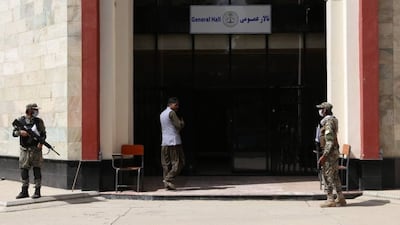
Taliban guards stand outside Kabul Education University in September. Getty -
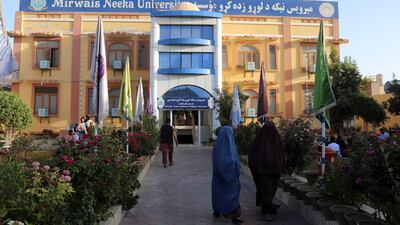
Afghan students at Mirwais Neeka University in Kandahar. EPA -
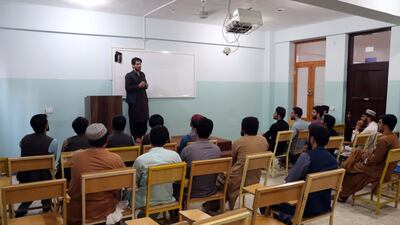
A class at Mirwais Neeka University, Kandahar. EPA -
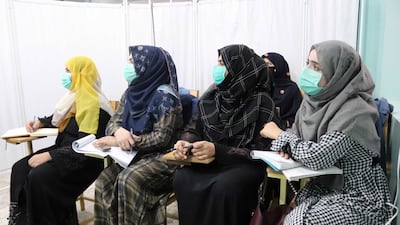
Women are separated from male students by a partition. EPA -

A class segregated by sex at Mirwais Neeka University. EPA -

Gharjistan University in Kabul. AFP -
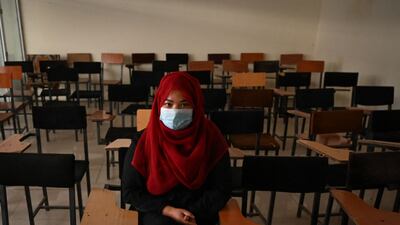
A student in a classroom in Kabul. AFP -
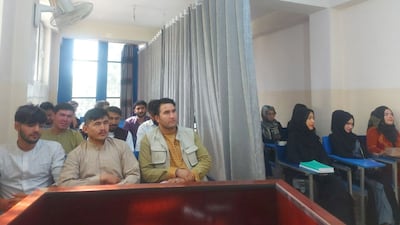
Students attend class at Avicenna University in Kabul. Reuters -
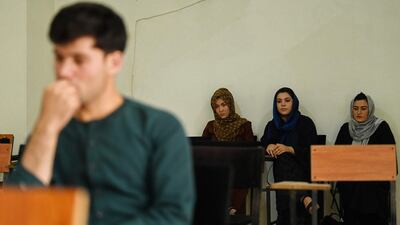
Students return to class after private universities reopened in Kabul. AFP


“That's a good step towards a stable investment climate,” said Mr Smith.
“You can send bags of food. But more than that, you need to address the reason why people are hungry, which is the collapse of the economy, mostly due to western economic restrictions.”
David Miliband, president of the International Rescue Committee, called for more talks between humanitarians in the US and Europe with Gulf donors, who are worried about the “stability of the Afghan state”.
The former UK foreign minister pushed US lawmakers for an “urgent change” in international aid policy to provide support without buttressing the Taliban and “avert a catastrophe-of-choice imposed on the Afghan people”.

