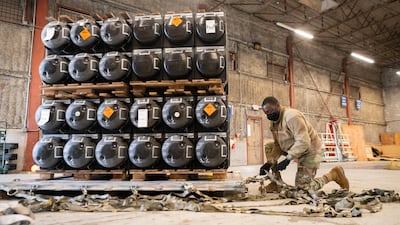
A US airman prepares pallets of ammunition, weapons and other equipment bound for Ukraine from Dover Air Force Base, Delaware. US Air Force via AP

US has limited military options in Ukraine as it tries to deter Russia


Joyce Karam
  • English
  • Arabic

As fears grow that Russia will soon invade Ukraine, the Biden administration finds itself squaring off against a nuclear superpower with only limited military options to try to deter President Vladimir Putin.

The probability of an attack has “increased significantly” in the past two weeks, a US defence official said, pointing to an increase in Russian forces on the border with Ukraine and in Moscow-allied Belarus.

“They’re deploying multiple-domain capabilities without any sign of de-escalation” the official told The National.

Defence Secretary Lloyd Austin briefed Mr Biden at Camp David at the weekend on some of the options available for Washington should Moscow launch an attack.

The Pentagon then announced it is putting 8,500 troops on standby to join a Nato response force in the event of an attack.

“This is really about reassuring the eastern flank of Nato … [Mr Austin] wants us postured to be ready for any other contingencies as well,” Pentagon spokesman John Kirby said.

And US Deputy Secretary of State Wendy Sherman on Wednesday said an invasion could come by mid-February.

But Mr Biden has stressed no US forces will be deployed into Ukraine, which is not a Nato member.

“There is not going to be any American forces moving into Ukraine,” Mr Biden said on Tuesday.

Mark Cancian, senior adviser at the Centre for Strategic and International Studies (CSIS), saw no strong rationale for the US to intervene directly in Ukraine.

“We have no treaty with Ukraine, we are not obligated to defend Ukraine, and they are not a member of Nato,” Mr Cancian, a retired US Marine colonel, told The National.

The doomsday scenario of a nuclear confrontation or the risk of drawing the US into a conflict on Russia’s border make any direct military intervention unappealing. With about 127,000 Russian forces massed along the Ukrainian border, Mr Cancian described any US force deployment to Ukraine as “an invitation for disaster".

Instead, Mr Cancian saw the 8,500 US troops as sending a signal to Mr Putin, who is loath to see US and Nato forces on his doorstep.

Other options include increasing lethal aid, training missions and intelligence sharing with Ukraine, Mr Cancian said.

CNN reported last week that the CIA is operating an intelligence collection training programme on US soil for Ukrainian special operators and intelligence officials.

The Biden administration announced this month that it is providing additional $200 million in military aid to Kiev. Since the Russian annexation of Crimea in 2014, the US has provided Ukraine with about $2.5bn in security assistance, most of it considered “non-lethal”, such as training and defensive weaponry.

A US plane carrying Javelin anti-tank missiles, launchers and other military hardware arrived in Kiev on Tuesday.

  • A Russian soldier attends a military exercise at the Golovenki training ground in the Moscow region, Russia. AP Photo
    A Russian soldier attends a military exercise at the Golovenki training ground in the Moscow region, Russia. AP Photo
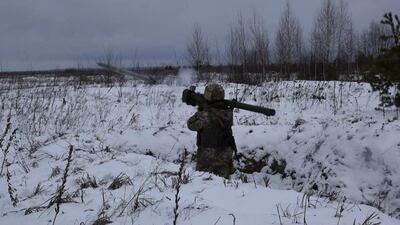
  • A member of the 14th Separate Mechanised Brigade of the Ukrainian Armed Forces takes part in anti-aircraft military drills in the Volyn region, Ukraine. Reuters
    A member of the 14th Separate Mechanised Brigade of the Ukrainian Armed Forces takes part in anti-aircraft military drills in the Volyn region, Ukraine. Reuters
  • People walk past a sign reading 'I Love Ukraine' in the central square in Kiev. EPA
    People walk past a sign reading 'I Love Ukraine' in the central square in Kiev. EPA
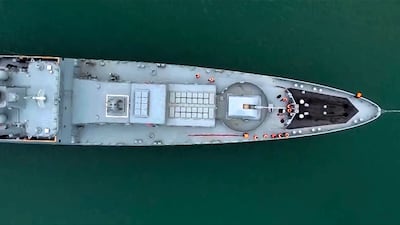
  • Russian naval frigate 'Admiral Essen' sails during an exercise in the Black Sea. AP
    Russian naval frigate 'Admiral Essen' sails during an exercise in the Black Sea. AP
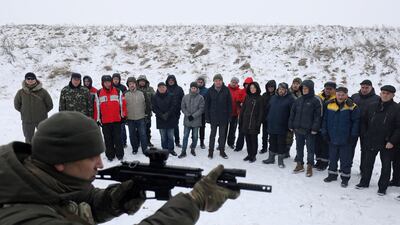
  • Employees of essential city industries and services attend a military training session outside Lviv, Ukraine. Reuters
    Employees of essential city industries and services attend a military training session outside Lviv, Ukraine. Reuters
  • Airman 1st Class Olabode Igandan organises ammunition, weapons and other equipment bound for Ukraine during a foreign military sales mission at Dover Air Force Base, Delaware. AP
    Airman 1st Class Olabode Igandan organises ammunition, weapons and other equipment bound for Ukraine during a foreign military sales mission at Dover Air Force Base, Delaware. AP
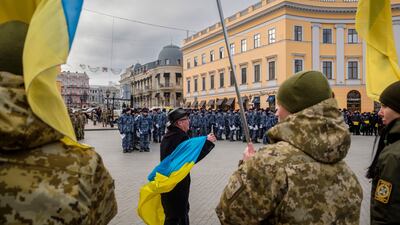
  • A member of the public waves a Ukrainian flag at a rally attended by soldiers and police in Odessa, Ukraine. Bloomberg
    A member of the public waves a Ukrainian flag at a rally attended by soldiers and police in Odessa, Ukraine. Bloomberg
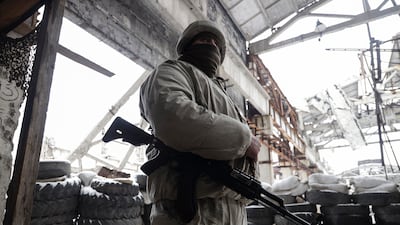
  • A Ukrainian serviceman patrols the front line near Avdiivka village, not far from the pro-Russian militant-controlled city of Donetsk, Ukraine. EPA
    A Ukrainian serviceman patrols the front line near Avdiivka village, not far from the pro-Russian militant-controlled city of Donetsk, Ukraine. EPA
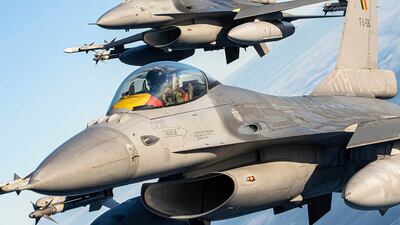
  • A Belgian Air Force F-16 fighter jet participates in Nato's Baltic Air Policing Mission in Lithuanian airspace. AP
    A Belgian Air Force F-16 fighter jet participates in Nato's Baltic Air Policing Mission in Lithuanian airspace. AP

Last week, the State Department gave Latvia, Estonia and Lithuania the go-ahead to send anti-armour missiles to Ukraine.

Other analysts see a need for the US to provide Kiev with sophisticated weaponry such as man-portable air defence systems as well as counter-UAV capabilities.

“The administration should be moving heaven and earth to urgently provide Ukraine — a beleaguered democracy pleading for American help — with the weapons and other support it needs to deter a Russian offensive by increasing the costs of aggression for the Kremlin,” Bradley Bowman, John Hardie and Jack Sullivan of the Foundation for Defence of Democracies said in a recent paper.

They argued that the Biden administration should do now what it should have done in November, when Mr Putin's invasion plans first came to light.

Mr Biden should “move with a sense of urgency to provide Kiev with additional defensive weapons and other support".

“The goal should be to help Ukrainian forces survive Russia’s initial air and missile assault, and to make clear to Putin that Russian forces would suffer major losses during an invasion and potential follow-on occupation,” they wrote.

Such options would increase Ukraine’s military capability but are not necessarily game-changers, Samuel Charap and Scott Boston of the RAND Corporation argued.

“The only weapons systems that could plausibly impose costs that could change Russia's calculus, such as surface-to-air missiles and combat aircraft, are ones that the United States would be highly unlikely to provide the Ukrainians,” they wrote last week.

The US is wary of antagonising Russia by sending such weaponry. But given the current crisis, US politicians from both parties have stepped up calls to allow supplying Kiev with surface-to-air missiles and defence systems.


The bio:

Favourite film:

Declan: It was The Commitments but now it’s Bohemian Rhapsody.

Heidi: The Long Kiss Goodnight.

Favourite holiday destination:

Declan: Las Vegas but I also love getting home to Ireland and seeing everyone back home.

Heidi: Australia but my dream destination would be to go to Cuba.

Favourite pastime:

Declan: I love brunching and socializing. Just basically having the craic.

Heidi: Paddleboarding and swimming.

Personal motto:

Declan: Take chances.

Heidi: Live, love, laugh and have no regrets.


Ten tax points to be aware of in 2026

1. Domestic VAT refund amendments: request your refund within five years

If a business does not apply for the refund on time, they lose their credit.

2. E-invoicing in the UAE

Businesses should continue preparing for the implementation of e-invoicing in the UAE, with 2026 a preparation and transition period ahead of phased mandatory adoption. 

3. More tax audits

Tax authorities are increasingly using data already available across multiple filings to identify audit risks. 

4. More beneficial VAT and excise tax penalty regime

Tax disputes are expected to become more frequent and more structured, with clearer administrative objection and appeal processes. The UAE has adopted a new penalty regime for VAT and excise disputes, which now mirrors the penalty regime for corporate tax.

5. Greater emphasis on statutory audit

There is a greater need for the accuracy of financial statements. The International Financial Reporting Standards standards need to be strictly adhered to and, as a result, the quality of the audits will need to increase.

6. Further transfer pricing enforcement

Transfer pricing enforcement, which refers to the practice of establishing prices for internal transactions between related entities, is expected to broaden in scope. The UAE will shortly open the possibility to negotiate advance pricing agreements, or essentially rulings for transfer pricing purposes. 

7. Limited time periods for audits

Recent amendments also introduce a default five-year limitation period for tax audits and assessments, subject to specific statutory exceptions. While the standard audit and assessment period is five years, this may be extended to up to 15 years in cases involving fraud or tax evasion. 

8. Pillar 2 implementation 

Many multinational groups will begin to feel the practical effect of the Domestic Minimum Top-Up Tax (DMTT), the UAE's implementation of the OECD’s global minimum tax under Pillar 2. While the rules apply for financial years starting on or after January 1, 2025, it is 2026 that marks the transition to an operational phase.

9. Reduced compliance obligations for imported goods and services

Businesses that apply the reverse-charge mechanism for VAT purposes in the UAE may benefit from reduced compliance obligations. 

10. Substance and CbC reporting focus

Tax authorities are expected to continue strengthening the enforcement of economic substance and Country-by-Country (CbC) reporting frameworks. In the UAE, these regimes are increasingly being used as risk-assessment tools, providing tax authorities with a comprehensive view of multinational groups’ global footprints and enabling them to assess whether profits are aligned with real economic activity. 

Contributed by Thomas Vanhee and Hend Rashwan, Aurifer

The National's picks

4.35pm: Tilal Al Khalediah
5.10pm: Continous
5.45pm: Raging Torrent
6.20pm: West Acre
7pm: Flood Zone
7.40pm: Straight No Chaser
8.15pm: Romantic Warrior
8.50pm: Calandogan
9.30pm: Forever Young

MATCH INFO

Manchester City 2 (Mahrez 04', Ake 84')

Leicester City 5 (Vardy 37' pen, 54', 58' pen, Maddison 77', Tielemans 88' pen)

Man of the match: Jamie Vardy (Leicester City)

Our legal consultant

Name: Dr Hassan Mohsen Elhais

Position: legal consultant with Al Rowaad Advocates and Legal Consultants.

MATCH INFO

Manchester United 1 (Greenwood 77')

Everton 1 (Lindelof 36' og)

Updated: January 26, 2022, 7:26 PM