

Jordanian Finance Minister Mohamad Al Ississ appealed to the international community on Wednesday to better support Jordan's economy as it continues to shoulder a heavy portion of the global refugee crisis.
Jordan is one of the world’s most stressed host countries: refugees make up 30 per cent of the population and a vast majority have integrated into local communities, data from the UN refugee agency show.
Amman’s approach of opening the Jordanian educational, healthcare and economic systems to refugees is an important instrument in improving regional and global security, Mr Al Ississ said at an event organised by the Washington-based Centre for Strategic and International Studies.
“Let me state very clearly: it was out of the refugee camps in Pakistan that the Taliban came. What Jordan is doing by providing a future for these refugees is a global public good. This is way bigger than the size of Jordan and the response should be as such,” he said.
The pandemic has further strained Jordan’s already flailing economy. General unemployment, which Mr Al Ississ characterised as the country's “biggest threat”, soared to almost 25 per cent in the first quarter of this year and the rate for youths is a staggering 50 per cent.
“These numbers keep us up at night,” the finance minister said.
“Jordan entered the pandemic with pre-existing economic conditions, and just like normal lives, countries with pre-existing conditions suffered the most under the pandemic.”
-
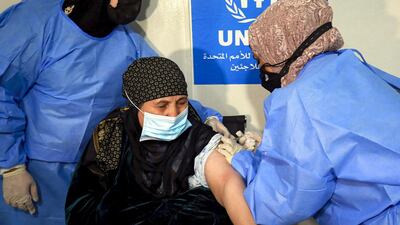
A Syrian refugee receives a Covid-19 vaccine at a medical centre in the Zaatari refugee camp in Jordan in February. AFP -
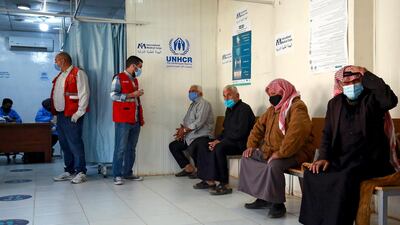
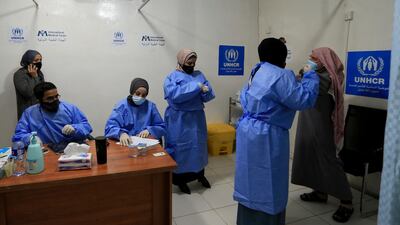
Syrian refugees wait to receive their vaccine at Zaatari. AFP -
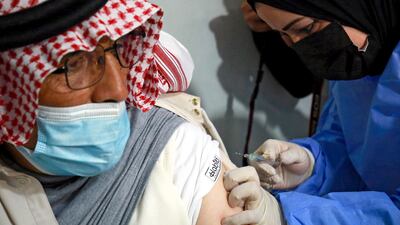
The UK is leading calls for a vaccination ceasefire to allow Covid-19 vaccines to reach people living in conflict zones. AFP -
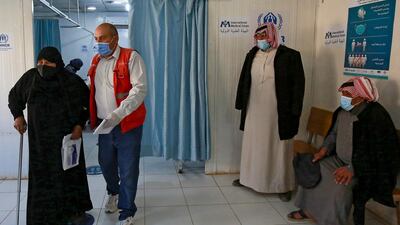
About $2.4bn has been raised for the UN-backed Covax campaign to help developing countries that are unable to afford their own vaccine stockpiles. AFP -
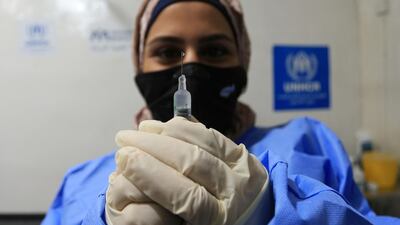
A medical worker prepares the coronavirus vaccine made by Sinopharm to administer to Syrian refugees in Jordan. AP Photo -
Britain's Foreign Secretary Dominic Raab highlighted the 160 million people who could miss out on Covid-19 vaccination because of conflict in their countries. AP Photo -
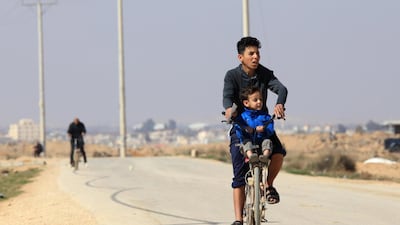
Syrian refugees ride their bicycles in the Zaatari camp, where a Covid-19 vaccination programme has begun. EPA -

'Global vaccination coverage is essential to beating coronavirus,' UK Foreign Secretary Dominic Raab said. EPA


But he also noted that the kingdom’s initial total lockdown during the global first wave as well as its campaign to increase hospital bed capacity and enact swift, nationwide vaccination efforts were a point of pride.
Jordan was the first country to inoculate refugees against Covid-19.
“That quick vaccination programme, I think, is now manifesting in low infection rates. While the rest of the world is being hit with a fourth wave, Jordan is doing well,” he said.
Another area for optimism Mr Al Ississ highlighted is Jordan's track record on renewable energy, which he said could “put Jordan on the map” as a regional energy exporter.
The kingdom’s potential in this sector is enormous due to its location in the world’s solar belt and renewables accounted for 20 per cent of the country’s power mix in 2020.

