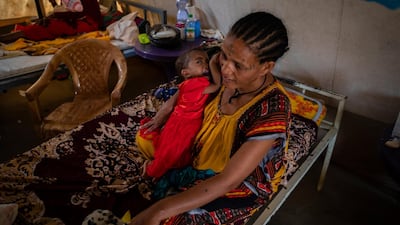
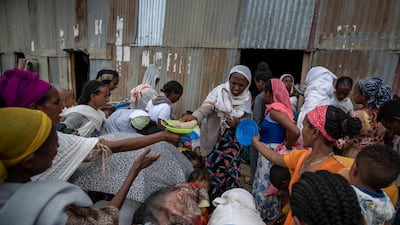
A woman holds a child during a screening for malnutrition by aid groups in the Tigray region of northern Ethiopia. AP

Bill in US Congress could lead to Tigray genocide designation


Bryant Harris
  • English
  • Arabic

The US House of Representatives on Thursday passed legislation that would force the Joe Biden administration to determine whether Ethiopia’s and Eritrea’s actions in the Tigray region constitute genocide.

The provision, introduced by Democrat Tom Malinowski, was included as an amendment to the annual defence authorisation bill, which the House passed 316-113.

The Senate has yet to vote on its own version of the defence authorisation bill. But if Mr Malinowski’s provision remains in the final legislation, it would require Secretary of State Antony Blinken to determine whether “actions in the Tigray region of Ethiopia by the Ethiopian and Eritrean armed forces constitute genocide” under US law.

The US legal code defines genocide as “the specific intent to destroy, in whole or in substantial part, a national, ethnic, racial or religious group".

Mr Biden signed a broad executive order last week paving the way for sanctions on actors responsible for human rights atrocities in the Tigray civil war.

  • Mother Roman Kidanemariam, 35, holds her malnourished daughter, Merkab Ataklti, 22 months old, in the treatment tent of a medical clinic in the town of Abi Adi, in the Tigray region of northern Ethiopia. AP Photo
    Mother Roman Kidanemariam, 35, holds her malnourished daughter, Merkab Ataklti, 22 months old, in the treatment tent of a medical clinic in the town of Abi Adi, in the Tigray region of northern Ethiopia. AP Photo
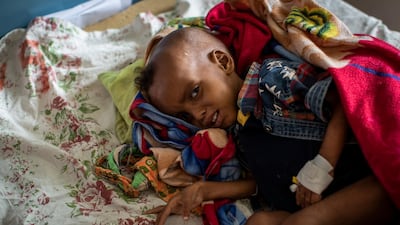
  • Gebre Kidan Gebrehiwet, 2, is treated for malnutrition after fleeing from the town of Abi Adi with his mother, Abeba Tesfay, at the Ayder Referral Hospital in Mekele, in the Tigray region of northern Ethiopia. AP Photo
    Gebre Kidan Gebrehiwet, 2, is treated for malnutrition after fleeing from the town of Abi Adi with his mother, Abeba Tesfay, at the Ayder Referral Hospital in Mekele, in the Tigray region of northern Ethiopia. AP Photo
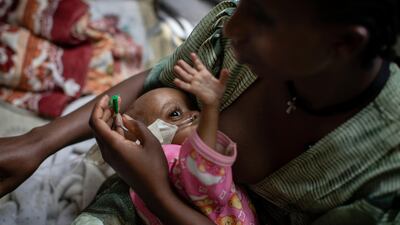
  • Birhan Etsana, 27, from Dengelat, uses a nasogastric tube to feed her malnourished baby, Mebrhit, who at 17 months old weighs just 5.2 kilograms (11 pounds and 7 ounces), at the Ayder Referral Hospital in Mekele, in the Tigray region of northern Ethiopia. AP Photo
    Birhan Etsana, 27, from Dengelat, uses a nasogastric tube to feed her malnourished baby, Mebrhit, who at 17 months old weighs just 5.2 kilograms (11 pounds and 7 ounces), at the Ayder Referral Hospital in Mekele, in the Tigray region of northern Ethiopia. AP Photo
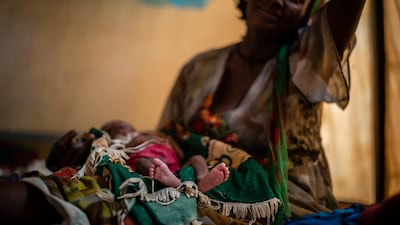
  • Abeba Gebru, 37, from the village of Getskimilesley, sits with her malnourished daughter, Tigsti Mahderekal, 20 days old, in the treatment tent of a medical clinic in the town of Abi Adi, in the Tigray region of northern Ethiopia. AP Photo
    Abeba Gebru, 37, from the village of Getskimilesley, sits with her malnourished daughter, Tigsti Mahderekal, 20 days old, in the treatment tent of a medical clinic in the town of Abi Adi, in the Tigray region of northern Ethiopia. AP Photo
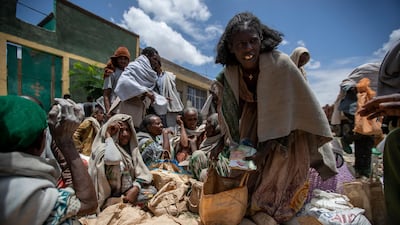
  • An Ethiopian woman scoops up portions of yellow split peas to be allocated to waiting families after it was distributed by the Relief Society of Tigray in the town of Agula, in the Tigray region of northern Ethiopia. AP Photo
    An Ethiopian woman scoops up portions of yellow split peas to be allocated to waiting families after it was distributed by the Relief Society of Tigray in the town of Agula, in the Tigray region of northern Ethiopia. AP Photo
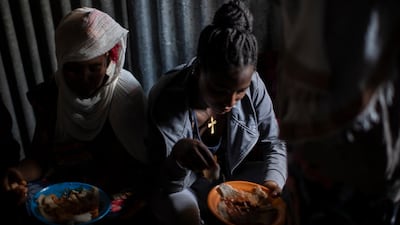
  • Displaced Tigrayan women sit in a metal shack to eat food donated by local residents at a reception center for the internally displaced in Mekele, in the Tigray region of northern Ethiopia. AP Photo
    Displaced Tigrayan women sit in a metal shack to eat food donated by local residents at a reception center for the internally displaced in Mekele, in the Tigray region of northern Ethiopia. AP Photo
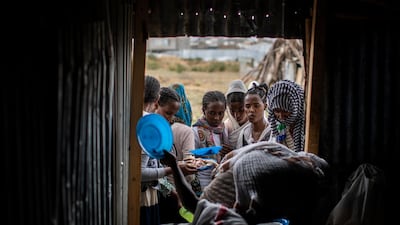
  • A woman stands in line to receive food donations at the Tsehaye primary school, which was turned into a temporary shelter for people displaced by conflict, in the town of Shire, Tigray region. Reuters
    A woman stands in line to receive food donations at the Tsehaye primary school, which was turned into a temporary shelter for people displaced by conflict, in the town of Shire, Tigray region. Reuters
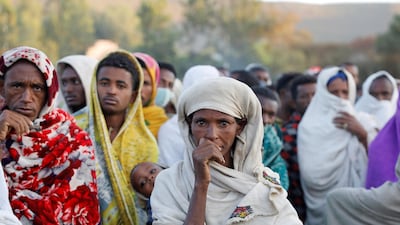
  • Tigrayans stand in line to receive food donated by local residents at a reception center for the internally displaced in Mekele, in the Tigray region of northern Ethiopia. AP Photo
    Tigrayans stand in line to receive food donated by local residents at a reception center for the internally displaced in Mekele, in the Tigray region of northern Ethiopia. AP Photo
  • An Ethiopian woman leaves with a portion of yellow split peas after it was distributed by the Relief Society of Tigray in the town of Agula, in the Tigray region of northern Ethiopia. AP Photo
    An Ethiopian woman leaves with a portion of yellow split peas after it was distributed by the Relief Society of Tigray in the town of Agula, in the Tigray region of northern Ethiopia. AP Photo
  • Displaced Tigrayans queue to receive food donated by local residents at a reception center for the internally displaced in Mekele, in the Tigray region of northern Ethiopia. AP Photo
    Displaced Tigrayans queue to receive food donated by local residents at a reception center for the internally displaced in Mekele, in the Tigray region of northern Ethiopia. AP Photo

The Biden administration has said that it would enact those sanctions on the Ethiopian and Eritrean governments as well as the Amhara Regional Government and the Tigray People’s Liberation Front within a matter of weeks unless the parties agree to a ceasefire.

The US last month sanctioned the chief of staff of the Eritrean defence forces, Filipos Woldeyohannes.

The Biden administration has repeatedly called on Eritrean forces to withdraw from Tigray.

Although Ethiopia has maintained an internet, phone and media blackout in Tigray, witnesses have described widespread human rights abuses, including the displacement and murder of civilians, rape, the destruction of civilian infrastructure and the burning of crops.

Fighters from the Tigray People’s Liberation Front have also retaliated with their own abuses during raids on villages in Amhara, including a massacre this month that killed 120 people.

The conflict broke out last year when Ethiopian Prime Minister Abiy Ahmed launched a military offensive against Tigray with the backing of Eritrean forces and Amhara militias.


Ten tax points to be aware of in 2026

1. Domestic VAT refund amendments: request your refund within five years

If a business does not apply for the refund on time, they lose their credit.

2. E-invoicing in the UAE

Businesses should continue preparing for the implementation of e-invoicing in the UAE, with 2026 a preparation and transition period ahead of phased mandatory adoption. 

3. More tax audits

Tax authorities are increasingly using data already available across multiple filings to identify audit risks. 

4. More beneficial VAT and excise tax penalty regime

Tax disputes are expected to become more frequent and more structured, with clearer administrative objection and appeal processes. The UAE has adopted a new penalty regime for VAT and excise disputes, which now mirrors the penalty regime for corporate tax.

5. Greater emphasis on statutory audit

There is a greater need for the accuracy of financial statements. The International Financial Reporting Standards standards need to be strictly adhered to and, as a result, the quality of the audits will need to increase.

6. Further transfer pricing enforcement

Transfer pricing enforcement, which refers to the practice of establishing prices for internal transactions between related entities, is expected to broaden in scope. The UAE will shortly open the possibility to negotiate advance pricing agreements, or essentially rulings for transfer pricing purposes. 

7. Limited time periods for audits

Recent amendments also introduce a default five-year limitation period for tax audits and assessments, subject to specific statutory exceptions. While the standard audit and assessment period is five years, this may be extended to up to 15 years in cases involving fraud or tax evasion. 

8. Pillar 2 implementation 

Many multinational groups will begin to feel the practical effect of the Domestic Minimum Top-Up Tax (DMTT), the UAE's implementation of the OECD’s global minimum tax under Pillar 2. While the rules apply for financial years starting on or after January 1, 2025, it is 2026 that marks the transition to an operational phase.

9. Reduced compliance obligations for imported goods and services

Businesses that apply the reverse-charge mechanism for VAT purposes in the UAE may benefit from reduced compliance obligations. 

10. Substance and CbC reporting focus

Tax authorities are expected to continue strengthening the enforcement of economic substance and Country-by-Country (CbC) reporting frameworks. In the UAE, these regimes are increasingly being used as risk-assessment tools, providing tax authorities with a comprehensive view of multinational groups’ global footprints and enabling them to assess whether profits are aligned with real economic activity. 

Contributed by Thomas Vanhee and Hend Rashwan, Aurifer

The%20Emperor%20and%20the%20Elephant
%3Cp%3E%3Cstrong%3EAuthor%3A%20%3C%2Fstrong%3ESam%20Ottewill-Soulsby%3C%2Fp%3E%0A%3Cp%3E%3Cstrong%3EPublisher%3A%20%3C%2Fstrong%3EPrinceton%20University%20Press%3C%2Fp%3E%0A%3Cp%3E%3Cstrong%3EPages%3A%20%3C%2Fstrong%3E392%3C%2Fp%3E%0A%3Cp%3E%3Cstrong%3EAvailable%3A%20%3C%2Fstrong%3EJuly%2011%3C%2Fp%3E%0A

Sting & Shaggy

44/876

(Interscope)

Updated: September 24, 2021, 1:18 AM