

Diplomat Bakhtiyor Ibragimov flew to America with his family on September 7, 2001.
The flight from Uzbekistan's capital, Tashkent, passed by the Twin Towers of the World Trade Centre on its final descent into New York.
Like everyone else who saw the glittering skyline of one of the world’s famous cities, the family gazed out of the windows at the skyscrapers.
Mr Ibragimov's wife and two young daughters had never been to the US.
Through the plane’s windows, he pointed to the towers that dominated the city’s iconic skyline.
“As we were landing, I was showing my family and telling them 'these are the Twin Towers',” said Mr Ibragimov, who was then 28.
“And I promised to take them there. They saw the towers just four days before it happened.”
Twenty years have passed since the events of September 11, 2001 and now Mr Ibragimov serves as Uzbekistan’s ambassador to the UAE.
But that day remains forever etched on his mind.
In 2001, Uzbekistan had been independent from the Soviet Union for just ten years and Mr Ibragimov was tasked with bolstering trade relations with America, serving at his country's embassy in Washington DC.
September 11 was his first day on duty as a councillor for trade and economic affairs. His wife did not speak English and mobile phones and communications were nothing like today.
Mr Ibragimov left for work that day.
“I said to my wife, see you tonight,” he said.
He was taken to the embassy in Washington, crossing from the Virginia side across the Potomac River in to the city. It was just after 9.30am.
“Towards the right something had happened," he said. Smoke and flames were visible. "I asked my colleague what was going on. He said maybe a fire or something and we saw the fire engines racing past.”
At the embassy it became clearer. America was under attack.
Hijackers had flown two planes into the World Trade Centre and another into the Pentagon, which Mr Ibragimov had just passed, while a fourth would come down in a field in Pennsylvania.
-

A hijacked commercial plane approaches the World Trade Centre shortly before crashing into the landmark skyscraper in New York on September 11, 2001. AFP -
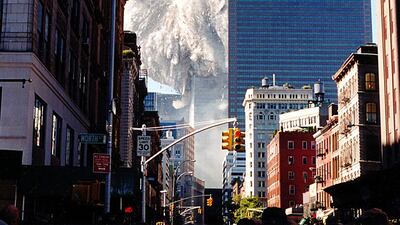
The South Tower of the World Trade Centre collapses sending dust and smoke into the streets in New York on September 11, 2001. Two planes crashed into the towers that later collapsed. AFP -
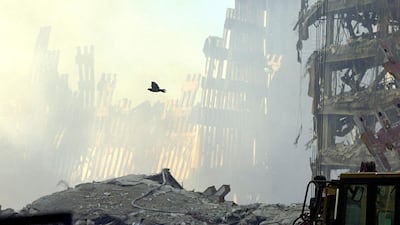
A bird takes flight over the wreckage of the World Trade Centre on September 16, 2001, as clearing work continued on the site of the nation's worst terrorist attack. AFP -
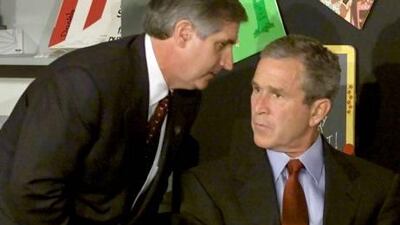
George W Bush, then US president, reacts after being told about the terrorist attack on September 11, 2001. -
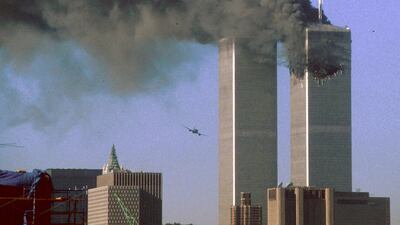
A hijacked United Airlines Flight 175 plane flies towards the World Trade Centre twin towers shortly before slamming into the south tower, as the north tower burns following an earlier attack in New York on September 11, 2001. Reuters -
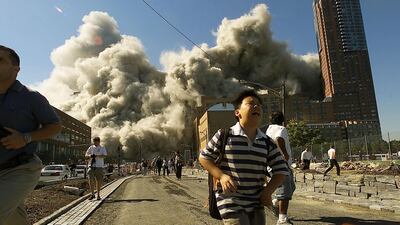
People run away as the second tower of World Trade Centre crumbles down after a plane hit the building on September 11, 2001, in New York. AFP -
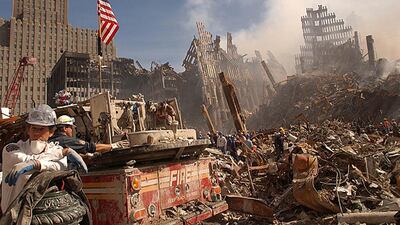
Firefighters and emergency workers battle fires as they search for survivors amid the debris of the World Trade Centre in New York on September 13, 2001. AFP -
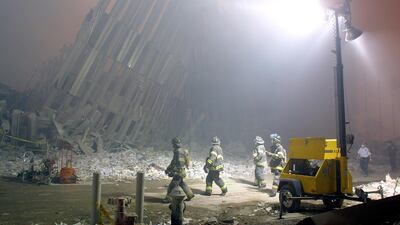
Firefighters make their way through the rubble of the World Trade Centre on September 11, 2001, in New York, after two hijacked planes flew into the skyscrapers. AFP -
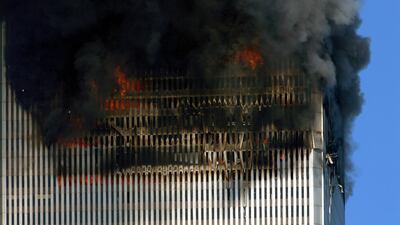
Smoke and flames billow out of the World Trade Centre towers before their collapse on September 11, 2001, in New York. AFP -

An American flag is posted in the rubble of the World Trade Centre on September 13, 2001, in New York. The search for survivors and the recovery of the victims continued in the days following the September 11 terrorist attack. AFP -
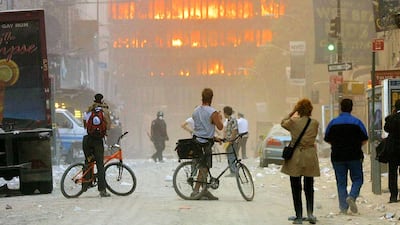
People walk in the street in the area where the World Trade Centre buildings collapsed on September 11, 2001, after two planes slammed into the twin towers in what was then a 'suspected' terrorist attack. AFP -
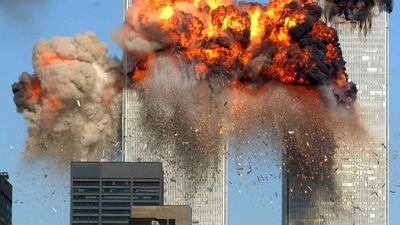
A plane hijacked by terrorists from Boston crashes into the South Tower of the World Trade Centre on September 11, 200,1 in New York. AFP -
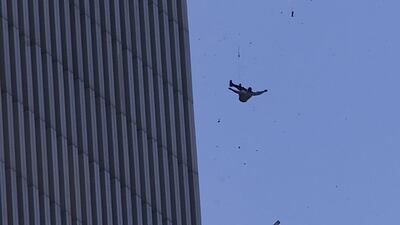
A man falls to his death from the World Trade Centre after two planes hit the building on September 11, 2001, in New York. AFP -
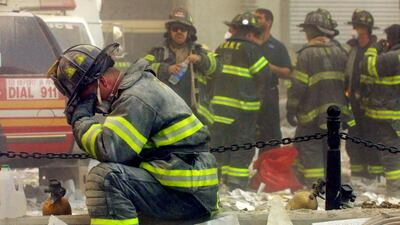
A firefighter breaks down as the World Trade Centre buildings collapsed on September 11, 2001, after two hijacked airplanes slammed into the twin towers in a terrorist attack. AFP


It was a day of terror that would cause the deaths of thousands of Americans and bring down the Twin Towers.
A state of emergency was declared in the capital, the National Guard was deployed and America closed its airspace. Across the country and world, people’s lives would never be the same again.
“We had a meeting and were told we had to be on duty. No one knew how the situation would develop,” said Mr Ibragimov.
“One of the impressions for me was that it was the first time we saw the military on the streets. No one knew what was going to happen next.”
He called his parents in Tashkent, where it was around 1am.
“They didn’t sleep. I told them everything was under control, although I hadn’t seen my family yet.”
Back at his family’s apartment, its ten-floor vantage point had given his wife a view of the Pentagon and the flames after the plane crashed into it.
“She only spoke basic English and asked what had happened. She said there was a fire and many fire engines went up there.”
Another issue was the fact 100 Uzbek musicians were at that moment on a plane bound for America to participate in concerts to mark Uzbekistan’s independence day that fell on September 1.
When the US closed its airspace, the aircraft did not have enough fuel to return to Uzbekistan and was forced to land at a military airbase in Newfoundland, Canada.
Stuck there for a week, they even performed a few shows for people there before eventually returning to Uzbekistan.
The situation remained fraught and busy at the Uzbekistan embassy for the rest of the year with America swiftly planning its campaign in Afghanistan and talking to Central Asian countries in advance.
“They started to talk with all [of Afghanistan's] neighbouring countries,” he said.
“Uzbekistan hosted an airbase at that time for the United States and provided logistical support.”
By the following year, Uzbekistan’s then president Islam Karimov visited the US and met President George W Bush. Things slowly returned to normal.
Twenty years on, Mr Ibragimov is now helping to boost ties between Uzbekistan and the UAE. But those memories of a fateful day are never too far from the surface.
“Yes,” recalls Mr Ibragimov. “That was my first working day in the US.”


