
The Bootleg blaze in southern Oregon has swelled to become the biggest among scores of current bushfires engulfing the western US and is expected to grow as dryness and heat thwart fire crews.
Bootleg is about 30 per cent contained, the US Forest Service says, and officials have ordered mandatory evacuations of some areas. While firefighters are battling to control its southern flank, the agency expects “significant acreage increase” on its eastern side.
Historic droughts and searing heat exacerbated by climate change have touched off a cascading series of bushfires, played havoc with electric grids and created water shortages for farmers and communities throughout the western US.
Bootleg comes on the heels of last year’s fires that amounted to the most expensive disaster in Oregon history. A study found that June’s deadly Pacific North-West heatwave was intensified by greenhouse gas pollution.
The fire now ranks as the fourth largest in the state in records dating to 1900 and could move up the list as it continues to expand, said Courtney Travis, a senior meteorologist with AccuWeather.
She said the area is not expected to receive any rain soon and temperatures will climb through the week, fuelling the blaze. It could be weeks before firefighters have it contained, she said.
There are currently 83 large fires burning in the US with all but one are in the west.
-
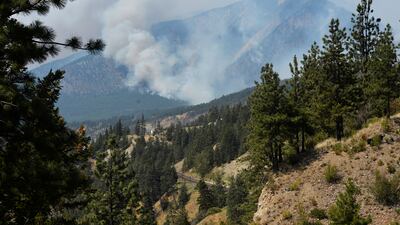
A wildfire burns outside of the town of Lytton, where a wildfire raged through and forced everyone to evacuate, in British Columbia, Canada, July 1, 2021. -
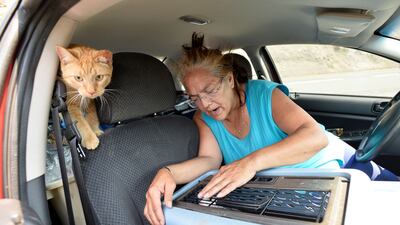
Martha Van Dyke of Lytton sits in her car with her cats, Tigger and Kona, after a wildfire that raged through her town forced residents to evacuate, outside of Lytton, British Columbia. -

Structures destroyed by a wildfire are seen in Lytton, British Columbia. -

A wildfire burns outside of the town of Lytton. -

The roughly 1,000 residents of Lytton had to abandon their homes with just a few minutes notice Wednesday evening, after searing the previous day under a record high of 121. 2 F (49. 6 C). -

The sign for the town of Lytton, where a wildfire raged through and forced residents to evacuate, is seen in Lytton, British Columbia. -
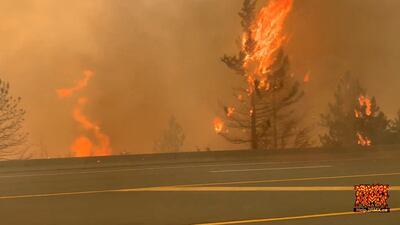
Trees burn along a street during a wildfire in Lytton, British Columbia, June 30, 2021 in this still image obtained from a social media video. -
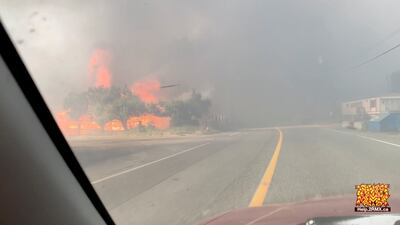
Flames are seen along a street during a wildfire in Lytton, British Columbia in this still image obtained from a social media video. -
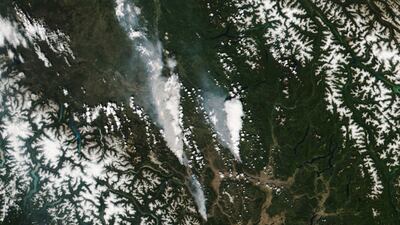
A handout satellite image made available by the National Aeronautics and Space Administration (NASA) shows the McKay Creek fire, left; the Sparks Lake fire, right; and smaller fire, visible just south of the town of Lytton, British Columbia. -
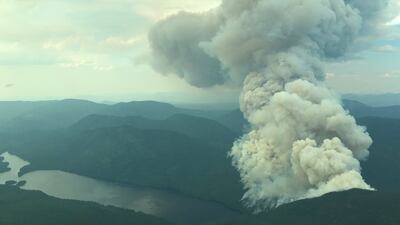
The plume of smoke from wildfire C31056, near McKinley Lake and about 35 kilometres east of Horsefly, British Columbia. -

Two plumes of smoke from the Long Loch wildfire (K51040) and the Derrickson Lake wildfire (K51041), British Columbia. -
A wildfire is seen from an airplane, in Lytton, British Columbia. -
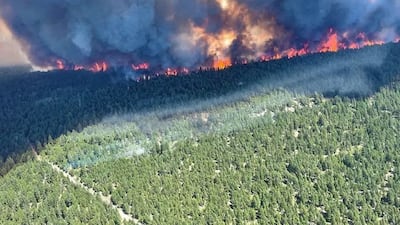
The Sparks Lake wildfire, British Columbia, is seen from the air on June 29, 2021.


Through July 19, more than 35,000 wildfires have burnt more than 2.5 million acres across the US, the US National Interagency Fire Centre said. While the number of fires is above the 10-year average, the amount of acreage is below.
Despite its size, the Bootleg blaze has not affected many communities because of its wilderness location.
“It’s a rather remote area,” said Ms Travis. “That’s probably the only good thing about the fire.”

