


The US Congress on Thursday advanced legislation that could hinder Azerbaijan’s multimillion-dollar military assistance packages that it has received yearly since 2002.
The powerful Appropriations Committee in the House of Representatives voted 32-25 along party lines to advance its annual foreign aid spending bill, which seeks to increase restrictions on Azerbaijani military aid by placing it within the context of the significantly smaller security assistance packages that Armenia typically receives.
The report accompanying the bill notes that “the committee is concerned by disparity in military assistance provided to Azerbaijan in comparison to Armenia".
The legislation would require Secretary of State Antony Blinken to consider “the military balance between Azerbaijan and Armenia and the diplomatic consequences of such disparity in military assistance” when issuing next year’s waiver to allow Azerbaijan to receive US security assistance.
Data compiled by the Centre for International Policy’s Security Assistance Monitor indicates that Washington provided Azerbaijan with over five times more military aid than Armenia in fiscal year 2019: about $45 million for Baku versus about $8m for Yerevan.
Congress first blocked military aid to Azerbaijan following its first war with Armenia over the disputed Nagorno-Karabakh territory. However, Congress passed legislation in 2001 that allowed the State Department to issue a waiver allowing Baku to receive military aid as tension mounted between Azerbaijan and neighbouring Iran over energy exploration in the Caspian Sea.
But the second conflict over Nagorno-Karabakh last year, which resulted in Azerbaijan once again seizing control of the territory with Turkish support, has drawn renewed scrutiny over US military aid to Baku among Armenia’s numerous allies in Congress.
The Armenian National Committee of America vocally condemned Mr Blinken's decision to issue the waiver for Azerbaijan to receive military aid in April. The waiver stipulates that the military assistance to Azerbaijan will not contribute to conflict in the region.
Lobbying disclosure records reviewed by The National indicate that the Armenian National Committee of America spent $30,000 lobbying Congress on several issues in January through March of this year, including on the foreign aid spending bill that includes the language focused on military aid to Azerbaijan.
“We welcome the US House report language as a first step towards rolling back President Biden’s reckless waiver … and stopping all US arms and aid to the oil-rich, racist and openly anti-Armenian Aliyev regime,” Tereza Yerimyan, the government affairs director for the Armenian National Committee of America, told The National.
-
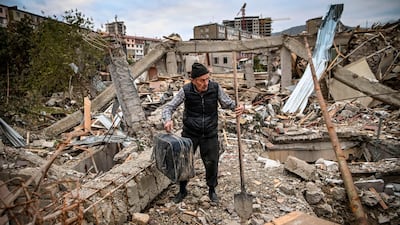
Retired police officer Genadiy Avanesyan, 73, searches for belongings in the remains of his house, which is said was destroyed by Azeri shelling, in the city of Stepanaker. AFP -

Yasin Budakov, 40, holds a book which his kid forgot to take when they were running out of his damaged flat as residents return to their homes following a ceasefire during a military conflict between Armenia and Azerbaijan. AFP -
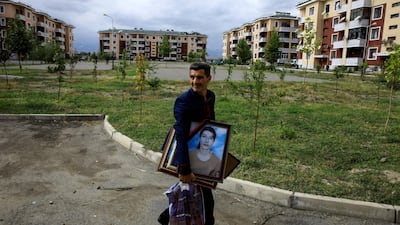
Iman Abisiv carries his belongings from his damaged home after a ceasefire begins during the fighting over the breakaway region of Nagorno-Karabakh in the city of Terter, Azerbaijan. Reuters -
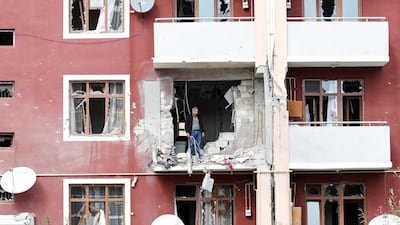
A man looks out from his damaged home after a ceasefire begins during the fighting over the breakaway region of Nagorno-Karabakh in the city of Terter, Azerbaijan. Reuters -
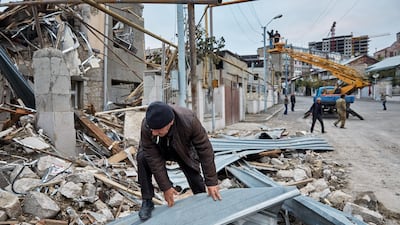
A man rummages through the remains of a home that was damaged by Azeri artillery in Stepanakert, Nagorno-Karabakh. Getty -
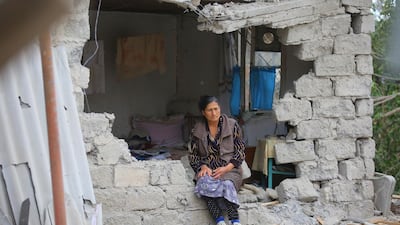
A woman sits in ruins of her house after shelling by Armenian's artillery during fighting over the separatist region of Nagorno-Karabakh, in Terter, Azerbaijan. AP -
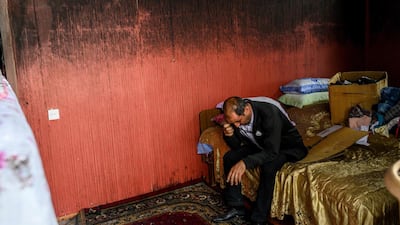
Razim Mehmedov, 40, sits in a bedroom of his flat that was damaged and burnt by shelling as residents return to their homes following a ceasefire during a military conflict between Armenia and Azerbaijan over the breakaway region of Nagorno-Karabakh, in the town of Terter, Azerbaijan. AFP -

Xatire Celilova stands inside her destroyed flat following a ceasefire during a military conflict between Armenia and Azerbaijan over the breakaway region of Nagorno-Karabakh. AFP -
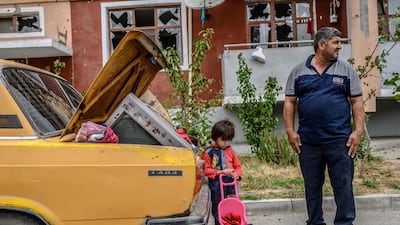
A man stands with his kid by a car outside a damaged apartment building after the family took their last belongings from their flat during a ceasefire during a military conflict between Armenia and Azerbaijan over the breakaway region of Nagorno-Karabakh. AFP


“Not a single US tax dollar should ever be shipped to the Azerbaijani military to kill, cripple or capture Armenians.”
But Aykhan Hajizada, a political counselor for the Azerbaijani embassy in Washington, characterised the efforts as "misleading lobbying efforts in Congress to undermine America's partnerships around the world" that do not help Armenia "reach a lasting peace with neighbours and propserity in the South Caucasus."
"Azerbaijan and the United States enjoy a robust bilateral partnership, including in the areas of defence and security," Mr Hajizada told The National. "This partnership benefits both our nations and the wider region and contributes to global peace. Azerbaijan's role as a force contributor to the operation in Afghanistan and its key role as a unique transit route are just some of the examples."
The Armenian National Committee of America in April called on members of Congress to sign on to a letter to the foreign aid panel urging its powerful members to suspend security aid to Azerbaijan. The letter was spearheaded by Democrats Frank Pallone of New Jersey as well as Jackie Speier and Adam Schiff of California — the three co-chairs of the Congressional Armenian Caucus.
Democrat Barbara Lee of California, the chairwoman of the foreign aid spending panel that initially placed the provision on Azerbaijani military aid in the legislation, is also a member of the Congressional Armenian Caucus.
Two other members of the foreign aid panel — Democrat Grace Meng of New York and Republican Jeff Fortenberry of Nebraska — are also members of the caucus.
The Congressional Armenian Caucus exercises considerable clout in Congress. It has more than 120 members in the House of Representatives, reflecting the hundreds of thousands of Armenian Americans residing throughout the US.
Conversely, the Congressional Azerbaijan Caucus has only 10 members, led by Democrat Steve Cohen of Tennessee and Republican Steve Chabot of Ohio.
-
-

A young French-Armenian woman prays during Easter Sunday mass at Surp Giragos Ermeni Churche in Diyarbakır, Turkey. The church, which had fallen into ruin after the 1915 Armenian Genocide, was recently renovated and Armenians, many of them children and grandchildren of those who had been forced to flee, came from all around the world to celebrate Easter at their ancestors’ church. Scout Tufankjian -

Turks, Armenians and Kurds dance to the music of Collectif Medz Bazar, a Paris-based musical group made up of Armenians and Turks that was touring Turkey and Armenia. While anti-minority prejudice remains strong in Turkey, a growing population of young Turkish citizens are embracing their multicultural roots and are beginning to celebrate the minority communities. Scout Tufankjian -
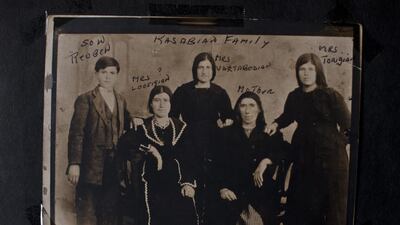
After being scattered across the globe by the 1915 Armenian Genocide and the pogroms that preceded it, family members attempted to keep in touch with relatives in Syria, France, Lebanon,and the United States through photographs and postcards. Courtesy Scout Tufankjian -
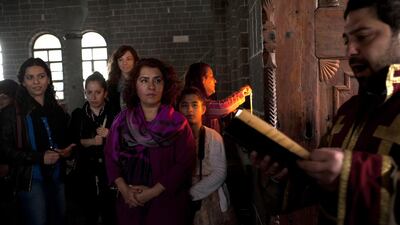
Armenian women pray and light candles during Easter Sunday mass at Surp Giragos Ermeni Kilisei in Diyarbakir, Turkey. The church, which had fallen into ruin after the 1915 Armenian Genocide and the pogroms that followed it, was recently renovated and Armenians, many of whom were the children and grandchildren of those who had been forced to flee Diyarbakir, came from all around the world in order to celebrate Easter at their ancestors' church. Courtesy Scout Tufankjian


As such, Mr Cohen and Mr Chabot faced tough odds when they launched an opposition letter calling on the foreign aid panel to support Azerbaijan in the spending bill and route all US assistance to Nagorno-Karabakh through Baku.
They cited Azerbaijan’s role as a counter-terrorism partner with Israel and as a supply route to US forces in Afghanistan as well as Russia’s support for Armenia in their failed appeal to the foreign aid panel.
Azerbaijan’s lobbyist in Washington, BGR Government Affairs, promoted the letter, but Baku seems to have lost this particular battle.

