

Tensions over Iran’s nuclear programme escalated further on Tuesday after the country’s intelligence chief said Tehran may need nuclear arms to defend itself and amid fresh reports of military co-operation between Iran and North Korea.
Iran's Minister of Intelligence Mahmoud Alavi said Western pressure could push Tehran to fight back like a “cornered cat” and seek nuclear weapons, which the country has long insisted it would not develop.
Mr Alavi's comments follow revelations from a UN report leaked to reporters on Monday that Tehran and Pyongyang have resumed co-operation by sharing "critical parts" of ballistic missiles in violation of successive rounds of UN sanctions.
The developments heap pressure on the weeks-old administration of US President Joe Biden, who says he is seeking to revive a 2015 nuclear deal with Iran but faces opposition from conservatives, security hawks and Washington’s Middle Eastern allies.
Speaking in a rare interview broadcast late on Monday, Iranian spymaster Mr Alavi referenced a religious decree issued in the early 2000s by Supreme Leader Ayatollah Ali Khamenei that barred Tehran from building or using nuclear weapons.
“The Supreme Leader has explicitly said in his fatwa that nuclear weapons are against sharia law and the Islamic Republic sees them as religiously forbidden and does not pursue them,” Mr Alavi told state television.
“But a cornered cat may behave differently from when the cat is free. And if [Western governments] push Iran in that direction, then it’s no longer Iran’s fault.”
Iran has insisted its nuclear programme is to generate carbon-free energy and for other peaceful purposes. But US spy agencies and the UN’s nuclear watchdog have said Tehran once had a nuclear arms program that it halted.
These concerns were further fuelled by an independent panel of UN experts, which on Monday submitted its annual report to the Security Council with fresh details of co-operation between Iran and another nuclear pariah, North Korea.
According to one unnamed UN member, Pyongyang and Tehran resumed co-operation on the development of long-range missiles in 2020, the report said, in violation of multiple rounds of sanctions against the North over its nuclear and ballistic weapons programmes.
-

Iranian President Hassan Rouhani, right, and the head of Atomic Energy Organization of Iran Ali Akbar Salehi inspect the nuclear technology on the occasion of Iran National Nuclear Technology Day in Tehran in 2019. EPA -
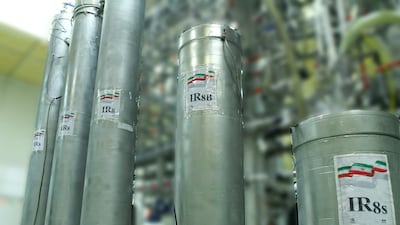
IR-8 centrifuges at Natanz nuclear power plant, some 300 kilometres south of capital Tehran. AFP -
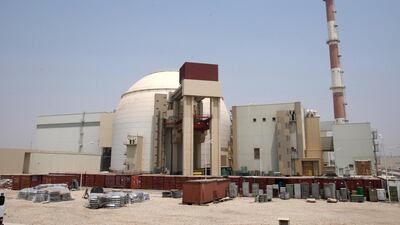
The Iranian nuclear power plant in Bushehr in 2010. EPA -

Salehi speaks with media while visiting Natanz enrichment facility, in central Iran in 2019. Atomic Energy Organization of Iran via AP -
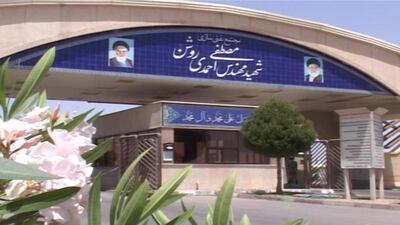
The gate of Natanz nuclear power plant in Natanz , Isfahan province, in 2019. EPA -
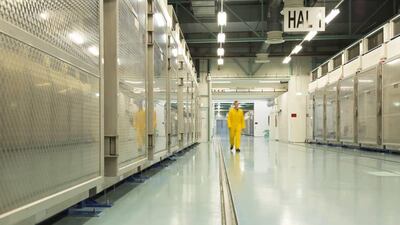
Inside of the Iran's Fordow nuclear facility, in Fordow, Qom province in 2019. EPA -
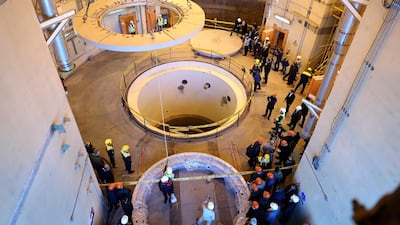
Technicians work at the Arak heavy water reactor's secondary circuit, as officials and media visit the site, near Arak, Iran in 2019. Atomic Energy Organization of Iran via AP -
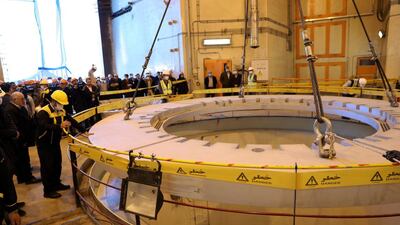
Members of the media and officials tour the water nuclear reactor at Arak in 2019. WANA via Reuters -
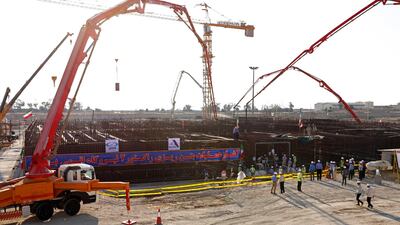
Concrete is poured for the base of the second nuclear power reactor at Bushehr plant in 2019. Atomic Energy Organization of Iran via AP


"This resumed co-operation is said to have included the transfer of critical parts, with the most recent shipment associated with this relationship taking place in 2020," said the report.
The experts said Iran had denied any such missile co-operation with the North.
In a December 21 reply, Iran said its "preliminary review of the information provided to us by the [UN experts] indicates that false information and fabricated data may have been used in investigations and analyses".
The report shines a spotlight on the murky world of cooperation between Iran and North Korea, two countries on the fringes of international diplomacy that are understood to have exchanged military gear, technology and funds over the decades.
Mr Biden’s administration is exploring ways to restore the 2015 nuclear deal that Iran signed with major world powers but that was scrapped in 2018 by then-President Donald Trump, who restored sanctions. Iran retaliated by gradually reviving its nuclear program.
Mr Biden says that, if Tehran returned to compliance with the deal, the US would follow suit. Iranian officials, however, say Washington must move first, creating an impasse that makes it unlikely US sanctions on Iran will be lifted any time soon.

