
North Korea and Iran resumed co-operation on the development of long-range missiles in 2020, according to a UN report that also confirmed Pyongyang continues to breach various nuclear resolutions.
The annual report, produced by an independent panel of UN experts, was submitted to the Security Council on Monday.
It said Tehran denies any such missile co-operation with North Korea.
But according to an unnamed member state, North Korea and Iran "have resumed co-operation on long-range missile development projects," the report states.
"This resumed co-operation is said to have included the transfer of critical parts, with the most recent shipment associated with this relationship taking place in 2020."
The report's experts monitor the multiple sanctions imposed on Pyongyang to attempt to force it to suspend its nuclear and ballistic weapons programmes.
In a December 21 reply, Iran stated the "preliminary review of the information provided to us by the (experts) indicates that false information and fabricated data may have been used in investigations and analyses."
In their assessment of North Korea, the experts said Pyongyang "maintained and developed its nuclear and ballistic missile programmes, in violation of UN Security Council resolutions."
Pyongyang last year announced preparation for testing and production of new ballistic missile warheads and development of tactical nuclear weapons.
"It produced fissile material, maintained nuclear facilities and upgraded its ballistic missile infrastructure. It continued to seek material and technology for these programmes from overseas," the expert report states.
-

Iranian President Hassan Rouhani, right, and the head of Atomic Energy Organization of Iran Ali Akbar Salehi inspect the nuclear technology on the occasion of Iran National Nuclear Technology Day in Tehran in 2019. EPA -
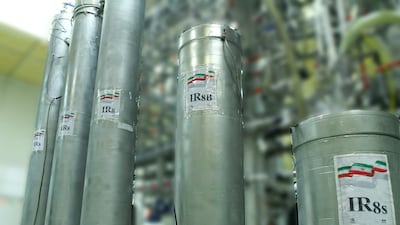
IR-8 centrifuges at Natanz nuclear power plant, some 300 kilometres south of capital Tehran. AFP -
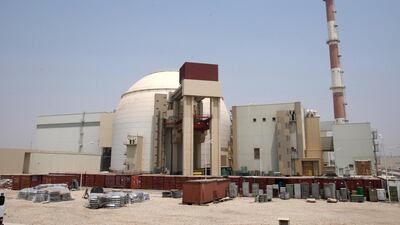
The Iranian nuclear power plant in Bushehr in 2010. EPA -

Salehi speaks with media while visiting Natanz enrichment facility, in central Iran in 2019. Atomic Energy Organization of Iran via AP -
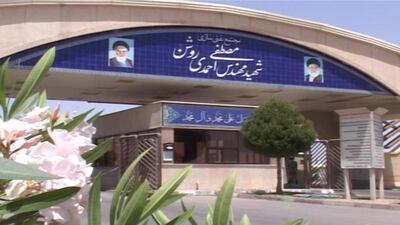
The gate of Natanz nuclear power plant in Natanz , Isfahan province, in 2019. EPA -
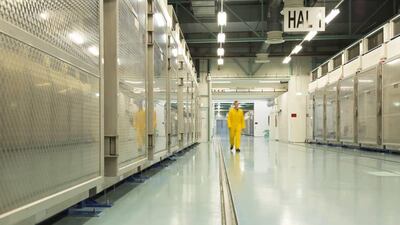
Inside of the Iran's Fordow nuclear facility, in Fordow, Qom province in 2019. EPA -
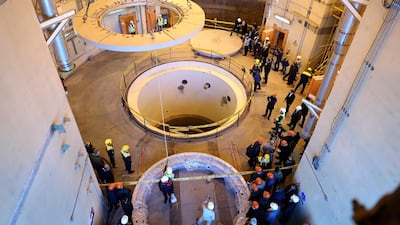
Technicians work at the Arak heavy water reactor's secondary circuit, as officials and media visit the site, near Arak, Iran in 2019. Atomic Energy Organization of Iran via AP -
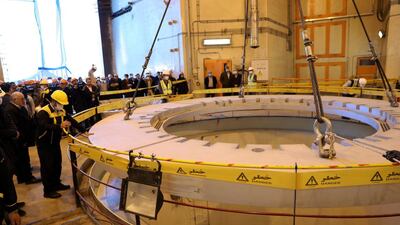
Members of the media and officials tour the water nuclear reactor at Arak in 2019. WANA via Reuters -
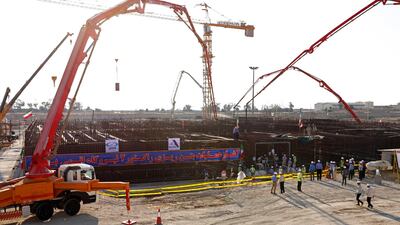
Concrete is poured for the base of the second nuclear power reactor at Bushehr plant in 2019. Atomic Energy Organization of Iran via AP


UN experts say North Korea has modernized its nuclear weapons and ballistic missile arsenals by flaunting using cyberattacks to help finance its arsenal.
The experts also investigated cases in which North Korea acquired ships, sold fishing rights and continued to export coal in breach of sanctions.
North Korea's border closure due to the pandemic may have hampered those shipments, however.
The experts also found that North Korea had continued to import more refined petroleum than is allowed under its 500,000-barrel limit, sometimes by using "elaborate subterfuge."
"According to imagery, data and calculations received from a member state covering the period 1 January to 30 September, in 2020 these illicit shipments exceeded the annual aggregate 500,000-barrel cap by several times," the report states.
Last year, like the year before, the US presented satellite imagery and data to show North Korea was surpassing its quotas.
China and Russia, North Korea's main supporters, have rejected the US claims and say petroleum imports are much smaller.

