


Representatives from governments of the Five Eyes intelligence partnership and those from other countries have agreed to work together to fight fraud
At a summit in London on Monday, the intelligence bloc of the UK, US, Canada, Australia and New Zealand were joined by representatives from France, Germany, Italy, Japan, Singapore and South Korea.
British Home Secretary James Cleverly hailed the pledge as a “massive step forward” in efforts to crack down on the crime.
Mr Cleverly, who hosted the event at Lancaster House, told media the move was to ensure “international crime has an international response”.
The National Crime Agency and US law-enforcement bodies including the FBI and the Secret Service also vowed to deal with scam call centres.
“We’ve been clear that the global community needs to unite to fight fraud head-on and this communique is a massive step forward," Mr Cleverly said.
Formally opening the summit, he said fraud was “evolving” and fraudsters were “taking advantage” of modern technology – with much of the crime taking place online.
Although acknowledging fraud was a “huge challenge”, Mr Cleverly told delegates: “We mustn’t be despondent, we mustn’t be fatalistic", adding that “collective efforts” to tackle the crime will make sure fraudsters do not succeed.
“We won’t ever be complacent or take our eye off the ball,” he said.
How criminals use technology to scam victims - in pictures
-

The use of technology in everyday lives has led to growth in scams and fraud. Reem Mohammed / The National -

Phishing is one of the most common methods used by fraudsters and it involves sending an unsolicited email that appears to be from a financial institution or online retailer. The National -
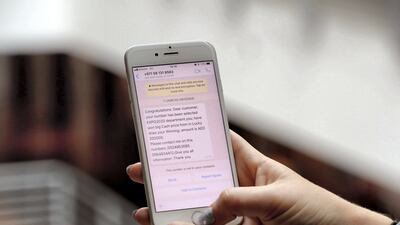
Smishing — the SMS equivalent of phishing — is where fraudsters falsify the telephone number so it appears to be a genuine text from a bank or well-known company. Chris Whiteoak / The National -

Vishing is the telephone equivalent of phishing and smishing. Fraudsters may pose as bank staff, police or government officials. Getty Images -

SIM swap involves fraudsters duplicating the SIM of your mobile number without your knowledge or authorisation, allowing them to conduct financial transactions with your bank. AP -

Identity theft is where someone illegally obtains your confidential information, through various ways such as theft of your wallet, bank and utility bill statements, computer intrusion and social networks. Getty Images -

Prize scams involve fraudsters claiming to represent well-known organisations. They contact victims to tell them they have won a cash prize and request them to share confidential banking details to transfer the prize money. -
Instagram influencer Ramon Abbas, known as Hushpuppi, used a technique known as business email compromise. -

The tax authority said some bank customers in the UAE have received phishing emails impersonating financial institutions. EPA -

Jenny Ross, Which? Money editor, says: ‘Scammers are relentless when it comes to wanting our personal information and ultimately our money.’ PA -

Netflix's The Tinder Swindler tells the story of three women who say they were conned out of $500. Photo: @simon_leviev_official via Instagram


NCA director general Graeme Biggar told the summit that fraud is one of his “biggest worries” among all the serious and organised crime threats he is responsible for tackling.
“That’s because of the scale of the threat and the mismatch between that and our response at the moment. It is not where we need to be,” Mr Biggar said.
Fraud represented 38 per cent of recorded crime in the UK last year, affecting three million victims and costing them £2.5 billion [$3.2 billion], he said.
Interpol has warned fraud is often perpetrated by organised criminal groups, including human traffickers, who force people to work in scam centres that exploit potential victims around the world.
A coming threat assessment is expected to show a concerning rise in fraud in all parts of the globe.
About 70 per cent of fraud offences in the UK have ties to international criminals, with £3 billion lost to overseas accounts last year.
As part of the international agreement, each nation recognised fraud as an “organised, transnational threat” that has become “one of the most prevalent global issues”.
They agreed to “protect citizens and target organised criminals” in a bid to combat fraud, according to the Home Office.
Countries have promised to share more intelligence and resources, and work with banks and other businesses to prevent fraud.
The communique recognises that the effects of fraud are “devastating and universal”, even if the specific types of crime vary, and paves the way for international law-enforcement bodies to work more closely, the department said.
Nations will look at ways of recovering illicitly gained assets and returning funds to victims in different countries. Leaders will also explore using sanctions and visa bans to disrupt organised crime groups.
Tech companies including Amazon, Apple, Google, Meta, TikTok and LinkedIn also attended the first summit of its kind, alongside banks HSBC, NatWest, Santander, and other financial organisations including Visa.
Leaders said social media companies and other online forums are expected to take further action to prevent fraud, including identifying and removing fraudulent posts, the Home Office said.
The event continues on Tuesday.

