


Ukraine aims to gain control over its skies in 2024, the country’s Foreign Minister Dmytro Kuleba said, as panellists at the World Economic Forum in Davos warned about the risk of war fatigue among its European allies on Wednesday.
Mr Kuleba was speaking during a panel discussion featuring several European leaders who stressed the need to sustain support for Ukraine, including Hungarian President Katalin Novak, who warned “Russia cannot win”.
During the first year of the war, in 2022, Ukraine liberated half of the territory that had been occupied by Russia, said Mr Kuleba, while last year it pushed the Russian Black Sea fleet back from its territorial waters, allowing it to restore the corridor.
He added that 2024 would be the year it “throws Russia from the skies”.
“Because the one who controls the skies will define when and how the war will end,” Mr Kuleba said in an address to the World Economic Forum.
His comments came as Kyiv said that Russia had launched 20 Iranian-made Shahed drones at targets in southern Ukraine overnight, and that its anti-air defence systems had destroyed all but one. Ukrainian authorities previously said 20 people were injured in Russian attacks on the cities of Kharkiv and Odesa.
Polish President Andrzej Duda told the session war fatigue was “a very risky phenomenon” that allies had to work to prevent.
“Perhaps it is not very politically correct. Perhaps some people are afraid to say it out loud that this is the case. This war fatigue is visible,” he said, citing the disappearance of the war from the news agenda.
Mr Kuleba said Ukrainians were tired but would not stop fighting.
“It doesn’t matter how tired or exhausted we will be. We will keep defending our country.”
The 2024 World Economic Forum in Davos – in pictures
-
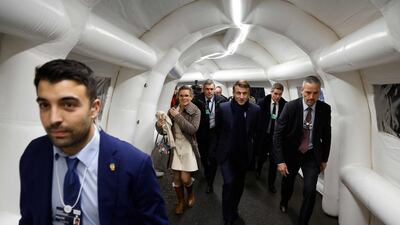
French President Emmanuel Macron (centre), flanked by delegation members, walks through an inflatable tunnel connecting venues at Davos. AFP -

Argentina's President Javier Milei. Reuters -
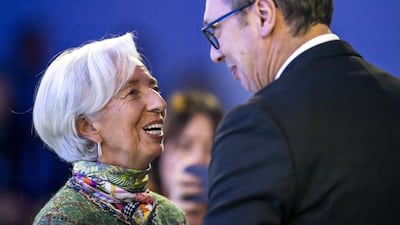
European Central Bank chief Christine Lagarde with Serbia's President Vucic. EPA -
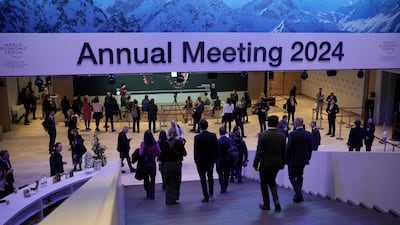
WEF participants gather at Davos Congress Centre. AP Photo -
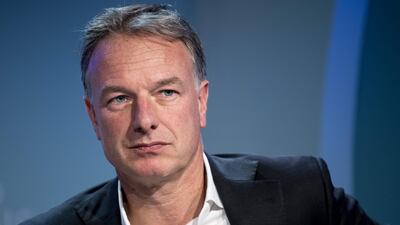
ING Group chief executive Steven van Rijswijk at the World Economic Forum gathering in Davos. AFP -
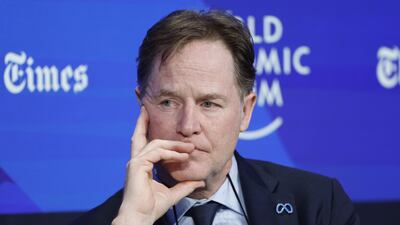
Nick Clegg, president of global affairs and communications with Meta at the WEF. Bloomberg -
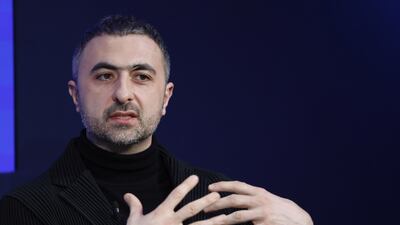
Mustafa Suleyman, co-founder and chief executive officer of Inflection AI, speaking at the event. Bloomberg -
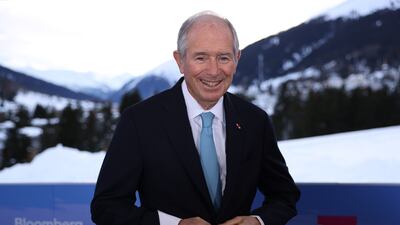
Steve Schwarzman, co-founder and chief executive officer of Blackstone Group, at the Swiss alpine resort. Bloomberg -
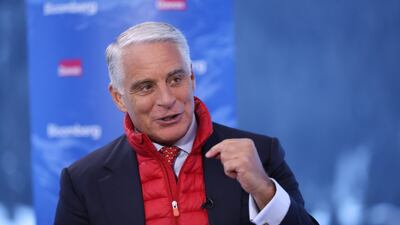
Andrea Orcel, group chief executive of Unicredit, speaking during an interview at the World Economic Forum in Davos, Switzerland. Bloomberg -

Mike Brown, chief executive of Nedbank Group Ltd. Bloomberg -
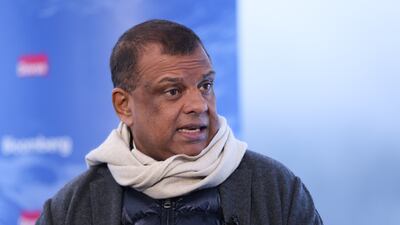
Tony Fernandes, chief executive Capital A Berhad. Bloomberg -
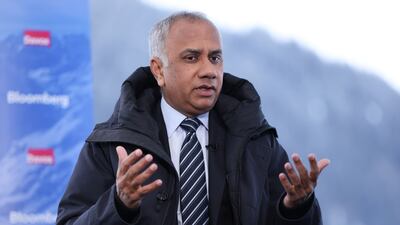
Salil Parekh, chief executive officer of Infosys. Bloomberg -
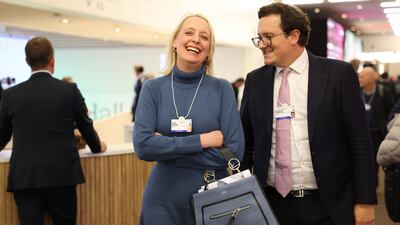
Julie Sweet, chief executive of Accenture, and Ludovic Subran, chief economist at Allianz SE. Bloomberg -
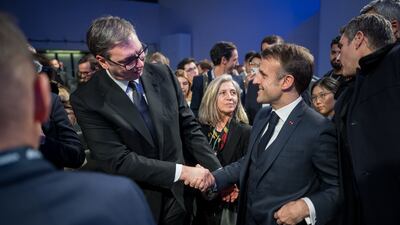
France's President Macron (right) shakes hand with Serbia's President Aleksandar Vucic after his speech. AFP -
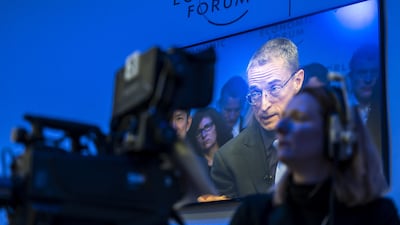
Pat Gelsinger, chief executive of Intel. EPA -
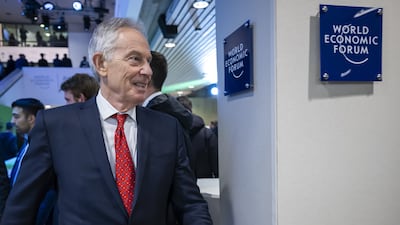
Former British prime minister Tony Blair. EPA -
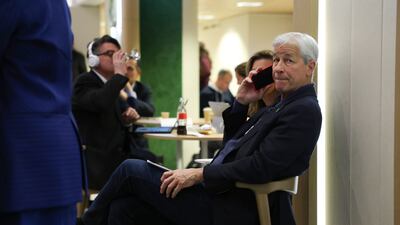
Jamie Dimon, chief executive of JP Morgan Chase. Bloomberg -
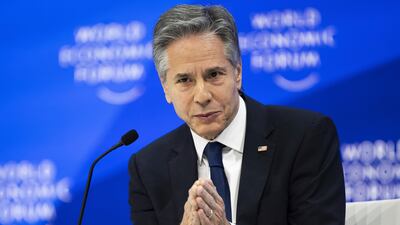
US Secretary of State Antony Blinken. AP -
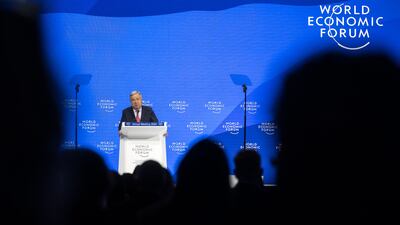
Antonio Guterres, UN Secretary General, addresses the assembly. AFP -

Former US vice president Al Gore speaks. Reuters


Ms Novak was questioned over Viktor Orban’s use of Hungary’s EU veto on using the bloc's budget to help Ukraine.
“I have already made it very clear that I condemn the Russian aggression,” she said.
“If we want to try to preserve our post-Second World War desire for peace, then we have to clarify that war is never the solution and aggression is never the solution.
“I think Russia cannot win. We have to further support Ukraine.”
Andrej Plenkovic, Prime Minister of Croatia, said EU members should be “persistent” in assisting Ukraine.
He said the EU is now in the process of formalising its regular financial support to the embattled nation.
“It would be very good politically if we could do it in the framework of 27 [EU members] all together. But if we don't I'm sure we'll find a legal and technical way to do it and ensure this consistency of assistance to Ukraine,” said Mr Plenkovic.
On Wednesday, European Commission President Ursula von der Leyen voiced confidence that all 27 member states will agree to jointly extend more financial aid to Ukraine.
Ms von der Leyen told EU members: “I am confident that we will find a solution by 27.”
Last month, EU leaders agreed to start accession talks with Ukraine, but Mr Orban, who is widely seen as an ally of Russian President Vladimir Putin, vetoed an initiative to grant €50 billion ($54.3 billion) in aid to Kyiv through 2027.
The bloc's leaders will meet again in Brussels on February 1 to try to agree on providing more financial assistance to Kyiv, which relies heavily on western support to defend itself against Russia.

