It is a significant milestone, as it demonstrates how greenhouse gas emissions are heating the Earth towards an environment that human beings have never experienced before. Reuters

Forecasts show world temperatures to exceed 1.5°C limit in 2024


Soraya Ebrahimi
  • English
  • Arabic

Average global temperatures next year may rise higher than 1.5°C above pre-industrial levels for the first time in modern history, according to Met Office forecasts.

The main goal of the Paris Agreement was to limit warming to 1.5°C, but as that is measured over a period of about 20 years, exceeding 1.5°C for one year does not mean the target has been missed.

The Met Office said it is probable that in the years immediately after 2024, the annual average will fall below 1.5°C again as temperature fluctuates naturally.

It is a significant milestone, nevertheless, as it demonstrates how greenhouse gas emissions are heating the Earth towards an environment that human beings have never experienced before.

The Met Office believe 2024 will finish with an average temperature between 1.34°C and 1.58°C above the period between 1850-1900 – the 11th year in a row that temperatures will have exceeded 1°C.

Forecasters also have tipped this year to finish with an average of 1.2°C above pre-industrial levels and it is almost certainly going to be the hottest year on record, surpassing 2020 and 2016.

El Nino, a naturally occurring phenomenon in which heat rises in the tropical eastern Pacific Ocean, is adding further heat to the atmosphere this year and is set to continue into spring 2024, pushing up the average global temperature temporarily.

“The forecast is in line with the ongoing global warming trend of 0.2°C per decade and is boosted by a significant El Nino event,” Nick Dunstone, of the Met Office, said.

“Hence, we expect two new global temperature record-breaking years in succession and, for the first time, we are forecasting a reasonable chance of a year temporarily exceeding 1.5°C.

“It’s important to recognise that a temporary exceedance of 1.5°C won’t mean a breach of the Paris Agreement. But the first year above 1.5°C would certainly be a milestone in climate history.”

Countries agreed in 2015 to stop the global temperature rising beyond 1.5°C as this is the point at which the climate starts becoming dangerously unstable.

Nations at risk due to climate change – in pictures

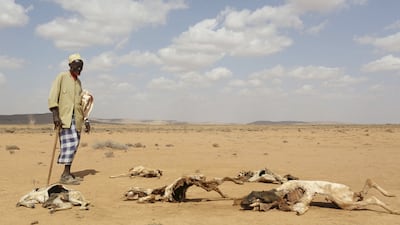
  • Internally displaced children Ali and Osman Abdulahi stand near carcasses of their family's livestock, killed by severe drought near Dollow, Somalia. Reuters
    Internally displaced children Ali and Osman Abdulahi stand near carcasses of their family's livestock, killed by severe drought near Dollow, Somalia. Reuters
  • Quick distribution of climate funds agreed at Cop28 will help devastated populations get back on their feet, Somalia’s Deputy Prime Minister Salah Jama has said. Reuters
    Quick distribution of climate funds agreed at Cop28 will help devastated populations get back on their feet, Somalia’s Deputy Prime Minister Salah Jama has said. Reuters
  • Commuters ride on rickshaws on a flooded road after heavy rains in Dhaka, Bangladesh. Reuters
    Commuters ride on rickshaws on a flooded road after heavy rains in Dhaka, Bangladesh. Reuters
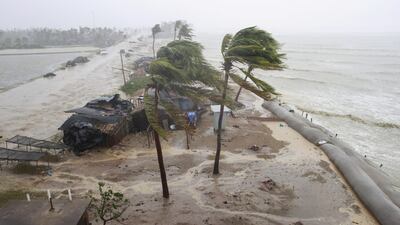
  • Cyclone Mocha makes landfall near Cox's Bazar, Bangladesh. A rise in extreme weather events around the world has been blamed on global warming caused by man-made greenhouse gases. EPA
    Cyclone Mocha makes landfall near Cox's Bazar, Bangladesh. A rise in extreme weather events around the world has been blamed on global warming caused by man-made greenhouse gases. EPA
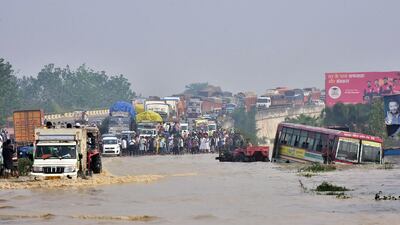
  • Commuters stand on a flyover, on a flooded motorway near Rampur, in India's Uttar Pradesh state, in 2021. AFP
    Commuters stand on a flyover, on a flooded motorway near Rampur, in India's Uttar Pradesh state, in 2021. AFP
  • Monsoon floods and landslides killed about 100 people in Nepal and India earlier this year. AFP
    Monsoon floods and landslides killed about 100 people in Nepal and India earlier this year. AFP
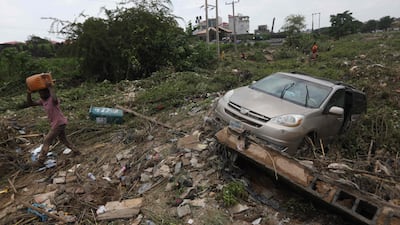
  • A man walks past a car swept by floodwaters in Abuja, Nigeria, in 2021. AFP
    A man walks past a car swept by floodwaters in Abuja, Nigeria, in 2021. AFP
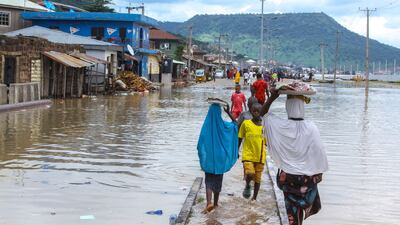
  • Flooding in Kogi, Nigeria, in October 2022. AP
    Flooding in Kogi, Nigeria, in October 2022. AP
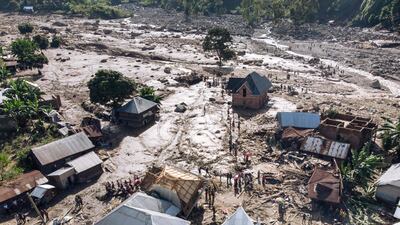
  • A landslide engulfs Nyamukubi village, eastern Democratic Republic of Congo. AFP
    A landslide engulfs Nyamukubi village, eastern Democratic Republic of Congo. AFP
  • A landslide in the Mont Ngafula district of Kinshasa, the capital of the Democratic Republic of Congo. AFP
    A landslide in the Mont Ngafula district of Kinshasa, the capital of the Democratic Republic of Congo. AFP
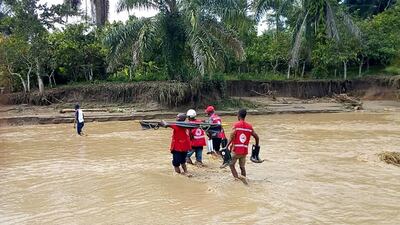
  • Aid workers crossing flooded areas in Bundibugyo, Uganda. Twitter/UgandaRedCross
    Aid workers crossing flooded areas in Bundibugyo, Uganda. Twitter/UgandaRedCross
  • Villagers try to pull up a minibus in which 14 bodies were retrieved, in the river Nabuyonga in eastern Uganda, after flash floods. AFP
    Villagers try to pull up a minibus in which 14 bodies were retrieved, in the river Nabuyonga in eastern Uganda, after flash floods. AFP

Melting of polar and mountain glaciers may become irreversible and trigger further warming regardless of whether human emissions are brought under control.

An overheating ocean may also kill off the world’s coral reefs, which form the basis of diverse ecosystems and the livelihoods of millions of people.

“The main driver for record-breaking temperatures is the ongoing human-induced warming since the start of the Industrial Revolution,” the Met Office’s Adam Scaife said.

“With a month to go, 2023 is almost certain to be the warmest year on record, exceeding the current record set in 2016 which was also boosted by an El Nino event.

“In addition to the El Nino event, we have anomalous high temperatures in the North Atlantic and Southern Ocean, and, together with climate change, these factors account for the new global temperature extremes.”


Mercer, the investment consulting arm of US services company Marsh & McLennan, expects its wealth division to at least double its assets under management (AUM) in the Middle East as wealth in the region continues to grow despite economic headwinds, a company official said.

Mercer Wealth, which globally has $160 billion in AUM, plans to boost its AUM in the region to $2-$3bn in the next 2-3 years from the present $1bn, said Yasir AbuShaban, a Dubai-based principal with Mercer Wealth.

Within the next two to three years, we are looking at reaching $2 to $3 billion as a conservative estimate and we do see an opportunity to do so,” said Mr AbuShaban.

Mercer does not directly make investments, but allocates clients’ money they have discretion to, to professional asset managers. They also provide advice to clients.

“We have buying power. We can negotiate on their (client’s) behalf with asset managers to provide them lower fees than they otherwise would have to get on their own,” he added.

Mercer Wealth’s clients include sovereign wealth funds, family offices, and insurance companies among others.

From its office in Dubai, Mercer also looks after Africa, India and Turkey, where they also see opportunity for growth.

Wealth creation in Middle East and Africa (MEA) grew 8.5 per cent to $8.1 trillion last year from $7.5tn in 2015, higher than last year’s global average of 6 per cent and the second-highest growth in a region after Asia-Pacific which grew 9.9 per cent, according to consultancy Boston Consulting Group (BCG). In the region, where wealth grew just 1.9 per cent in 2015 compared with 2014, a pickup in oil prices has helped in wealth generation.

BCG is forecasting MEA wealth will rise to $12tn by 2021, growing at an annual average of 8 per cent.

Drivers of wealth generation in the region will be split evenly between new wealth creation and growth of performance of existing assets, according to BCG.

Another general trend in the region is clients’ looking for a comprehensive approach to investing, according to Mr AbuShaban.

“Institutional investors or some of the families are seeing a slowdown in the available capital they have to invest and in that sense they are looking at optimizing the way they manage their portfolios and making sure they are not investing haphazardly and different parts of their investment are working together,” said Mr AbuShaban.

Some clients also have a higher appetite for risk, given the low interest-rate environment that does not provide enough yield for some institutional investors. These clients are keen to invest in illiquid assets, such as private equity and infrastructure.

“What we have seen is a desire for higher returns in what has been a low-return environment specifically in various fixed income or bonds,” he said.

“In this environment, we have seen a de facto increase in the risk that clients are taking in things like illiquid investments, private equity investments, infrastructure and private debt, those kind of investments were higher illiquidity results in incrementally higher returns.”

The Abu Dhabi Investment Authority, one of the largest sovereign wealth funds, said in its 2016 report that has gradually increased its exposure in direct private equity and private credit transactions, mainly in Asian markets and especially in China and India. The authority’s private equity department focused on structured equities owing to “their defensive characteristics.”

MATCH INFO

Uefa Champions League semi-finals, first leg
Liverpool v Roma

When: April 24, 10.45pm kick-off (UAE)
Where: Anfield, Liverpool
Live: BeIN Sports HD
Second leg: May 2, Stadio Olimpico, Rome

MATCH INFO

Manchester United v Manchester City, Wednesday, 11pm (UAE)

Match is on BeIN Sports

How to donate

Send “thenational” to the following numbers or call the hotline on: 0502955999
2289 – Dh10
2252 – Dh 50
6025 – Dh20
6027 – Dh 100
6026 – Dh 200

Updated: December 08, 2023, 5:07 AM