Head of the Atomic Energy Organisation of Iran, Mohammad Eslami, right, and Rafael Grossi, Director General of the International Atomic Energy Agency, in Tehran in March 2022. EPA

US, France, UK and Germany urge Iran to reverse nuclear inspectors ban


  • English
  • Arabic

The US, Britain, France and Germany on Monday urged Iran to "immediately reverse" its decision to withdraw accreditation from top UN nuclear inspectors.

The "disproportionate and unprecedented" move to bar International Atomic Energy Agency (IAEA) inspectors would seriously hamper the watchdog's work in Iran, the organisation said on Saturday.

The decision concerned eight inspectors, all from France and Germany, Iranian state media reported.

"Iran must immediately reverse these inspector de-designations and fully co-operate with the agency to enable them to provide assurances that Iran's nuclear programme is exclusively peaceful," the permanent representatives of the four countries to the IAEA said in a statement.

The four "will continue to stand in strong support of the IAEA and the international safeguards verification regime on which the world's security relies", they said.

IAEA Director General Rafael Grossi on Monday also urged Iran to reconsider its decision, warning that its failure to co-operate would carry severe consequences.

"If they do not co-operate with the IAEA, they will not get what they want: the assurances they want to see, the confirmation they want to see, the approval of the international community," Mr Grossi told AFP.

Iran's nuclear programme - in pictures

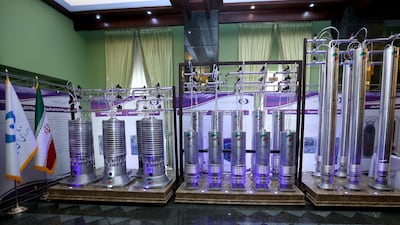
  • New generation Iranian centrifuges on display for Iran's National Nuclear Energy Day in Tehran, in April 2021. Iranian Presidency Office / Wana
    New generation Iranian centrifuges on display for Iran's National Nuclear Energy Day in Tehran, in April 2021. Iranian Presidency Office / Wana
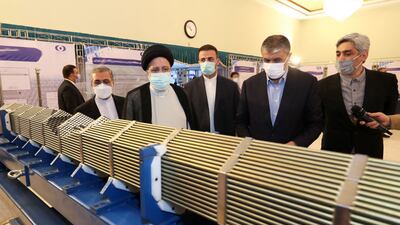
  • President Ebrahim Raisi, second right, is accompanied by Atomic Energy Organisation of Iran chief Mohammad Eslami, at Nuclear Technology Day in Tehran in April 2022. Iranian presidency / AFP
    President Ebrahim Raisi, second right, is accompanied by Atomic Energy Organisation of Iran chief Mohammad Eslami, at Nuclear Technology Day in Tehran in April 2022. Iranian presidency / AFP
  • Mr Raisi and Mr Eslami at the April 2022 event. Iranian presidency / AFP
    Mr Raisi and Mr Eslami at the April 2022 event. Iranian presidency / AFP
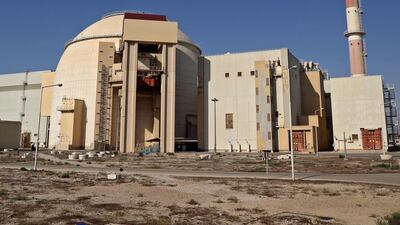
  • The Bushehr Nuclear Power Plant during a visit by Mr Raisi in October 2021. Iranian Presidency / AFP
    The Bushehr Nuclear Power Plant during a visit by Mr Raisi in October 2021. Iranian Presidency / AFP
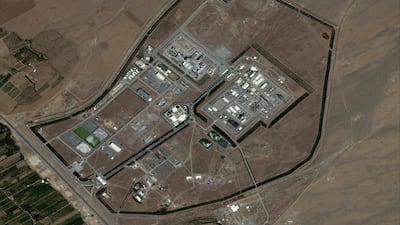
  • Iran's Arak Heavy Water Reactor complex, south of the capital Tehran in January 2020. Maxar Technologies / AFP
    Iran's Arak Heavy Water Reactor complex, south of the capital Tehran in January 2020. Maxar Technologies / AFP
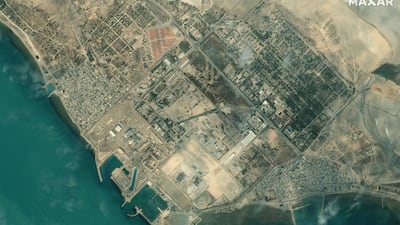
  • A satellite image of Iran's Bushehr Nuclear Power Plant in January 2020. Maxar Technologies / AFP
    A satellite image of Iran's Bushehr Nuclear Power Plant in January 2020. Maxar Technologies / AFP
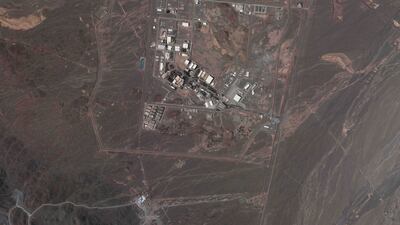
  • A satellite image of Iran's underground Natanz nuclear site in May 2022. Planet Labs PBC / AP
    A satellite image of Iran's underground Natanz nuclear site in May 2022. Planet Labs PBC / AP
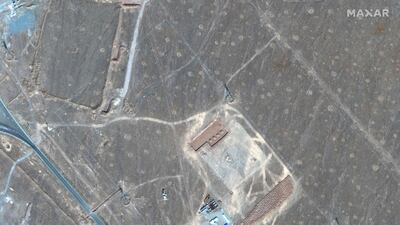
  • A satellite image in January 2020 of Iran's Fordow Fuel Enrichment Plant, north-east of the city of Qom. Maxar Technologies / AFP
    A satellite image in January 2020 of Iran's Fordow Fuel Enrichment Plant, north-east of the city of Qom. Maxar Technologies / AFP
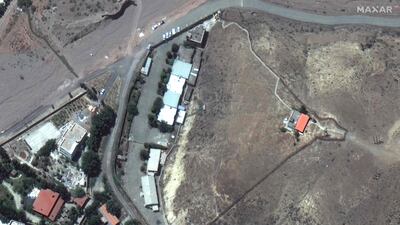
  • The Sanjarian nuclear centre, east of Tehran, in May 2021. Maxar Technologies / AFP
    The Sanjarian nuclear centre, east of Tehran, in May 2021. Maxar Technologies / AFP

Brussels, which acts as co-ordinator for the 2015 nuclear deal between Tehran and world powers, on Sunday said it was "highly concerned" by the development.

In 2015, major world powers reached the accord with Iran under which Tehran would curb its nuclear programme in exchange for relief from crippling economic sanctions.

But that started to unravel in 2018 when then-US president Donald Trump withdrew from the deal and reimposed sanctions.

Tehran increased its nuclear programme, while continuing to deny that it harbours ambitions of developing nuclear weapons capability.

Efforts to revive the deal have been fruitless so far.

WHAT FANS WILL LOVE ABOUT RUSSIA

FANS WILL LOVE
Uber is ridiculously cheap and, as Diego Saez discovered, mush safer. A 45-minute taxi from Pulova airport to Saint Petersburg’s Nevsky Prospect can cost as little as 500 roubles (Dh30).

FANS WILL LOATHE
Uber policy in Russia is that they can start the fare as soon as they arrive at the pick-up point — and oftentimes they start it even before arriving, or worse never arrive yet charge you anyway.

FANS WILL LOVE
It’s amazing how active Russians are on social media and your accounts will surge should you post while in the country. Throw in a few Cyrillic hashtags and watch your account numbers rocket.

FANS WILL LOATHE
With cold soups, bland dumplings and dried fish, Russian cuisine is not to everybody’s tastebuds.  Fortunately, there are plenty Georgian restaurants to choose from, which are both excellent and economical.

FANS WILL LOVE
The World Cup will take place during St Petersburg's White Nights Festival, which means perpetual daylight in a city that genuinely never sleeps. (Think toddlers walking the streets with their grandmothers at 4am.)

FANS WILL LOATHE
The walk from Krestovsky Ostrov metro station to Saint Petersburg Arena on a rainy day makes you wonder why some of the $1.7 billion was not spent on a weather-protected walkway.

Dirham Stretcher tips for having a baby in the UAE

Selma Abdelhamid, the group's moderator, offers her guide to guide the cost of having a young family:

• Buy second hand stuff

 They grow so fast. Don't get a second hand car seat though, unless you 100 per cent know it's not expired and hasn't been in an accident.

• Get a health card and vaccinate your child for free at government health centres

 Ms Ma says she discovered this after spending thousands on vaccinations at private clinics.

• Join mum and baby coffee mornings provided by clinics, babysitting companies or nurseries.

Before joining baby classes ask for a free trial session. This way you will know if it's for you or not. You'll be surprised how great some classes are and how bad others are.

• Once baby is ready for solids, cook at home

Take the food with you in reusable pouches or jars. You'll save a fortune and you'll know exactly what you're feeding your child.

The biog

Family: He is the youngest of five brothers, of whom two are dentists. 

Celebrities he worked on: Fabio Canavaro, Lojain Omran, RedOne, Saber Al Rabai.

Where he works: Liberty Dental Clinic 

Founders: Abdulmajeed Alsukhan, Turki Bin Zarah and Abdulmohsen Albabtain.

Based: Riyadh

Offices: UAE, Vietnam and Germany

Founded: September, 2020

Number of employees: 70

Sector: FinTech, online payment solutions

Funding to date: $116m in two funding rounds  

Investors: Checkout.com, Impact46, Vision Ventures, Wealth Well, Seedra, Khwarizmi, Hala Ventures, Nama Ventures and family offices

Mercer, the investment consulting arm of US services company Marsh & McLennan, expects its wealth division to at least double its assets under management (AUM) in the Middle East as wealth in the region continues to grow despite economic headwinds, a company official said.

Mercer Wealth, which globally has $160 billion in AUM, plans to boost its AUM in the region to $2-$3bn in the next 2-3 years from the present $1bn, said Yasir AbuShaban, a Dubai-based principal with Mercer Wealth.

Within the next two to three years, we are looking at reaching $2 to $3 billion as a conservative estimate and we do see an opportunity to do so,” said Mr AbuShaban.

Mercer does not directly make investments, but allocates clients’ money they have discretion to, to professional asset managers. They also provide advice to clients.

“We have buying power. We can negotiate on their (client’s) behalf with asset managers to provide them lower fees than they otherwise would have to get on their own,” he added.

Mercer Wealth’s clients include sovereign wealth funds, family offices, and insurance companies among others.

From its office in Dubai, Mercer also looks after Africa, India and Turkey, where they also see opportunity for growth.

Wealth creation in Middle East and Africa (MEA) grew 8.5 per cent to $8.1 trillion last year from $7.5tn in 2015, higher than last year’s global average of 6 per cent and the second-highest growth in a region after Asia-Pacific which grew 9.9 per cent, according to consultancy Boston Consulting Group (BCG). In the region, where wealth grew just 1.9 per cent in 2015 compared with 2014, a pickup in oil prices has helped in wealth generation.

BCG is forecasting MEA wealth will rise to $12tn by 2021, growing at an annual average of 8 per cent.

Drivers of wealth generation in the region will be split evenly between new wealth creation and growth of performance of existing assets, according to BCG.

Another general trend in the region is clients’ looking for a comprehensive approach to investing, according to Mr AbuShaban.

“Institutional investors or some of the families are seeing a slowdown in the available capital they have to invest and in that sense they are looking at optimizing the way they manage their portfolios and making sure they are not investing haphazardly and different parts of their investment are working together,” said Mr AbuShaban.

Some clients also have a higher appetite for risk, given the low interest-rate environment that does not provide enough yield for some institutional investors. These clients are keen to invest in illiquid assets, such as private equity and infrastructure.

“What we have seen is a desire for higher returns in what has been a low-return environment specifically in various fixed income or bonds,” he said.

“In this environment, we have seen a de facto increase in the risk that clients are taking in things like illiquid investments, private equity investments, infrastructure and private debt, those kind of investments were higher illiquidity results in incrementally higher returns.”

The Abu Dhabi Investment Authority, one of the largest sovereign wealth funds, said in its 2016 report that has gradually increased its exposure in direct private equity and private credit transactions, mainly in Asian markets and especially in China and India. The authority’s private equity department focused on structured equities owing to “their defensive characteristics.”

Updated: September 18, 2023, 10:44 PM