


Prince Harry laid out his grievances in court for a second day in his legal case against a newspaper group, admitting he would feel "some injustice" if the High Court in London finds his phone had not been hacked.
The duke is among more than 100 people who are suing Mirror Group Newspapers (MGN), publisher of the Daily Mirror, Sunday Mirror and Sunday People tabloids, accusing them of widespread unlawful activities between 1991 and 2011.
Barrister Andrew Green KC, representing MGN, on Wednesday continued to cross-examine the Duke of Sussex, asking him if he was aware the claimants in a 2015 phone-hacking trial against the newspaper publisher had "extensive data" showing calls to their mobile phones.
Prince Harry said he was not.
Mr Green asked if the lack of call data suggested his phone had not been hacked, to which the duke replied: "Absolutely not."
The barrister then asked Prince Harry if he would be disappointed if the court found his phone was not hacked by MGN journalists.
Harry said he "would be speculating" but when pushed further he said he would "feel some injustice".
He told the court: "I believe that phone hacking was [done] on an industrial scale across at least three of the papers at the time ... that is beyond any doubt.
"To have a decision against me and any of the other people [bringing a claim], given that Mirror Group have admitted hacking, yes, I would feel some injustice ... if it wasn't accepted."
Mr Green then asked: "So you want to have been phone hacked?", to which Harry replied: "Nobody wants to be phone hacked."
He appeared emotional as he came to the end of two days of cross-examination.
"It's a lot," the prince replied in a near-whisper after his own lawyer David Sherborne asked him how having to relive upsetting episodes of his life in court made him feel.
As he left the witness box he let out a deep sigh and sat down among his legal team.
The barrister told the court that in the duke's separate claim over alleged unlawful information gathering against News Group Newspapers (NGN), publisher of The Sun and the defunct News Of The World, there was "extensive call data" relating to both the duke and his brother the Prince of Wales in 2005 and 2006.
Prince Harry said he was aware of the call data in relation to him but added: "I have no idea about my brother's phone."
In another exchange, Prince Harry was asked about a Sunday Mirror article about his breakup with former girlfriend Chelsy Davy entitled "Hooray Harry's dumped".
The story reported that the duke went to West London nightclub Amika and "drowned his sorrows" over the split, with Prince Harry complaining over its alleged use of his private information.
The duke told the court the article headline "does seem to suggest that people are celebrating", adding it was "a little bit mean".
He later said: "'Hooray Harry's dumped' was hurtful to say the least, that such a private moment was turned into a bit of a laugh."
Referencing a private investigator invoice, Prince Harry said the fact that "these payments were referred to as 'Project Harry' is incredibly disturbing".
British royals in court - in pictures
-
Prince Harry will not be the first UK royal to enter a witness box. In 1870, his great-great-great grandfather, who became King Edward VII - voluntarily appeared as a witness. PA -
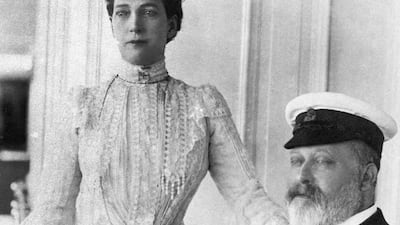
King Edward VII and Queen Alexandra. King Edward appeared as a witness in a divorce case when Lady Harriet Mordaunt falsely accused the heir to the throne of being one of her lovers. PA -
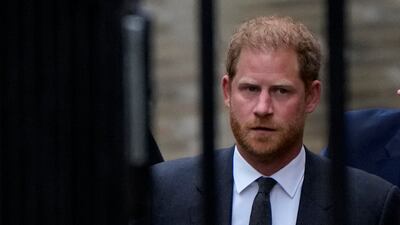
Prince Harry at the Royal Courts Of Justice in London. AP -
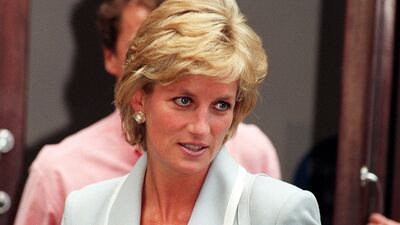
In 1994, the late Princess Diana was preparing to enter the witness box in her High Court action over photographs of her exercising in a gym. In the end she won her privacy battle without having to go to court. PA -
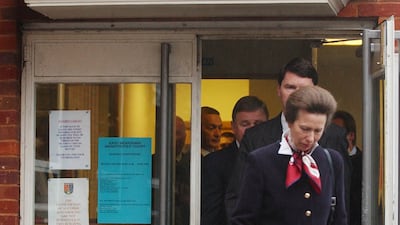
In 2002, Princess Royal Anne was summoned to appear before magistrates after being accused of keeping a dangerous dog after her English bull terrier dog Dotty bit two children in Windsor Great Park. PA -
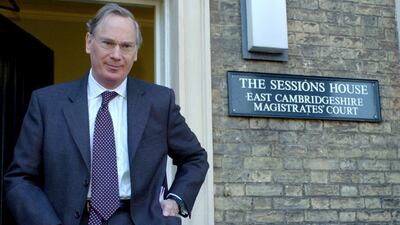
In 2004 the Duke of Gloucester appeared before magistrates in Ely, Cambridgeshire and was banned from driving for six months after admitting his fourth speeding offence in three years. Getty Images


"The level of surveillance that I was under was quite something," the duke said.
Mr Green said of the article: "It's not celebrating the demise of the relationship."
Prince Harry later told the court he once found a tracking device on the car belonging to Ms Davy, while a friend, Mark Dyer, found a similar device on his car.
The Duke of Sussex, the first senior British royal to appear in a witness box in more than a century, faced almost five hours of cross-examination from Mr Green on Tuesday.
He told the court the press had destroyed his relationships and that he believed the British media and the UK government had hit "rock bottom".
In a 50-page written witness statement and in questioning, Prince Harry said the press had blood on its hands, had destroyed his adolescence, ruined relationships with friends and girlfriends, and sowed paranoia and mistrust since 1996 when he was a schoolboy.
His anger at suggestions his mother, Princess Diana, was a victim of phone hacking before her death in 1997 was also clear.
"I've experienced hostility from the press since I was born," he said, calling the behaviour "vile".
The duke appeared relaxed but spoke firmly, as Mr Green quizzed him in detail over 33 newspaper articles, whose details Prince Harry claims were obtained unlawfully.
On a number of occasions, Mr Green described the prince's allegations as "total speculation".
Claimants in the legal case include actors, sports stars, celebrities and people who simply had a connection to high-profile figures.
The duke was selected at an earlier hearing as one of four test cases for the trial which began on May 10.
His individual case against MGN got under way on Monday.
Prince Harry and his American wife Meghan stepped down from royal duties in 2020, with press intrusion cited as a key factor in their decision to move to the US, where they still live.
The prince is simultaneously the subject of a federal court hearing across the Atlantic about his US visa application, following admissions in his memoir that he took drugs in the past.
American conservative think tank the Heritage Foundation wants to know how he answered official questions about drug taking, which could have rendered his application inadmissible under US law.
The complaint being heard in US District Court says: "United States law generally renders such a person inadmissible for entry to the United States."
The Heritage Foundation noted that other celebrities such as the late football star Diego Maradona and the late singer Amy Winehouse had been denied entry into the US because of past drug use.
In its response, the government said that while there "may be some public interest in the records sought" it is not presently convinced there is a compelling need to release the records.
Judge Carl Nichols gave the Department of Homeland Security until June 13 to come up with a response to the records request.
The trial continues.

