


The UK's inflation rate is expected to drop significantly below 10 per cent when the headline consumer price index (CPI) is updated this week after surprising economists by remaining stubbornly high in March.
The “stickiness” of inflation in the UK meant that the March figure actually came in at 10.1 per cent.
On Wednesday, economists expect the Office for National Statistics to reveal a figure of around 8 per cent, which would be the first time in eight months that inflation in Britain has been in single digits.
However, food price inflation is now proving to be more of a concern than energy costs in the broader cost of living crisis.
While energy’s role in this crisis may have peaked, that of food very much has not. Food price inflation reached around 19 per cent in March, the highest in almost half a century, said Torsten Bell, chief executive of the Resolution Foundation.
“While food price inflation should eventually fall relatively rapidly later this year, factory gate prices – which tend to lead movements in consumer food prices – suggest that the level of food prices could easily continue rising into the summer.
“As a result, food prices will be contributing far more than energy to CPI inflation through the remainder of 2023.”
A year ago, the Bank of England was forecasting that inflation would be approaching its 2 per cent target by some time in 2024. Now, most analysts feel the target will not be in sight for a least a year beyond that.
The Bank of England has raised interest rates 12 times in a row and they now sit at 4.5 per cent, the highest level in nearly 15 years.
Delayed effect
One problem is that the effect of interest rate rises is delayed – so, while the Bank of England has been putting up interest rates for more than a year, the inflation-busting purpose of each rise doesn't kick in for several months.
Another problem is that in raising interest rates, the Bank of England is attempting to dampen demand in the economy. But reducing demand for food and energy is not that easy.
“The Bank of England can print money, but it cannot print salad, bread, meat or cereals, and some will argue that increasing interest rates to cool inflation is to use a blunt tool, because the idea behind higher borrowing costs is to decrease demand for credit and decrease end-demand for goods and services,” said Russ Mould, investment director at AJ Bell.
“Everyone still has to eat, though, so this is a tickly issue.”
Even given this, Mr Mould said the Bank of England should still be concerned that the level of core CPI, which strips out volatile items such as food and fuel, is “stuck north of 6 per cent”.
“That is what is driving wage demands from workers, whether they are public or private sector, unionised or not, and policymakers’ key concern remains that wages rise and fuel demand stokes inflation, prompting more wage demand and ultimately creating the vicious spiral that bedevilled the 1970s and resulted in both inflation and interest rates going way above 10 per cent, helped along the way by a couple of oil price shocks,” he added.
Inflation around the world – in pictures
-

People queue to buy wheat flour at government-controlled prices in Islamabad. Pakistan's economy has been hit hard by a political crisis, as well as devastating floods and the global energy crisis, with the rupee plummeting and inflation at decades-high levels. AFP -
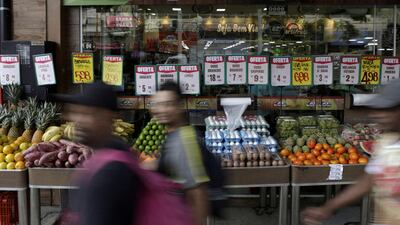
A market in Rio de Janeiro. Brazil's inflation ended 2022 with a sharp slowdown from double-digit peaks seen throughout the year. Reuters -
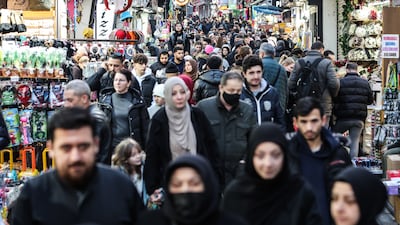
A market in Istanbul. Turkey's inflation at the end of 2022 stood at 64. 27 per cent, the country's Statistical Institute said, while the independent group of inflation researchers ENAG calculated it at 137. 55 per cent. EPA -
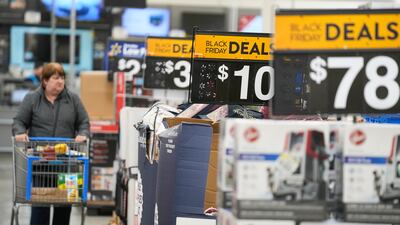
A Walmart in New Jersey. According to a poll, US Republicans and Democrats have distinct views of what’s most important for the government to address amid high inflation. More Republicans name gas and food prices, energy and immigration, while Democrats focus on health care, climate change and poverty. AP -

A used car sales lot in California. US Federal Reserve officials have indicated it’s possibly too early to declare victory over inflation. AFP -

A person walks by a sign showing interest rates at a bank in New York. EPA -
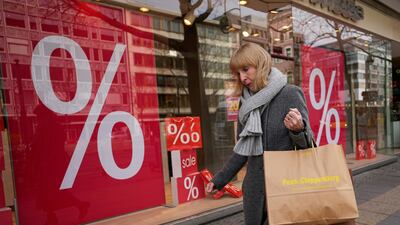
A woman walks with purchases past a store in Berlin. In December, consumer price growth across the Euro zone slowed to 9.2 per cent from 10.1 per cent a month earlier, Eurostat data showed last week. AP -
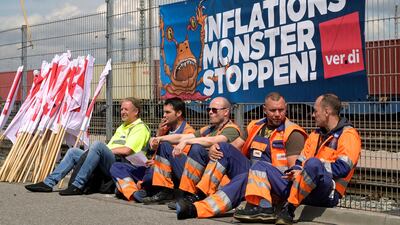
Workers sit in front of a banner reading "Stop the Inflation Monster" at the Burchardkai Container Terminal as they go on strike for higher wages at the harbour in Hamburg, Germany. Reuters -
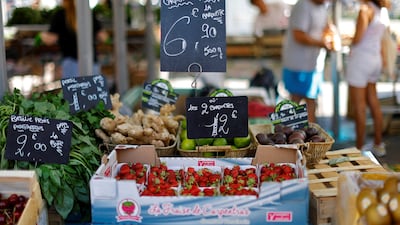
Price tags at a market in Nice, France. Reuters -

Commuters cross Waterloo Bridge in London. The British Retail Consortium said spending in store chains rose by 6.9 per cent in annual terms in December, but this was a long way off consumer price inflation, which hit 10.7 per cent in November. Reuters -

Jobseekers in Johannesburg. South Africa’s governing party wants the central bank’s mandate broadened to shore up the economy and promote employment in addition to its existing task of tackling inflation. Reuters -

Social grant recipients stand in a queue outside a post office, as joblessness takes its toll in Meadowlands, South Africa. Reuters


It's this upwards spiral of wages chasing inflation, and particularly food inflation, and then inflation chasing wages that scares the interest rate-setting Monetary Policy Committee at the Bank of England – do too little and inflation starts to ramp up uncontrollably; do too much and the UK economy falls headlong into recession.
“It is also worth noting that a reduction in inflation does not indicate falling prices, rather that they are rising at a slower rate than previously,” Richard Hunter, head of markets at Interactive Investor, told The National.
“As such, there should be some mitigation on the increases for goods and services which cost-pressured consumers are encountering, although even the current round of pay increases are not necessarily keeping up with these higher costs.”
“An additional complication is that wage rises are themselves inflationary and therefore part of the mix.”
Food replaces energy
Normally, food prices in the UK tend to ease off during the summer months as domestic crops start to replace more expensive imports. But so far this year, there has been a marked rise in farm gate prices.
A report from the Resolution Foundation called Food for Thought predicts that by summer food price rises will be weighing more heavily on overall inflation than energy costs.
“Between March and September 2023, food prices are expected to contribute around 2 percentage points to inflation each month, while the contribution of energy prices is set to fall from 3 percentage points to less than 1,” the report said.
Meanwhile, as it seems households are swapping one inflationary problem for another, the Bank of England is, once again, being accused of doing too little, too late.
UK Chancellor says 'best tax cut right now is a cut in inflation' – video
Appearing in front of a committee of MPs last week, the top officials at the Bank of England were asked more than once why interest rates were still at 0.5 per cent, when inflation was already at 6 per cent, months before the Russian invasion of Ukraine in February last year.
However, Bank of England Governor Andrew Bailey told the British Chambers of Commerce meeting last week that economic modelling shows that had the bank increased rates faster and earlier it would not have helped.
“The headline is that, even if we had had the benefit of full hindsight in the run-up to the war in Ukraine, and ample advanced warning – which for the record we did not, no one did – then in order to keep inflation at around 2 per cent, we would have had to raise the bank rate well into double digits, sending unemployment much higher than it is today, and we would have had to do so in the middle of the worst pandemic in more than a century,” Mr Bailey said.
Nonetheless, the Bank of England said last week that it expects “inflation to begin to fall quite sharply from now on”.
“But we need to make sure that it falls and then stays low.”
Some see comments like that as an indication that interest rates could go up at least once more, possibly peaking at 5 per cent, at some point over the summer, if inflation, and particular food price inflation, remains strong.
Either way, households are unlikely to see relief for their already battered budgets any time soon.
“Inflation is expected to have fallen back into single figures in April, as hikes in energy prices last April drop out of the data,” said Sarah Coles, head of personal finance at Hargreaves Lansdown.
“However, while we’ve waited a long time for inflation to fall, we may need to wait a while longer for any more significant change. Meanwhile, April’s drop is unlikely to ease the pressure on our pockets.”
Meanwhile, figures from retail intelligence company Kantar showed a slight dip in grocery prices this month.
Prices of goods over the four weeks to May 14 were 17.2 per cent higher than a year ago, down from April's 17.3 per cent, Kantar said.
For example, the price of four pints of milk has come down by 8p since April, but is still 30p higher than a year ago.
“The drop in grocery price inflation, which is down by 0.1 percentage points on last month's figure, is without doubt welcome news for shoppers but it is still incredibly high – 17.2 per cent is the third fastest rate of grocery inflation we've seen since 2008,” Fraser McKevitt, said head of retail and consumer insight at Kantar.
“This could add an extra £833 to the average household's annual grocery bill if consumers don't shop in different ways.”
Those different ways include opting to buy supermarket own-labelled products, sales of which so far this month have been nearly double those of branded goods, according to Kantar.
Chancellor to discuss curbing rampant food inflation with manufacturers
Chancellor Jeremy Hunt will ask food manufacturers to do what they can to support consumers amid skyrocketing food prices.
The Chancellor will meet representatives from the industry on Tuesday to raise concerns over rampant food inflation, according to the Treasury.
“High food prices are proving stubborn so we need to understand what’s driving that,” Mr Hunt said.
“That’s why I’m asking industry to work with us as we halve inflation, to help ease the pressure on household budgets.”
The Chancellor will also meet the competition watchdog to discuss its investigation into whether any failure in competition is leaving consumers paying higher grocery and fuel prices than they should be.
The Competition and Markets Authority last week said it had not seen evidence pointing to specific competition concerns in the grocery sector “at this stage”, but it was “important to be sure that weak competition is not adding to the problems”.
It will provide an update on its work over the coming months.
The watchdog also announced an update on the Road Fuel market study it began last year, saying that indications were that higher pump prices could not be attributed solely to factors outside the control of the retailers and “appear in part to reflect some weakening of competition in the road fuel retail market”.
The CMA is also scrutinising supermarket unit pricing to ensure retailers are sticking to rules that help consumers accurately compare products and choose the best value for money.
The government will consider updating pricing rules, including by strengthening the Price Marking Order 2004, once the CMA review has concluded, the Treasury said.
The legislation governing the display of prices of goods specifies a range of different units that can be used depending on the product type, which can result in confusion for shoppers.

