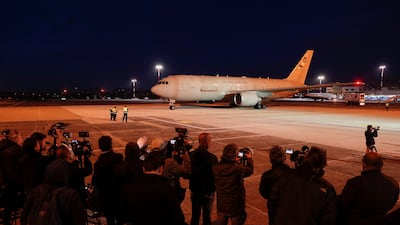
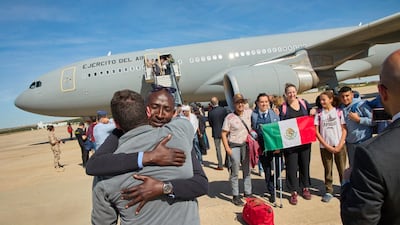
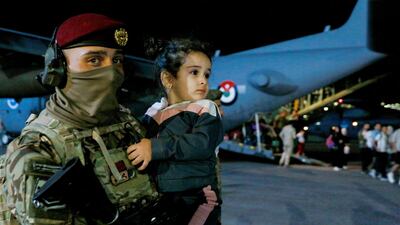
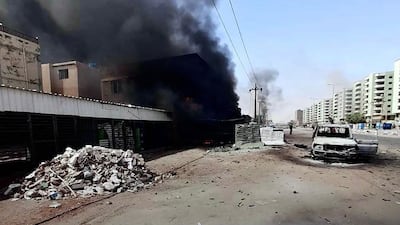
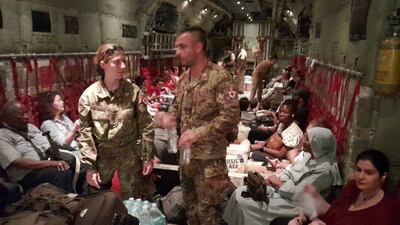
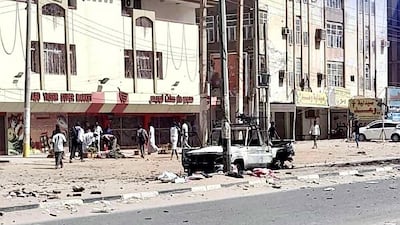
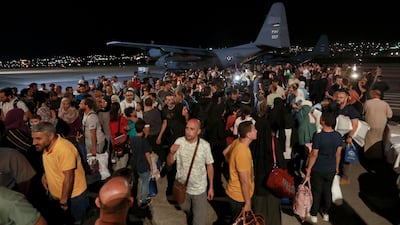
British citizens from Sudan leave an RAF aircraft at Larnaca International Airport in Cyprus on April 26. Getty

British man who fled Sudan with children says 'I was in middle of a gunfight'


Soraya Ebrahimi
  • English
  • Arabic

A widowed British-Sudanese father said he told his three children “it was like a hide-and-seek game” when his home was caught in the middle of a gunfight in Sudan.

Munzir Salman, 37, who has dual citizenship, spoke while he and his children waited to fly to the UK through Larnaca, Cyprus.

Mr Salman said he was at home in Khartoum with his children when Sudanese soldiers were ambushed by Rapid Support Forces troops outside his block of flats.

“What happened was some army soldiers were coming through and they were ambushed by the RSF,” he said.

“They then ran behind my house and they were shooting at each other. I was in the middle.

“It was horrendous and, unfortunately, it’s not the first time I’ve had gunshots around me. I’m a single father of three kids so I had to stay calm for them.

“I had to tell them it was like a game and told them it was like a hide-and-seek game.

“It was an experience they had never been through before. It was very scary but I tried to make it a game for them.

“I explained the danger before trying to make it like Tom and Jerry, where the people outside were Tom and we were Jerry.”

Mr Salman lived in Sudan until he turned 10, thereafter moving to Toxteth in Liverpool, where he lived for 16 years.

He then moved to Dubai before returning to Sudan in 2013 where he had his three children, Siddig, 11, Shaden, eight, and Yasmin, six, with his wife, who died in the coronavirus pandemic in 2020.

Meanwhile, a British businessman has described hiding in basements for three days with no food or water to avoid the fighting in Khartoum.

Ibrahim Ibrahim, who owns a security company in Birmingham, travelled to Sudan in February to visit family for the first time in nearly a decade — leaving his wife and four children at home.

Mr Ibrahim, 37, was on his way to buy a return plane ticket from a travel agency in the centre of the Sudanese capital when fighting broke out between military and militia forces on the morning of April 15.

“Suddenly, everybody was running," he said from an airbase near Khartoum.

“I saw a lot of people get shot and dying in front of my eyes, people getting injured. It was really terrible.”

Mr Ibrahim hid in the basements of abandoned buildings for three days, covering himself with sheets of cardboard or plywood. To avoid detection, he moved only at night.

“I was hiding for three days with no food, no water,” he said.

“You go to the wrong road, you’re going to get shot. One way you’ve got the army, the other you’ve got militia.

“I tried to move in the middle of night slowly, slowly until I got out [of central Khartoum].

“I couldn’t tell what day it is. Everywhere there is guns shooting, tanks and bombing.

“I worried a lot about not seeing my children and my wife again.

“My family was worrying and tried to call me but my battery’s dead. Everybody I know was trying to call me to help me to escape.”

After three days, he knocked on the door of a family who took him in, gave him food and water and allowed him to charge his phone.

Having contacted the British Foreign Office, Mr Ibrahim travelled to an airstrip on the outskirts of Khartoum on Wednesday morning, hoping to be flown out.

First evacuees arrive at Stansted Airport

The first flight carrying British citizens from Sudan landed at Stansted Airport on Wednesday afternoon.

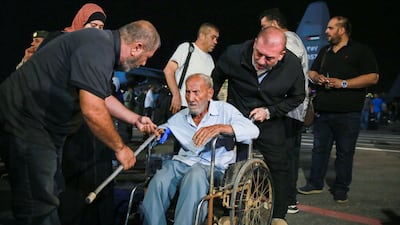
Women and children including babies in prams were among those who arrived after escaping the conflict-torn nation. Staff were on hand to assist elderly people in wheelchairs.

Anxious friends and family waited at the airport to be reunited with relatives and loved ones.

Many of the arrivals clutched Red Cross bags containing supplies.

Britain runs evacuation flights for UK citizens fleeing Sudan fighting - video

British citizens in Sudan have described being told to to make a chaotic and dangerous journey to the airstrip without a military escort.

“We are not seeing those who are making that travel having significant issues," Prime Minister Rishi Sunak's spokesman said.

But Sudanese-British citizen Tarig Babikir, 42, who used to live in Coventry, told of the challenge of making it to Wadi Saeedna amid the continuing violence.

“It’s complete anarchy right now, complete chaos. Anyone can rob you, anyone can shoot you,” Mr Babikir said.

Sudan crisis latest — in pictures

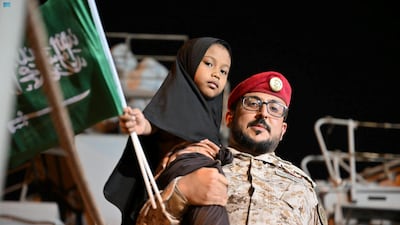
  • A member of the Saudi Navy carries a child from a ship at Jeddah's port during the kingdom's evacuation of civilians from Sudan. Reuters
    A member of the Saudi Navy carries a child from a ship at Jeddah's port during the kingdom's evacuation of civilians from Sudan. Reuters
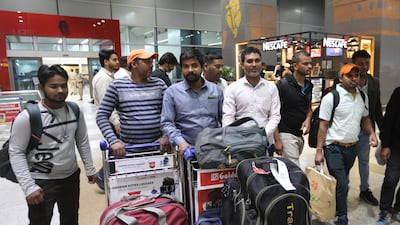
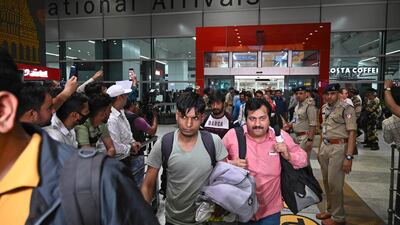
  • Indian nationals evacuated from Sudan arrive at Indira Gandhi International Airport in New Delhi. EPA
    Indian nationals evacuated from Sudan arrive at Indira Gandhi International Airport in New Delhi. EPA
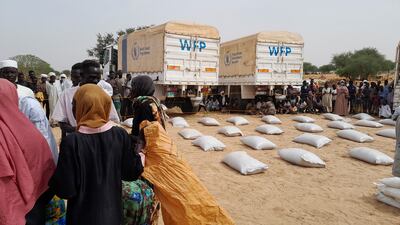
  • Sudanese refugees queue to receive aid from the World Food Programme near the border between Sudan and Chad in Adre, Chad. Reuters
    Sudanese refugees queue to receive aid from the World Food Programme near the border between Sudan and Chad in Adre, Chad. Reuters
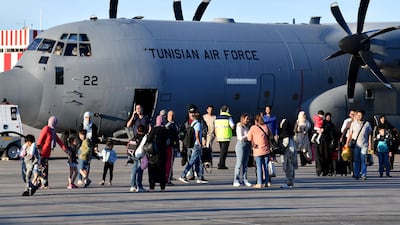
  • Tunisian citizens evacuated from Sudan leave a military aircraft upon their arrival at Tunis-Carthage International Airport. AFP
    Tunisian citizens evacuated from Sudan leave a military aircraft upon their arrival at Tunis-Carthage International Airport. AFP
  • Indians evacuated from Sudan arrive on a flight at the Indira Gandhi International Airport in New Delhi, India. AP Photo
    Indians evacuated from Sudan arrive on a flight at the Indira Gandhi International Airport in New Delhi, India. AP Photo
  • Moroccan nationals, who have been evacuated from Sudan, arrive at Mohammed V airport in Casablanca, Morocco. EPA
    Moroccan nationals, who have been evacuated from Sudan, arrive at Mohammed V airport in Casablanca, Morocco. EPA
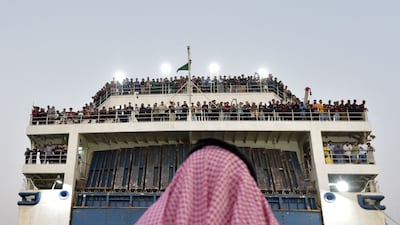
  • A boat with 1,687 civilians from more than 50 countries fleeing violence in Sudan, arrives at King Faisal naval base in Jeddah, Saudi Arabia. AFP
    A boat with 1,687 civilians from more than 50 countries fleeing violence in Sudan, arrives at King Faisal naval base in Jeddah, Saudi Arabia. AFP
  • RSF fighters in the East Nile district of greater Khartoum. AFP
    RSF fighters in the East Nile district of greater Khartoum. AFP
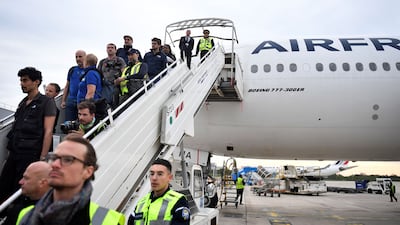
  • Passengers disembark a plane from Djibouti at Roissy-Charles-de-Gaulle airport near Paris after being evacuated from Sudan. AFP
    Passengers disembark a plane from Djibouti at Roissy-Charles-de-Gaulle airport near Paris after being evacuated from Sudan. AFP
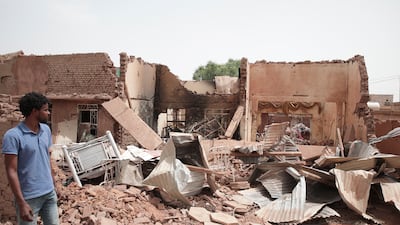
  • Buildings destroyed in recent fighting in Khartoum, Sudan. AP
    Buildings destroyed in recent fighting in Khartoum, Sudan. AP
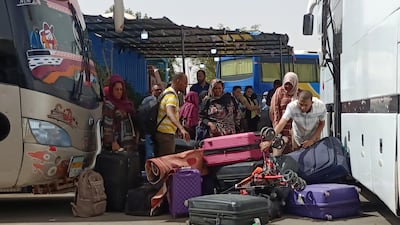
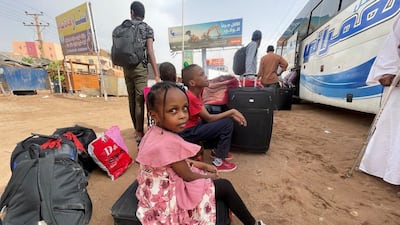
  • Passengers fleeing the fighting in Sudan arrive at Wadi Karkar bus station in Aswan, Egypt. EPA
    Passengers fleeing the fighting in Sudan arrive at Wadi Karkar bus station in Aswan, Egypt. EPA
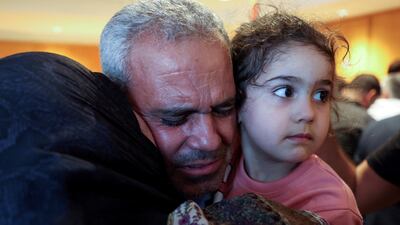
  • Ali Mazloum, a Lebanese citizen who was evacuated from Sudan, is welcomed upon his arrival at Beirut airport. Reuters
    Ali Mazloum, a Lebanese citizen who was evacuated from Sudan, is welcomed upon his arrival at Beirut airport. Reuters
  • A woman helps another after fleeing clashes between the paramilitary Rapid Support Forces and the army in Khartoum. Reuters
    A woman helps another after fleeing clashes between the paramilitary Rapid Support Forces and the army in Khartoum. Reuters
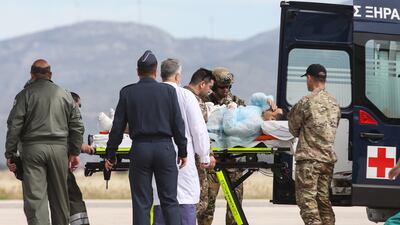
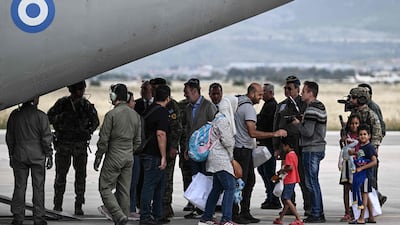
  • Soldiers attend to Greek citizens evacuated from Sudan as they disembark from a military aircraft in Attica, Greece. EPA
    Soldiers attend to Greek citizens evacuated from Sudan as they disembark from a military aircraft in Attica, Greece. EPA
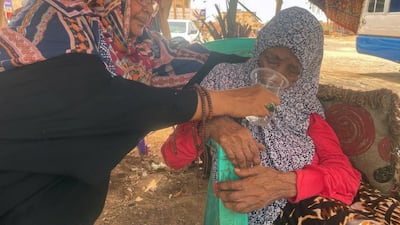
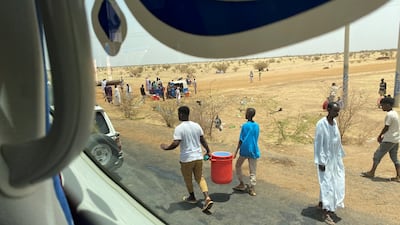
  • People carry hibiscus juice and cold water for those being evacuated from Khartoum to Port Sudan. Reuters
    People carry hibiscus juice and cold water for those being evacuated from Khartoum to Port Sudan. Reuters
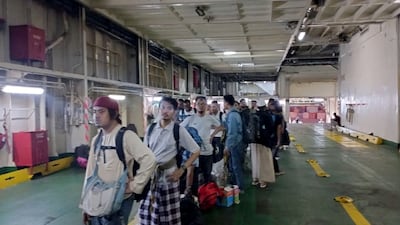
  • Thais wait to be evacuated by boat at a port in Sudan. EPA
    Thais wait to be evacuated by boat at a port in Sudan. EPA
  • Greek citizens arrive from Sudan on a military plane in Elefsina, south of Athens. AFP
    Greek citizens arrive from Sudan on a military plane in Elefsina, south of Athens. AFP
  • Japan's senior Vice Foreign Minister Shunsuke Takei welcomes his country's citizens in Djibouti after they were rescued from Sudan. AFP
    Japan's senior Vice Foreign Minister Shunsuke Takei welcomes his country's citizens in Djibouti after they were rescued from Sudan. AFP
  • A member of the Saudi Royal Navy carries a child who was rescued from Sudan, in Jeddah. Reuters
    A member of the Saudi Royal Navy carries a child who was rescued from Sudan, in Jeddah. Reuters
  • A military plane carrying evacuees arrives at Ciampino Airport near Rome, Italy. Reuters
    A military plane carrying evacuees arrives at Ciampino Airport near Rome, Italy. Reuters
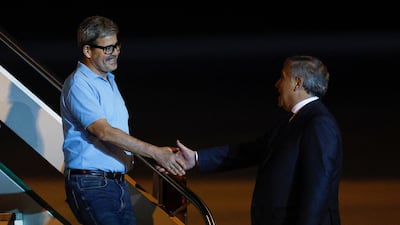
  • Italy's Foreign Minister Antonio Tajani greets the country's ambassador to Sudan, Michele Tommasi, as he arrives at Ciampino Airport. Reuters
    Italy's Foreign Minister Antonio Tajani greets the country's ambassador to Sudan, Michele Tommasi, as he arrives at Ciampino Airport. Reuters
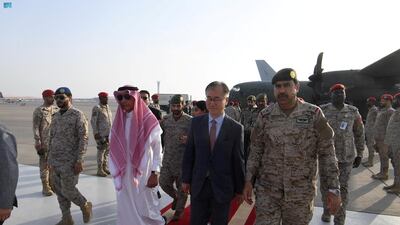
  • South Korea's ambassador to Saudi Arabia, Park Joon-yong, at a Saudi Air Force base in Jeddah, where he met diplomats from his country evacuated from Sudan by the kingdom's air force. Reuters
    South Korea's ambassador to Saudi Arabia, Park Joon-yong, at a Saudi Air Force base in Jeddah, where he met diplomats from his country evacuated from Sudan by the kingdom's air force. Reuters
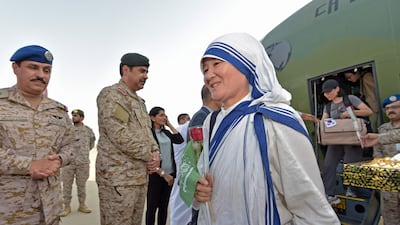
  • Having fled from Sudan, a South Korean nun disembarks from a military plane after landing at King Abdullah Air Base in Jeddah. AFP
    Having fled from Sudan, a South Korean nun disembarks from a military plane after landing at King Abdullah Air Base in Jeddah. AFP
  • People gather as they seek to escape the violence in Khartoum. Reuters
    People gather as they seek to escape the violence in Khartoum. Reuters
  • Spanish diplomatic personnel and citizens wait to disembark from a military plane after being evacuated from Sudan, in Djibouti. Reuters
    Spanish diplomatic personnel and citizens wait to disembark from a military plane after being evacuated from Sudan, in Djibouti. Reuters
  • A closed pharmacy and shops in the south of Khartoum as battles rage in the capital between the army and paramilitaries. AFP
    A closed pharmacy and shops in the south of Khartoum as battles rage in the capital between the army and paramilitaries. AFP
  • Passengers from Sudan disembark from a Spanish Air Force plane at Torrejon Airbase in Madrid. AP
    Passengers from Sudan disembark from a Spanish Air Force plane at Torrejon Airbase in Madrid. AP
  • People evacuated from Sudan arrive at a military airport in Amman. AFP
    People evacuated from Sudan arrive at a military airport in Amman. AFP
  • Jordan was among those countries to have rapidly flown its citizens in Sudan to safety. AFP
    Jordan was among those countries to have rapidly flown its citizens in Sudan to safety. AFP
  • This child was one of those to have arrived safely in Amman. AFP
    This child was one of those to have arrived safely in Amman. AFP
  • A building in Khartoum burns as violence rages in Sudan. EPA
    A building in Khartoum burns as violence rages in Sudan. EPA
  • Italian citizens are flown out of the Sudanese capital on a military aircraft. Reuters
    Italian citizens are flown out of the Sudanese capital on a military aircraft. Reuters
  • The fighting has caused heavy damage to parts of Khartoum. EPA
    The fighting has caused heavy damage to parts of Khartoum. EPA
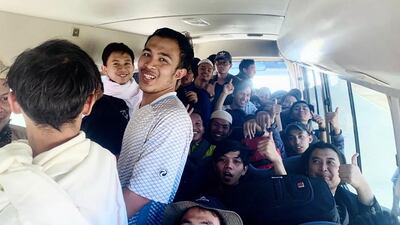
  • Indonesian citizens travel on a bus during an evacuation operation in Khartoum. EPA
    Indonesian citizens travel on a bus during an evacuation operation in Khartoum. EPA
  • A Spanish military aircraft takes off from Khartoum as European countries rescue citizens from Sudan. Reuters
    A Spanish military aircraft takes off from Khartoum as European countries rescue citizens from Sudan. Reuters
  • Jordanians arrive at a military airport in Amman after their evacuation from Sudan to escape the fighting. AP
    Jordanians arrive at a military airport in Amman after their evacuation from Sudan to escape the fighting. AP
  • French troops arrive at an air base in Djibouti to prepare to evacuate about 100 people from Sudan. AFP
    French troops arrive at an air base in Djibouti to prepare to evacuate about 100 people from Sudan. AFP
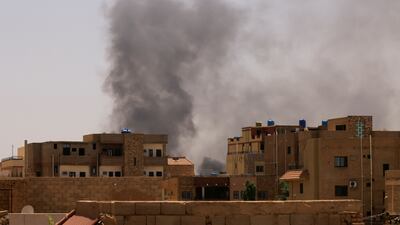
  • Smoke rises from buildings during clashes between the paramilitary Rapid Support Forces and the Sudanese army in Khartoum. Reuters
    Smoke rises from buildings during clashes between the paramilitary Rapid Support Forces and the Sudanese army in Khartoum. Reuters
  • Saudis are met by Saudi Royal Navy staff as they arrive at Jeddah on the Red Sea after being evacuated from Sudan. Reuters
    Saudis are met by Saudi Royal Navy staff as they arrive at Jeddah on the Red Sea after being evacuated from Sudan. Reuters
  • The streets of southern Khartoum bear the scars of fighting between two factions of the Sudanese military. AFP
    The streets of southern Khartoum bear the scars of fighting between two factions of the Sudanese military. AFP
  • A convoy leaves Khartoum for Port Sudan as fighting between military factions in the Sudanese capital continues. AFP
    A convoy leaves Khartoum for Port Sudan as fighting between military factions in the Sudanese capital continues. AFP
  • A civilian convoy leaving Khartoum for Port Sudan. AFP
    A civilian convoy leaving Khartoum for Port Sudan. AFP
  • Saudi citizens and people of other nations are evacuated by the Saudi Royal Navy from Port Sudan to escape the conflict. Reuters
    Saudi citizens and people of other nations are evacuated by the Saudi Royal Navy from Port Sudan to escape the conflict. Reuters
  • A photo from October 2017 of the US embassy in Khartoum. AFP
    A photo from October 2017 of the US embassy in Khartoum. AFP
  • Saudi citizens are met by Saudi Royal Navy staff as they arrive at Jeddah after being evacuated from Sudan. Reuters
    Saudi citizens are met by Saudi Royal Navy staff as they arrive at Jeddah after being evacuated from Sudan. Reuters
  • Smoke hangs over Khartoum as factions belonging to the Sudanese Army and the Rapid Support Forces go back to trading gunfire after a ceasefire failed. AP
    Smoke hangs over Khartoum as factions belonging to the Sudanese Army and the Rapid Support Forces go back to trading gunfire after a ceasefire failed. AP

A UK-born student trying to flee Sudan said she did not have enough petrol to make the dangerous one-hour drive from the outskirts of Khartoum to the airstrip.

"I’m trying to get there but the problem is the vehicles that we have have no gas, and the petrol stations are empty," said Samar Eltayeb, 20, from Birmingham.

“There’ll be constant flights within the next few days but if I can’t find gas to get there, then I’m stuck.”

A man who arrived in the UK on Wednesday described the experience as a “nightmare”.

The man, who did not give his name, said: “It’s absolutely fantastic to be back. It’s been a nightmare. We’ve never seen anything like it before.

“We saw it on the television before but we never thought it was going to happen to a peaceful country like Sudan.”

He described the capital Khartoum as a “ghost city” and said everyone was fleeing.

“We are very grateful to the British servicemen and women who risked their lives to come to Sudan and help us out,” he said.

“There are more people stranded there and I think there should be more awareness to those stranded. We were very lucky but not everyone was as lucky we are.

“I was in the middle of the conflict. There was bombing and shelling, the house next to us was shelled. It was like a Bond movie, I’ve never seen anything like it before.”

Evacuation flights continue to rescue British nationals from Sudan

The British evacuation mission from Sudan has lifted 536 people to safety on six flights as the military races against time to rescue citizens while a fragile ceasefire holds.

The Foreign, Commonwealth and Development Office said “in a fast-moving situation” these were the figures at 9pm on Wednesday “with further flights to come”.

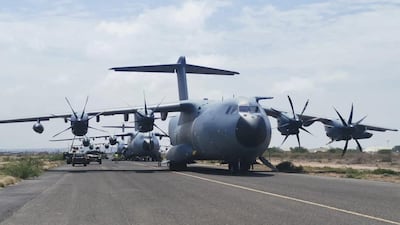
Another two RAF flights were expected to take off from the Wadi Saeedna air strip near the capital Khartoum.

Foreign Secretary James Cleverly has said the UK “cannot guarantee” how many more flights will depart when the 72-hour ceasefire in Sudan expires on Thursday night.

Downing Street said the flights have been “full or close to full”, with no “significant issues” faced by the evacuees.

More than 2,000 British citizens have registered in Sudan under evacuation plans, but thousands more could be in the country.

Mr Sunak's official spokesman said the operation in Khartoum was “running smoothly” and there was currently “no issue with capacity”.

The official said most of the people on the planes were British but that some were also citizens of allied countries.

He had not been informed of “large-scale problems” of non-British passport holders turning up and being told they are not eligible.

Downing Street hopes to carry on with flights throughout the week and does not believe there will be a need to “leave the airport imminently”.

The ceasefire has largely held since it began in the early hours of Monday.

Brig Dan Reeve, chief of joint force operations, said at least 500 people could be flown out from the airstrip every day and that the evacuation window was “not conditional on that ceasefire holding”.

“I can see no reason at the moment why we can’t continue to do that for as long as the Prime Minister wants us to,” he told journalists.

Mr Sunak was asked by the Scottish National Party’s Westminster leader Stephen Flynn whether he would deport child refugees who arrive in the UK without authorisation, under plans to “stop the boats”.

The Prime Minister told the Commons of the country’s “proud record” of supporting asylum seekers, but did not commit to a new safe and legal route for those fleeing Sudan.

HMS Lancaster is progressing towards Port Sudan, the Red Sea dock about 800km from Khartoum that could possibly be used in a seaborne operation — although with fuel shortages and crowded motorways, the journey could prove difficult for many.

British forces are expected to take over command of the operation in Wadi Saeedna from German troops on Wednesday.

About 160 British service personnel have been sent to the airfield, but the security of the site is being maintained by the Sudanese Armed Forces.

The military is ready to use force if the site comes under attack, although the troops are primarily there to help with logistics and providing air traffic control.

Families with children or elderly relatives, or people with medical conditions, are being given priority for the flights.

Only British passport holders and immediate family members with existing UK entry clearance are being told they are eligible.

Citizens have been warned that all travel within Sudan is “conducted at your own risk”.

UK accused of delaying Germany’s evacuation

The UK has reportedly been accused of delaying Germany’s efforts to evacuate its citizens from Sudan at the weekend.

The BBC reported it was told by senior German political sources that Britain’s mission to extract its embassy staff led to a temporary blockade of the airfield near Khartoum, from which later evacuation flights have taken off.

The sources claimed that British forces landed without the permission of the Sudanese army, angering them so that they barred access to the site.

German rescuers “lost at least half a day” as negotiations to use the airstrip took place, according to the broadcaster.

The British were forced to pay the Sudanese army before leaving, one source told the BBC.

Germany and other European nations were hoping to use the Wadi Saeedna airfield to fly their citizens to safety.

In an apparent swipe at the UK’s initial handling of the crisis, German Foreign Minister Annalena Baerbock said Berlin would not leave civilians “to their own devices” as it completed its evacuation.

Announcing the completion of Germany’s evacuation efforts on Tuesday, Ms Baerbock said that “unlike in other countries”, it had included all German nationals and their partners, and not just diplomatic personnel.

The UK started its mission to evacuate when a ceasefire was brokered between the warring factions.

The UK Ministry of Defence has been contacted for comment.

A spokesman for the department told the BBC: “It is not accurate to suggest that Britain’s efforts to evacuate embassy staff from Sudan last weekend slowed down Germany’s plans.”


RESULT

Everton 2 Huddersfield Town 0
Everton: 
Sigurdsson (47'), Calvert-Lewin (73')

Man of the Match: Dominic Calvert-Lewin (Everton)

John%20Wick%3A%20Chapter%204
%3Cp%3E%3Cstrong%3EDirector%3A%3C%2Fstrong%3E%20Chad%20Stahelski%3C%2Fp%3E%0A%3Cp%3E%3Cstrong%3EStars%3A%3C%2Fstrong%3E%20Keanu%20Reeves%2C%20Laurence%20Fishburne%2C%20George%20Georgiou%3C%2Fp%3E%0A%3Cp%3E%3Cstrong%3ERating%3A%20%3C%2Fstrong%3E4%2F5%3C%2Fp%3E%0A
Ten tax points to be aware of in 2026

1. Domestic VAT refund amendments: request your refund within five years

If a business does not apply for the refund on time, they lose their credit.

2. E-invoicing in the UAE

Businesses should continue preparing for the implementation of e-invoicing in the UAE, with 2026 a preparation and transition period ahead of phased mandatory adoption. 

3. More tax audits

Tax authorities are increasingly using data already available across multiple filings to identify audit risks. 

4. More beneficial VAT and excise tax penalty regime

Tax disputes are expected to become more frequent and more structured, with clearer administrative objection and appeal processes. The UAE has adopted a new penalty regime for VAT and excise disputes, which now mirrors the penalty regime for corporate tax.

5. Greater emphasis on statutory audit

There is a greater need for the accuracy of financial statements. The International Financial Reporting Standards standards need to be strictly adhered to and, as a result, the quality of the audits will need to increase.

6. Further transfer pricing enforcement

Transfer pricing enforcement, which refers to the practice of establishing prices for internal transactions between related entities, is expected to broaden in scope. The UAE will shortly open the possibility to negotiate advance pricing agreements, or essentially rulings for transfer pricing purposes. 

7. Limited time periods for audits

Recent amendments also introduce a default five-year limitation period for tax audits and assessments, subject to specific statutory exceptions. While the standard audit and assessment period is five years, this may be extended to up to 15 years in cases involving fraud or tax evasion. 

8. Pillar 2 implementation 

Many multinational groups will begin to feel the practical effect of the Domestic Minimum Top-Up Tax (DMTT), the UAE's implementation of the OECD’s global minimum tax under Pillar 2. While the rules apply for financial years starting on or after January 1, 2025, it is 2026 that marks the transition to an operational phase.

9. Reduced compliance obligations for imported goods and services

Businesses that apply the reverse-charge mechanism for VAT purposes in the UAE may benefit from reduced compliance obligations. 

10. Substance and CbC reporting focus

Tax authorities are expected to continue strengthening the enforcement of economic substance and Country-by-Country (CbC) reporting frameworks. In the UAE, these regimes are increasingly being used as risk-assessment tools, providing tax authorities with a comprehensive view of multinational groups’ global footprints and enabling them to assess whether profits are aligned with real economic activity. 

Contributed by Thomas Vanhee and Hend Rashwan, Aurifer

HOW TO WATCH

Facebook: TheNationalNews  

Twitter: @thenationalnews  

Instagram: @thenationalnews.com  

TikTok: @thenationalnews 

Mercer, the investment consulting arm of US services company Marsh & McLennan, expects its wealth division to at least double its assets under management (AUM) in the Middle East as wealth in the region continues to grow despite economic headwinds, a company official said.

Mercer Wealth, which globally has $160 billion in AUM, plans to boost its AUM in the region to $2-$3bn in the next 2-3 years from the present $1bn, said Yasir AbuShaban, a Dubai-based principal with Mercer Wealth.

Within the next two to three years, we are looking at reaching $2 to $3 billion as a conservative estimate and we do see an opportunity to do so,” said Mr AbuShaban.

Mercer does not directly make investments, but allocates clients’ money they have discretion to, to professional asset managers. They also provide advice to clients.

“We have buying power. We can negotiate on their (client’s) behalf with asset managers to provide them lower fees than they otherwise would have to get on their own,” he added.

Mercer Wealth’s clients include sovereign wealth funds, family offices, and insurance companies among others.

From its office in Dubai, Mercer also looks after Africa, India and Turkey, where they also see opportunity for growth.

Wealth creation in Middle East and Africa (MEA) grew 8.5 per cent to $8.1 trillion last year from $7.5tn in 2015, higher than last year’s global average of 6 per cent and the second-highest growth in a region after Asia-Pacific which grew 9.9 per cent, according to consultancy Boston Consulting Group (BCG). In the region, where wealth grew just 1.9 per cent in 2015 compared with 2014, a pickup in oil prices has helped in wealth generation.

BCG is forecasting MEA wealth will rise to $12tn by 2021, growing at an annual average of 8 per cent.

Drivers of wealth generation in the region will be split evenly between new wealth creation and growth of performance of existing assets, according to BCG.

Another general trend in the region is clients’ looking for a comprehensive approach to investing, according to Mr AbuShaban.

“Institutional investors or some of the families are seeing a slowdown in the available capital they have to invest and in that sense they are looking at optimizing the way they manage their portfolios and making sure they are not investing haphazardly and different parts of their investment are working together,” said Mr AbuShaban.

Some clients also have a higher appetite for risk, given the low interest-rate environment that does not provide enough yield for some institutional investors. These clients are keen to invest in illiquid assets, such as private equity and infrastructure.

“What we have seen is a desire for higher returns in what has been a low-return environment specifically in various fixed income or bonds,” he said.

“In this environment, we have seen a de facto increase in the risk that clients are taking in things like illiquid investments, private equity investments, infrastructure and private debt, those kind of investments were higher illiquidity results in incrementally higher returns.”

The Abu Dhabi Investment Authority, one of the largest sovereign wealth funds, said in its 2016 report that has gradually increased its exposure in direct private equity and private credit transactions, mainly in Asian markets and especially in China and India. The authority’s private equity department focused on structured equities owing to “their defensive characteristics.”

How much do leading UAE’s UK curriculum schools charge for Year 6?
  1. Nord Anglia International School (Dubai) – Dh85,032
  2. Kings School Al Barsha (Dubai) – Dh71,905
  3. Brighton College Abu Dhabi - Dh68,560
  4. Jumeirah English Speaking School (Dubai) – Dh59,728
  5. Gems Wellington International School – Dubai Branch – Dh58,488
  6. The British School Al Khubairat (Abu Dhabi) - Dh54,170
  7. Dubai English Speaking School – Dh51,269

*Annual tuition fees covering the 2024/2025 academic year

GAC GS8 Specs

Engine: 2.0-litre 4cyl turbo

Power: 248hp at 5,200rpm

Torque: 400Nm at 1,750-4,000rpm

Transmission: 8-speed auto

Fuel consumption: 9.1L/100km

On sale: Now

Price: From Dh149,900

MATCH INFO

England 2
Cahill (3'), Kane (39')

Nigeria 1
Iwobi (47')

Details

Through Her Lens: The stories behind the photography of Eva Sereny

Forewords by Jacqueline Bisset and Charlotte Rampling, ACC Art Books

How to wear a kandura

Dos

  • Wear the right fabric for the right season and occasion 
  • Always ask for the dress code if you don’t know
  • Wear a white kandura, white ghutra / shemagh (headwear) and black shoes for work 
  • Wear 100 per cent cotton under the kandura as most fabrics are polyester

Don’ts 

  • Wear hamdania for work, always wear a ghutra and agal 
  • Buy a kandura only based on how it feels; ask questions about the fabric and understand what you are buying
Ferrari 12Cilindri specs

Engine: naturally aspirated 6.5-liter V12

Power: 819hp

Torque: 678Nm at 7,250rpm

Price: From Dh1,700,000

Available: Now

The specs

Engine: 4.0-litre V8 twin-turbocharged and three electric motors

Power: Combined output 920hp

Torque: 730Nm at 4,000-7,000rpm

Transmission: 8-speed dual-clutch automatic

Fuel consumption: 11.2L/100km

On sale: Now, deliveries expected later in 2025

Price: expected to start at Dh1,432,000

Key facilities
  • Olympic-size swimming pool with a split bulkhead for multi-use configurations, including water polo and 50m/25m training lanes
  • Premier League-standard football pitch
  • 400m Olympic running track
  • NBA-spec basketball court with auditorium
  • 600-seat auditorium
  • Spaces for historical and cultural exploration
  • An elevated football field that doubles as a helipad
  • Specialist robotics and science laboratories
  • AR and VR-enabled learning centres
  • Disruption Lab and Research Centre for developing entrepreneurial skills
MEDIEVIL%20(1998)
%3Cp%3E%3Cstrong%3EDeveloper%3A%3C%2Fstrong%3E%20SCE%20Studio%20Cambridge%3Cbr%3E%3Cstrong%3EPublisher%3A%3C%2Fstrong%3E%20Sony%20Computer%20Entertainment%3Cbr%3E%3Cstrong%3EConsole%3A%3C%2Fstrong%3E%20PlayStation%2C%20PlayStation%204%20and%205%3Cbr%3E%3Cstrong%3ERating%3A%3C%2Fstrong%3E%203.5%2F5%3C%2Fp%3E%0A
How to apply for a drone permit
  • Individuals must register on UAE Drone app or website using their UAE Pass
  • Add all their personal details, including name, nationality, passport number, Emiratis ID, email and phone number
  • Upload the training certificate from a centre accredited by the GCAA
  • Submit their request
What are the regulations?
  • Fly it within visual line of sight
  • Never over populated areas
  • Ensure maximum flying height of 400 feet (122 metres) above ground level is not crossed
  • Users must avoid flying over restricted areas listed on the UAE Drone app
  • Only fly the drone during the day, and never at night
  • Should have a live feed of the drone flight
  • Drones must weigh 5 kg or less


Brief scoreline:

Tottenham 1

Son 78'

Manchester City 0

Company Profile
Company name: OneOrder

Started: October 2021

Founders: Tamer Amer and Karim Maurice

Based: Cairo, Egypt

Industry: technology, logistics

Investors: A15 and self-funded 

Racecard

5.25pm: Etihad Museum – Maiden (TB) Dh82,500 (Turf) 1,200m

6pm: Al Shindaga Museum – Handicap (TB) Dh87,500 (Dirt) 1,200m

6.35pm: Poet Al Oqaili – Handicap (TB) Dh95,000 (T) 1,400m

7.10pm: Majlis Ghurfat Al Sheif – Handicap (TB) Dh87,500 (D) 1,600m

7.45pm: Hatta – Handicap (TB) Dh95,000 (T) 1,400m

8.20pm: Al Fahidi – Rated Conditions (TB) Dh87,500 (D) 2,200m

8.55pm: Zabeel Trophy – Rated Conditions (TB) Dh120,000 (T) 1,600m

9.30pm: Coins Museum – Rated Conditions (TB) Dh95,000 (D) 1,600m

10.05pm: Al Quoz Creative – Handicap (TB) Dh95,000 (T) 1,000m

Brief scores:

Everton 0

Leicester City 1

Vardy 58'

BIOSAFETY LABS SECURITY LEVELS

Biosafety Level 1

The lowest safety level. These labs work with viruses that are minimal risk to humans.

Hand washing is required on entry and exit and potentially infectious material decontaminated with bleach before thrown away.

Must have a lock. Access limited. Lab does not need to be isolated from other buildings.

Used as teaching spaces.

Study microorganisms such as Staphylococcus which causes food poisoning.

Biosafety Level 2

These labs deal with pathogens that can be harmful to people and the environment such as Hepatitis, HIV and salmonella.

Working in Level 2 requires special training in handling pathogenic agents.

Extra safety and security precautions are taken in addition to those at Level 1

Biosafety Level 3

These labs contain material that can be lethal if inhaled. This includes SARS coronavirus, MERS, and yellow fever.

Significant extra precautions are taken with staff given specific immunisations when dealing with certain diseases.

Infectious material is examined in a biological safety cabinet.

Personnel must wear protective gowns that must be discarded or decontaminated after use.

Strict safety and handling procedures are in place. There must be double entrances to the building and they must contain self-closing doors to reduce risk of pathogen aerosols escaping.

Windows must be sealed. Air from must be filtered before it can be recirculated.

Biosafety Level 4

The highest level for biosafety precautions. Scientist work with highly dangerous diseases that have no vaccine or cure.

All material must be decontaminated.

Personnel must wear a positive pressure suit for protection. On leaving the lab this must pass through decontamination shower before they have a personal shower.

Entry is severely restricted to trained and authorised personnel. All entries are recorded.

Entrance must be via airlocks.

Our legal consultant

Name: Hassan Mohsen Elhais

Position: legal consultant with Al Rowaad Advocates and Legal Consultants.

Updated: April 27, 2023, 9:57 AM