

Satellite images have revealed a “spectacular” find of Roman military camps in the Arabian Desert.
Archaeologists from the University of Oxford identified three new fortified Roman camps — in the “typical playing-card shape” — across northern Arabia.
The discovery supports the idea that surprise attacks during a previously undiscovered Roman military campaign were linked to the 106 AD takeover of the Nabataean Kingdom, a civilisation centred around the city of Petra in modern-day Jordan.
Michael Fradley, who led the research and first identified the well-preserved camps on Google Earth, suggests that there is little doubt about the date of the camps.
“We are almost certain they were built by the Roman army, given the typical playing-card shape of the enclosures with opposing entrances along each side,” he said.
“The only notable difference between them is that the westernmost camp is significantly larger than the two camps to the east.”
Oxford’s Mike Bishop, an expert on the Roman military, said: “These camps are a spectacular new find and an important new insight into Roman campaigning in Arabia.
“Roman forts and fortresses show how Rome held a province, but temporary camps reveal how they acquired it in the first place.”
The researchers suggest the camps would have been built by the army as temporary, defensible stations used when they were out on campaign.
Ten treasures yet to be discovered around the world — in pictures
-

The removal of the mummy of King Tutankhamun in Luxor in 2007. The tomb of his stepmother, Queen Nefertiti, has never been found but is thought to be in a chamber behind. Reuters -
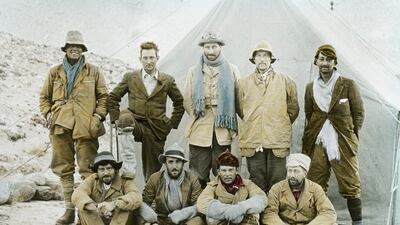
Members of the 1924 Mount Everest Expedition at camp. Andrew Irvine and George Mallory, on furthest left and second left of the back row, may have been the first to summit Everest but Irvine's camera, which would prove their feat, has never been found. Getty -

Leonardo Da Vinci's sketch of The Battle of Anghiari painting. He was said to have begun it on the wall of Florence's Palazzo Vecchio but it has since been covered. Getty -
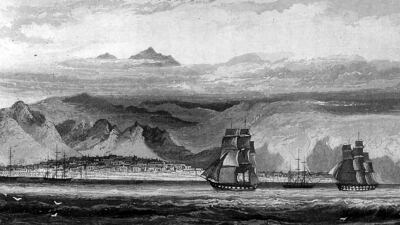
Lithograph titled View of Lima from the sea near Callao, Lima, Peru, in 1840. It is said to have been stolen by the crew of a ship tasked with sailing it to Mexico in 1820. Getty -
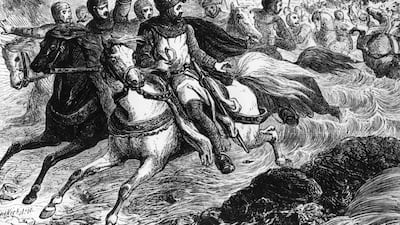
A drawing of King John (1167-1216) from around 1200 showing him and his companions escaping the tide on Long Sutton Beach during the search for the king's lost treasure. Getty -

The amber room, back in place in the Catherine Palace outside St Petersburg after 20 years of reconstruction by Russian craftsmen, is seen on May 13, 2003. The original was stolen by retreating Nazi troops at the end of the Second World War. Reuters -
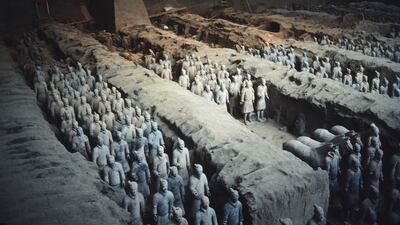
The excavated Terracotta Army in the tomb of China's first emperor, Qin Shi Huang, in October 1986. The tomb was first discovered in 1974 and a remaining treasure has yet to be uncovered. Getty -

A relief from the Arch of Titus in Rome, photographed circa 1955. The carving depicts spoils, including the Menorah and the trumpets of Jericho, being carried away from the Temple after the Siege of Jerusalem in 70 AD. Getty -
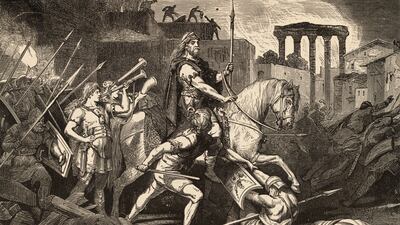
Alaric (370-410 AD), King of the Visigoths. Invaded and raided Piraeus, Corinth, Megara, Argos, Sparta, and sacked Rome. 'Alaric's Entrance Into Rome.' Getty -

British soldiers on the terrace of the Great Dagon Pagoda at Rangoon, taken near the Great Bell in Burma (Myanmar) during the First Anglo-Burmese War (1824-1826). Getty


“The level of preservation of the camps is really remarkable, particularly as they may have only been used for a matter of days or weeks,” Dr Fradley added.
“They went along a peripheral caravan route linking Bayir and Dumat Al Jandal.
“This suggests a strategy to bypass the more used route down the Wadi Sirhan, adding an element of surprise to the attack.
“It is amazing that we can see this moment in time played out at a landscape scale.”
Andrew Wilson, a co-author on the paper, said: “These marching camps — if we are correct in dating them to the early second century — suggest the Roman annexation of the Nabataean Kingdom following the death of the last king, Rabbel II Soter in 106 AD, was not an entirely straightforward affair and that Rome moved quickly to secure the kingdom.”
Because the distance between each camp is 37km to 44km, the researchers speculate it was too far to be crossed by infantry in a day.
Therefore they suggest the camps were instead built by a cavalry unit which would have been able to travel over barren terrain in a single day, possibly on camels.
On the basis of the distance between the camps, there is also a suggestion that another camp may have been located further west at the later Umayyad fort and well station at Bayir.
The study sets out that the newly discovered camps run in a straight line towards Dumat Al Jandal in what is now Saudi Arabia, but which was then a settlement in the east of the Nabataean Kingdom.
The researchers said that the findings suggest Rome had to force its takeover, whereas surviving Roman history argues the transfer of power was a peaceful event at the end of the reign of the last Nabataean king.
Archaeologists still need to confirm the date of the camps through investigation on the ground, but there are other questions that need to be answered.
“Why does the western camp have twice the capacity of the other two? Did the force split, and if so, where did the other half go?” Dr Wilson said.
“Was it half wiped out in a battle, or did they remain in the western camp to resupply the other camps with water?”
The paper has been published in the journal Antiquity.

