


A Manchester-based company has struck a $1 billion partnership deal with a major UAE investment fund that will spearhead an unprecedented scale-up of graphene-based technologies intended “to make a substantial impact on global CO2 emissions".
UK-based Graphene Innovations Manchester has signed an agreement with Quazar Investment Company to create a new company in the UAE.
The partnership will be one of the most ambitious projects to date to commercialise graphene, an exceptionally strong and electrically conductive material made up of a single layer of carbon atoms arranged in a hexagonal lattice.
It's stronger than steel, more conductive than copper and more flexible than rubber.
This new venture will develop and produce premium, environmentally-friendly products using advanced materials, including graphene-enhanced concrete that does not need cement or water and can be made using recycled materials.
-
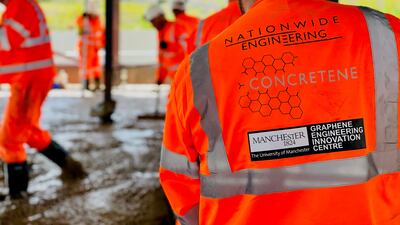
1: Graphene-enhanced concrete to slash global C02 emissions. Concretene can be used just like standard concrete, meaning no new equipment or training is needed in the batching or laying process – making this product both greener and cheaper. All photos: University of Manchester -

2: Graphene to revolutionise desalination and filtration technologies. LifeSaver, a UK-based manufacturer of portable and reusable water filtration systems, has been working exclusively with the University of Manchester with the aim of reducing the sieve size of filters so its portable devices can remove a much wider range of contaminants, such as heavy metals, pesticides and toxic chemicals from drinking water supplies. -

3: Graphene can make our cities even smarter. Graphene’s multi-functionality can make buildings and infrastructure smarter by embedding smart technologies into the fabric of the material itself. -
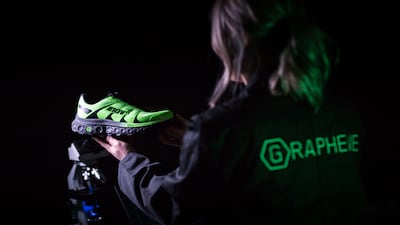
4: Graphene can boost the performance of sportswear. Scientists at the University of Manchester have teamed up with UK-based sportswear experts at inov-8 to create a global, best-selling graphene enhanced running shoe. -
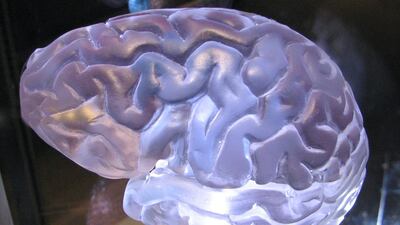
5: Graphene brain probes will help tackle epilepsy. Nanomedicine experts from the University of Manchester’s have been working with researchers in the UK and Europe to discover how new graphene neural probes will improve detection of epileptic brain signals. -

6: Graphene in space. The Graphene Space Habitat space station is made from conjoined pressurised capsules with the front of the vehicle featuring an impressive viewing deck. Users of the glassed observational dome can be protected from damaging solar radiation by closing its petal-like shields. -
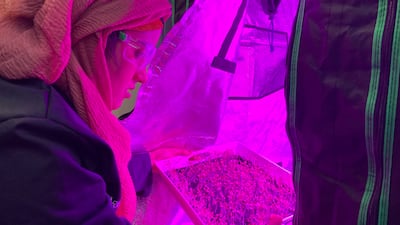
7: Graphene supporting sustainable food production and packaging. Entrepreneur Dr Beenish Siddique, founder of AEH Innovative Hydrogel, has developed a pioneering vertical farming system using graphene-based technology that aims to make food production more sustainable and use less much less water. -

8: Graphene makes supercars go even faster. The BAC Mono R supercar being put through its paces. The Mono R is the first production car in the world incorporating revolutionary material graphene in its panels, contributing to a kerb weight of just 555kg. -

9: Graphene is supporting the development of next-generation of batteries for use in electric cars. -

10: Graphene coatings can fight rust - or even boost your sports kit.


"The new graphene company will take a global lead in making environmentally friendly concrete and other products," said Waleed Al Ali, chief executive of Quazar.
"We are glad that Quazar can play an active role in helping fulfil the UAE's His Highness Sheikh Saeed Bin Hamdan Bin Mohamed Al Nahyan's support for the UAE Vision 2030."
Meanwhile, Dr Vivek Koncherry, chief executive of GIM said: "We are proud to be associated with Quazar so that we can assemble a powerful world-class team to provide us the opportunity to massively deploy our graphene-based technologies.”
Graphene was first isolated and analysed at University of Manchester about twenty years ago. The two scientists involved, Andre Geim and Konstantin Novoselov, won the Nobel Prize for Physics in 2010.
“This agreement with our GEIC partner Graphene Innovations Manchester and Quazar is a seminal moment for the commercialisation of graphene as it demonstrates huge confidence in the potential for this advanced material to help lead our transition into a net zero world," said James Baker, chief executive of Graphene@Manchester, which is part of the University of Manchester.

